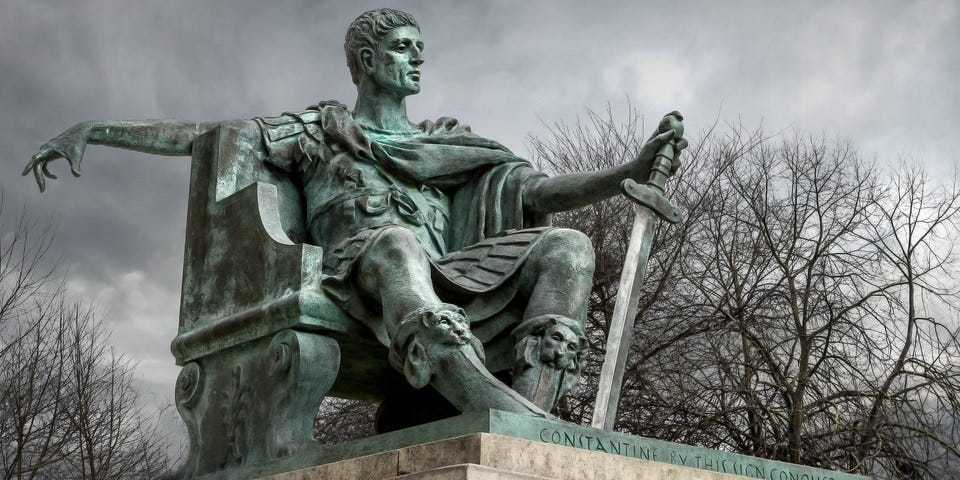
Correction: Constantine & His Conversion
As has been the case with a few other nuanced issues in the past, I need to post a correction on something concerning Constantine. History is extremely nuanced, and as is the case when researching anything — you have to double and triple check things and also understand that things always have multiple dimensions. In the work that I do, I have to question everything multiple times because everyone has something they’ve been deceived on. This is why finding the narrow road is so important on every topic. With that in mind, what I need to correct specifically is that I have said on several occasions that Constantine converted to Christianity in 323 AD, two years after his Sunday law proclamation in 321 AD. I have also stated that, because of this, the precedent to rest was set forth by a pagan first and, as a result, when Christians follow the command to rest on Sunday they are following the precedent of a pagan Pontifex.
But Constantine did not convert in 323 AD, he (officially) converted in 312 AD, after seeing a vision of what he thought was Jesus commanding him to conquer in a particular sign. So this discrepancy may seem to cast doubt on the conclusion that the precedent to rest was set forth by a pagan, which is why I need to provide additional clarity in my position. In fact these things are not entirely incorrect, and we will discuss them here, but they do need to be distinguished better so that the thesis can remain in tact. So, the following is a timeline of key events with some discussion afterwards.
In 310 AD Constantine claimed to have a vision of Apollo (Sol Invictus) at a shrine in Gaul, which made Sol his personal patron deity. From roughly 310 AD until 325–326 AD, his official coins featured the sun god with the legend SOLI INVICTO COMITI (”To the Unconquered Sun, my companion”). Constantine also minted coins with the goddess Nike (victory) up through his death, and even beyond with use by his various sons — all done to honor a pagan goddess as celebration of his military conquests. The Chi-Rho symbol he supposedly saw is also seen as a symbol honoring Zeus and used for Zeus in coinage centuries before Constantine. Keep all of this in mind.
Just two years later in 312 AD he reportedly saw a vision of a cross (or Chi-Rho) before the Battle of the Milvian Bridge, and that bright light told him to “conquer in this sign.” This vision is inconsistent with all the visions we have of God or Jesus in the Bible, yet it is completely consistent with the visions that many false prophets have had throughout time (i.e. Mohammad, Ignatius of Loyola, Ellen White, Joseph Smith, etc.). Considering Constantine’s obvious predisposition toward spiritual experiences, and previous interactions with Satan via paganism, it is likely that Satan appeared to him and deceived him for his purposes.
In 313 AD, as a result of this experience, Constantine issued the Edict of Milan, legalizing Christianity and beginning his image as a defender of the faith — a savior for the people.
Around 323-325 AD Constantine defeated his last rival, Licinius, who had begun persecuting Christians again. This victory made Constantine the sole ruler of the entire Roman Empire and a champion of the Church. Some historians have commented that at this point he was even seen as a proto-Vicar of Christ, as that radiant Christian king that administrates Christ’s kingdom and ushers in a golden age. These things are very important to remember, but it’s also why this number (323 AD) is often associated by many groups as the date of his “real” conversion, though it’s not accurate. Nevertheless, because of these political shifts, Constantine began actively persecuting paganism and upholding the institutional Church at this time. Although he did not technically issue a single decree outlawing all of paganism (which didn’t happen until Theodosius I in the 380s), he did pass several aggressive anti-pagan measures during this timeframe such as bans on public sacrifices, consultation of oracles and setting up of new cult statues. Furthermore, to fund his growing new capital, named after himself (Constantinople), he looted pagan temples and took their treasures to repurpose the wealth for the new institutional Church that he was now the head of as Pontifex. Satan’s plan was unfolding marvelously, and people were not the wiser because they had just been granted relief from persecution.
In 337 AD Constantine was supposedly baptized formally, on his deathbed.
So, what do we take from all of this? What we take is that history is very complicated, and people’s lives even more so. Constantine was, in the most optimistic evaluation, a very confused man. There are many books that document his love affair with pagan gods and goddesses even after his so-called conversion, and the fruits of his new life were lacking considering he had bitter rivalry, bloodlust and idolatry plaguing his life until the end. His vision of Apollo and dedication to serving the sun god (Satan), only to be shifted toward a new zeal by yet another satanic vision is the obvious clue that Constantine was a puppet. Only God knows the heart, but in life Constantine served the devil’s agenda by solidifying the institutional counterfeit of the Church and also setting the precedent for reinterpreting the 4th commandment according to traditions of men. That much is true and history is very clear.
What is not true is that Constantine converted in 323 AD, two years after his Sunday law proclamation. I’ve actually talked quite a bit about his vision at Milvian Bridge in 312 AD, however the mistake is going with the 323 AD number for his conversion by following the commentary of most Sabbath keeping and SDA sites. Originally I discussed the 312 date quite a bit, and at some point down the line with all the material I was ingesting for my Sabbath research, I confused the two dates. In my mind at the time, it seemed very clever by Satan that the conversion would happen after the precedent was laid down, so I went with it, never double and triple checking my work. However the truth of this situation is far worse, so there’s that. To be clear, it’s not convincing that Constantine ever converted. And even the mainstream narrative presents a very convoluted picture of a man whose “conversion” took him decades, if indeed it was a conversion. Nevertheless, I went with that number in my mind because that is used a lot by many sources.
Johann Lorenz von Mosheim, a historian whose work is often cited by these Sabbath keeping groups, was an influential 18th-century historian and his observation was that Constantine converted two years after a specific edict, and that conversion specifically was a “nominal” conversion (in name only). This is interpreted in two ways depending on the source: either it means two years after the Edict of Milan (313 AD), meaning his conversion was around 315 AD, or two years after the Sunday law edict (321 AD), which is the 323 AD date. Many Sabbatarian groups online favor this second timeline in order to argue that Constantine’s “real” conversion only happened once he began to actively suppress the Sabbath and paganism through imperial force, seeing a historical fulfillment of the beginning of the transition of power from the 4th beast to the little horn, although that transition wouldn’t completely take place for another 200 or so years after Constantine.
So you have many narratives. The official narrative (which Catholic and Orthodox apologists will cling to) is that he converted in 312 AD, after seeing the vision of the bright light and cross or symbol in the sky and then became a defender of the faith. The Sabbatarian counter-narratives focus on 323 AD, or sometime after 312, or that he never actually converted and was a pagan his entire life. Because my mind can only process so many numbers at once, I made the mistake of conflating these two numbers and presenting it to you as if he was a full blown pagan up until 323 AD and setting the precedent as a full blown pagan in 321 AD, which makes Sunday rest an obviously pagan decree.
But now, does this actually impact our conclusion that when you follow the command to rest on Sunday you are following the edict of a pagan Pontifex? The answer of course is no. The truth is much more nuanced, and through this study you can learn the conniving nature of the devil.
I believe history clearly testifies against Constantine as being a true convert. If he was, the fruits of his faith are not seen or well documented. It is possible he repented at the end, but during life it’s just not that clear. What is documented shows the opposite, and religiously minded people (Catholic, Orthodox, etc.) cherry pick things like Constantine passing various measures against pagans or looting their temples as a way to misrepresent Constantine as some sort of pious individual. But Constantine was a pagan emperor, king of the known world. He had whatever he wanted, and pride isn’t too far away when you have that kind of power. Constantine was also in the seat of authority that Satan had continued from Babylon. For decades after his supposed conversion in 312 AD, Constantine minted coins with pagan gods and goddesses. And given the dubious nature and timing of his vision, the thesis that Constantine was deceived by Satan in order to further the agenda is still as strong as ever.
In fact this nuance makes the deception even more potent and reveals the devil’s schemes on a much deeper level. Constantine was indeed a “full blown pagan” based on his actions and the evidence we have, but at that time of the edict he had supposedly been a Christian for almost a decade. So when Constantine passed his Sunday law in 321 AD, he was not proclaiming to be a pagan — but rather a Christian, and a champion of the Church. He was dressed in light, yet he proclaimed darkness. His Sunday edict was also highly ecumenical, because he knew Christians were gathering on Sundays already, and in this way he could create a precedent to unite the empire (pagans and Christians) by dedicating a day they both could find appropriate to venerate. The edict dedicated the day to the “venerable day of the sun” — something pagans could relate to in name, and Christians could relate to in action (by resting, which they were already doing because of the Sabbath, and worshiping, which they were already doing by gathering on Sunday). Court puppets like Eusebius were quick to pat the emperor on the back for a good decision and wash away his sins with typology, poetry and metaphor about Christ being our rest and the resurrection being the true Christian Sabbath, and the rest as they say is history.
All of this actually paints a much more sinister picture than the simplistic timeline I have commented on in certain places. In other words, it is far worse that Constantine was deceived into proclaiming himself as a Christian, when in fact he wasn’t. Why? Because Satan used Constantine as a Trojan horse to enter Christianity and subvert it. He offered Christians the material salvation they desired by lifting persecution, giving them a hero, destroyed paganism and puffing up the Church hierarchs with power, giving them all that the world had to offer. Hidden behind this shield of outwardly appearing noble intentions, Satan could then work his sinister agenda and fulfill Daniel 8:25, that God’s sacred time and law would be changed.
Therefore the thesis that a pagan Pontifex set the precedent to rest on Sunday is sustained, yet it is even more nuanced than before — because Satan snuck paganism into the Church via a sleight of hand and a Trojan horse.
Apart from all of this, what remains as historical fact for anyone to verify is that no Christian before Constantine ever rested on Sunday, and yet within just a few decades after Constantine’s Sunday law decree, Christians were already being persecuted for keeping the Sabbath. So yes, when you obey the command to rest on the first day of the week — you are acknowledging the authority of a (highly likely) pagan Pontifex. Perhaps Constantine was saved in the end, but considering the evidence, what is highly improbable is that he was saved at the time that he made that Sunday law proclamation. No true Christian being led by the Holy Spirit would think to change God’s laws or try to unite paganism with Christianity, so I still believe Constantine was a pagan when he decreed that precedent and therefore obeying it is not obeying God but obeying man. It is also acknowledging that man has the authority to reinterpret God’s moral commandments and ultimately tell God how to be rather than God telling man how to be, which is blasphemy.
So I hope also that this exercise in history has revealed to you the agenda of the enemy, to use light for darkness and good for evil — the opposite of what God does, which is using darkness for light and evil for good. And if prophecy operates in threads and waves and multiple fulfillments, what does it say for our current day and the destination of history that Satan used a pretend convert and so-called “champion of Christianity” to actually subvert Christianity? It says a lot, don’t you think?


