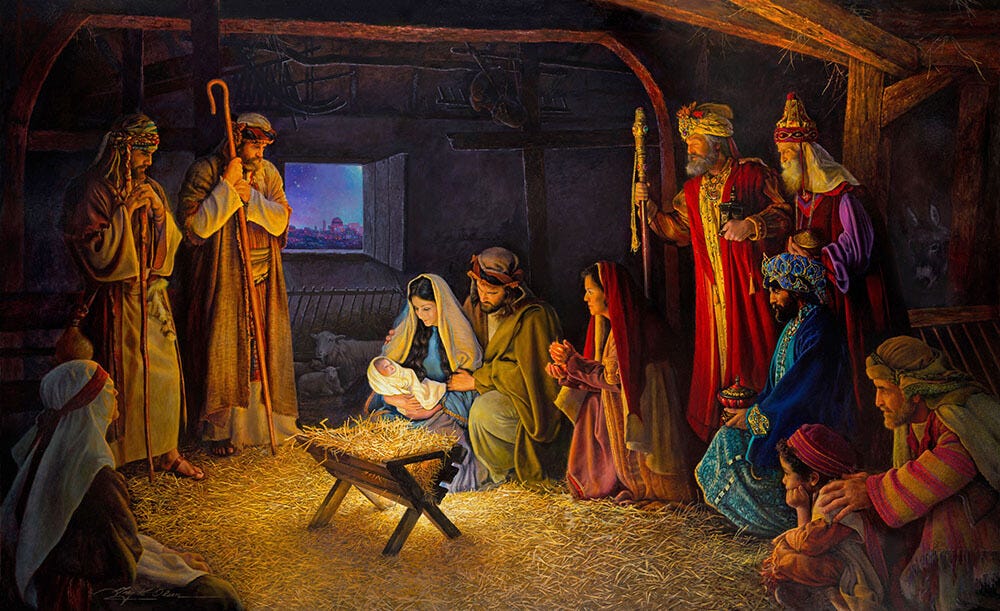
The Reason for the Season
I know that many of you are aware of the deceptions of this time of the year, with the carnal decorations of winter spirits, the materialism, the invented character of Santa Claus and the fact that Jesus was not, in fact, born on December 25th but rather in what we call September (the 11th if you use a proleptic calendar).
I also know that many of you celebrate the birth of Jesus on this day with a sincere heart, or you may be questioning if or to what extent you should do these things based on all the material you have been learning. So, I decided to address this issue so that you know where I stand personally. If you have not yet gone through my recent study published on this, with the history of Christmas, I encourage you to go. This here is just a general idea of how I approach this topic.
My position is the following: I have never been against people celebrating Christmas as a purely joyful memorial to remember Christ’s birth. I have no problem with people putting up modest decorations (like a nativity scene) that can serve as evangelistic opportunities to people who may be lost. I think that’s actually a good thing. I have no problem with gathering with your family and celebrating Jesus, or even exchanging thoughtful gifts with people you care about. I think all of these things are good and if you want to do them, be my guest.
So I do not condemn or shame anyone who wants to participate out of the joy of their heart or celebrate The Nativity this time of year. I also do not think it’s right or good or kind to condemn others and call them “pagans” or “deceived” if they choose to do these things — as I just described them and without the added fluff of superstitions or carnality. We must have love and compassion, and also use right judgment. No, that doesn’t mean compromise or being lukewarm. It means exactly what I said: right judgment. Jesus sat with sinners and ate with them. Did He call them to repent? Yes, but He actually dined with them and was among them, too. Don’t forget that part. Paul was among the people, and related to them — whether they were Jew or Pagan — so that he might win some of them to the truth, all the while not partaking in the things that they do that are error (1 Corinthians 9:20-21).
So this is the fine line. It is a balance as always between two things, and on this issue the narrow road is not partaking in superstition and mythology while also not become paranoid and condemning to your fellow brothers and sisters. History is complex and not so black and white. Christians historically celebrated Christ’s nativity as early as the 4th (and probably 3rd) century, with the earliest record of people deciding on December 25th as far back as the early 200’s, and calculations and speculations beginning even before that. The reasons for this date were not because of pagan festivals, but rather something actually (believe it or not) much more biblical and typological. The bible uses many images of the sun as pictures of Christ. Jesus even calls Himself the bright morning star and the light of the world, and very likely God created the Earth and began history in the spring, with life, at the equinox. I’ve said the same thing in my cosmology videos. These are observable and factual things, and the early Christians speculated on Christ’s birth and saw lots of typological connections, and made (the erroneous) assumption that He was probably conceived at the equinox, and therefore born on December 25th.
The solstice was never in view, only as a secondary pattern that emerged once the conception was connected. The bible says John the Baptist was conceived 6 months before Jesus, so in the timeline this would place John the Baptist’s conception at the autumnal equinox and his birth at the summer solstice. The summer solstice is when the light begins to decrease, and John said that “I must decrease, He must increase.” All of these things are very typologically beautiful, but they are inaccurate with history. But when you are a Christian in the early Church without the internet and Stellarium and a library in your pocket, and everyone is trying to figure out Christ’s birthday, the thing that makes the most sense is the one that has the most symbolic and typological value according to the bible.
So just as some people are brainwashed today with materialism and Jewish Christmas jingles and religion and winter spirits — what my bible study presentation on this topic reveals is that there are equally as many brainwashed people on the other side of the debate calling everyone who doesn’t agree with them a pagan or lukewarm or compromised or whatever else, not realizing that the polemics against Christmas began with the Puritans (who flogged people for not going to church on Sunday) and that for 1500+ years before that not a single person protesting the idolatry of the RCC ever said Christmas was “pagan” — because it isn’t.
Christmas is a typological celebration of a distinctly Christian event, which is the Nativity of Jesus Christ. For the first 1,000 years it wasn’t even called “Christmas”, and of course today 1,000 years after that it has become full of mythology and carnal mindedness, which is true. But learn to separate truth from error and walk the narrow road, because when you are in either camp of the dialectic all you will do is be baited by your emotions and swing to and fro in conflict with others. There are worldly and carnal elements that were incorporated into this celebration over the last 1700 years, and there are good things about it that can serve good outcomes. Don’t throw the baby out with the bath water in your zeal.
So, I do encourage everyone to study and to learn that Jesus was not actually born on this day but rather in the fall. This is important, because one of the pieces of evidence for this are the astronomical alignments listed in Revelation 12, which not only point to the fall -- but the fall of 3 BC, an essential date because it proves the prophecy of the 70 weeks given in Daniel 9, and corroborates perfectly the records of the New Testament that Jesus began His ministry in 27 AD, was crucified 31 AD and the time for the Jews as the chosen people came to an end with their official rejection of the gospel by way of Stephen’s martyring in 34 AD and the dispersion that followed.
It is also important during this time to learn about the corruptions of the institutional model(s) (Catholicism, Orthodoxy, Harlot Protestantism), and how they integrated pagan ideas and concepts (like the immortality of the soul or Sunday rest) into their framework. The bible calls us to be set apart, but it does not call us to go into the mountains and live like hermits. We are to be in the world but not of the world, and this is the dance. This means using the material things we have, but making it an ongoing practice to detach from materialism.
On that note, I think it’s OK to give each other presents during this time, but even these things can become a snare if done without right judgment and wanton materialism. Presents should be an afterthought to the real gift, which is Christ -- not the highlight of this season. Unfortunately, Christmas as it is celebrated today is extremely materialistic because it inverts these priorities. So, we should “invert them back” and turn all these things into opportunities to help others learn the truth, to being generous and toward good will.
Lastly, the name itself, “Christmas” comes from the term “Christ’s Mass”, because when this name began being used in the 11th century — the world was largely Catholic. The Great Schism happened around that time, but today that wound is healing and these things are ecumenical opportunities. Regardless, the mass according to the RCC’s catechism must be a sacrifice, so “Merry Christmas” in essence boils down to, “Merry Sacrifice of Christ.” Because the bible tells us the sacrifice has already been done (Hebrews 7:27; 9:12; 9:26; 10:10) — then this is at best anachronistic, and at worst endorsing the Catholic view of transubstantiation. Most people don’t think of these weighty matters but history is important. I think a more pure approach would be to celebrate Christ’s nativity, because that’s what it was for the first 800 years before it was called “Christmas.” So, “Happy Nativity” is very historical and free of any baggage.
Whether you choose to celebrate Christmas or not, I am not going to judge or condemn you -- and I remind everyone not to judge and condemn each other over this issue. If you celebrate, don’t judge those who do not. If you do not, don’t judge those who do. In all matters use right judgment and compassion, because the truth is often woven with error and we have to move carefully, like a skillful surgeon, to separate the two when dealing with emotionally-charged issues. Either way, remember the reason for the season and Happy Nativity :)
For the deep dive bible study on this issue, you can watch below:
https://www.danceoflife.com/p/is-christmas-pagan-and-should-you


Thank you very much, Tudor! Enjoy Nativity day with your family. ❤️