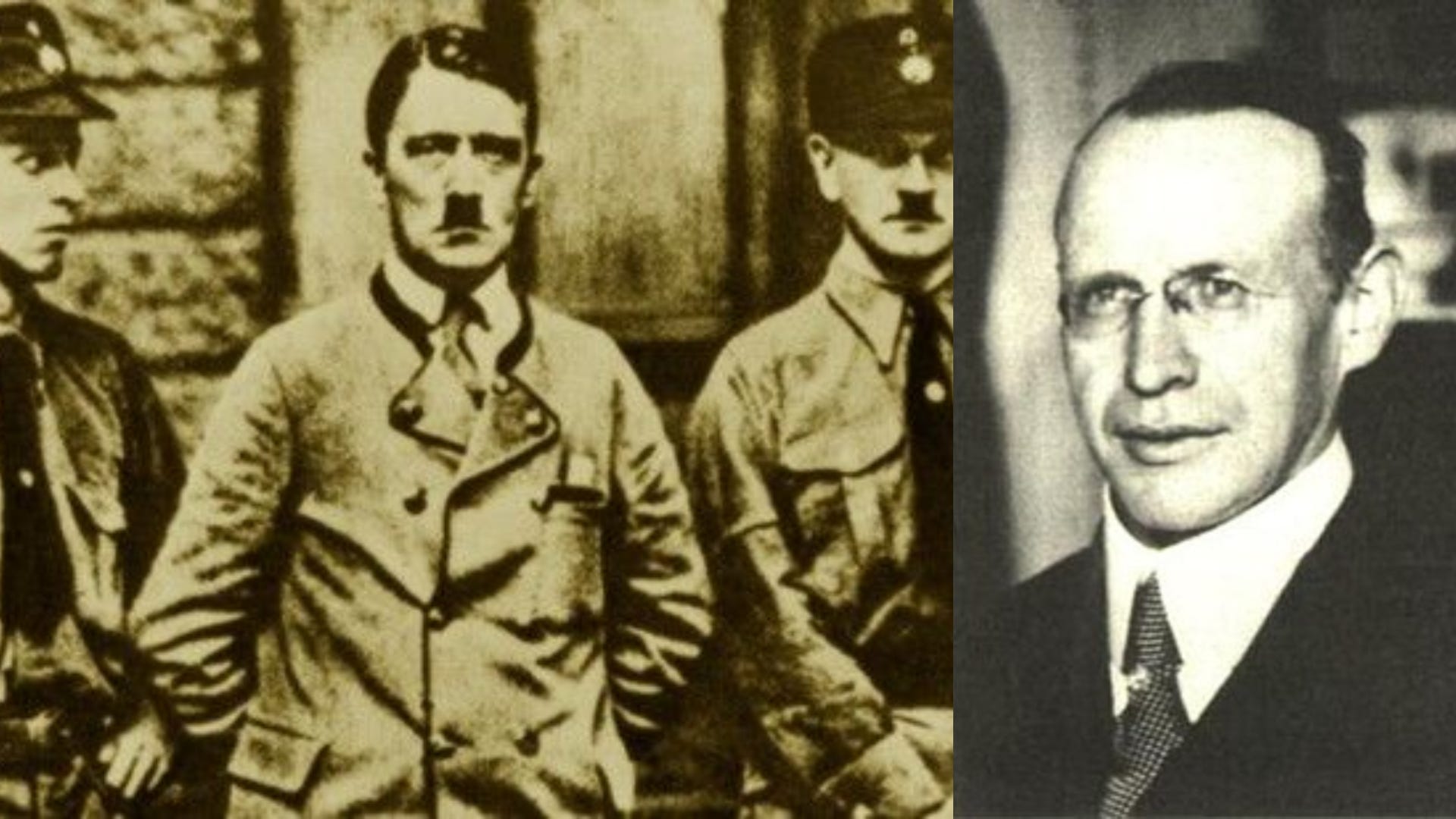
Nazis & Jesuits: Bernhard Stempfle
Many today are clueless when it comes to true World War II history, however the example of Bernhard Stempfle (or Staempfle) is an exercise in extracting an important pattern: that history is often written by the winners and mainstream sources sometimes omit important details or outright lie. In the mainstream, Bernhard was a lowly Catholic priest of a minor order (Hieronymites) that happened to be at the wrong place at the wrong time in Nazi Germany. He dabbled in contributing to Hitler’s Mein Kempf and he was executed by the Nazis in their bloodthirsty quest for world domination.
That’s the mainstream narrative, but the truth of history is always much more nuanced -- and in certain cases it can take some digging.
Up until 2021, Wikipedia listed Bernhard as a Jesuit priest, which they changed to now just a general ‘Catholic priest.’ This in and of itself is not incriminating, because people can argue that the change was to update an erroneous record. Or perhaps it was intended to whitewash the situation. Today you will be the judge. Regardless, historians known for their detail have documented these things extensively. Edmond Paris in The Secret History of the Jesuits and Eric Jon Phelps in his Vatican Assassins both document that Bernhard was actually a Jesuit priest. Phelps asserts Stempfle was ‘Jesuit-controlled’ and Edmond just makes the claim outright. Admittedly, they do not document these claims robustly -- but that’s because they are going off of older primary sources, not because they are making something up to smear the Catholic Church.
Another detailed historian, Leo H. Lehmann, has some extra pieces to provide us. Lehmann was an Irish Protestant author and editor who died in 1950 and lived through WWII. He wrote in his book, Behind the Dictators, the following on page 26, Chapter 5 (Hitler and the Catholic Church):
‘In fact, in his Mein Kampf Hitler approves of everything particularly relating to Jesuit Catholicism as opposed to Protestantism. He approves of the indisputability of Catholic dogmas, of the intolerant attitude of Catholic education, of the necessity of blind faith, of the personal infallibility of the pope — imposed upon the Church by the Jesuits in 1870 — and of the compulsory celibacy of the Catholic clergy. These are all matters that make Catholicism radically different from the other churches of Christendom. In an open and prophetic expression of his admiration for the Catholic Church, he says: Thus the Catholic Church is more secure than ever. It can be predicted that, as passing phenomena vanish away, she will remain as a beacon light amid these vanishing elements, attracting blind adherents in ever-increasing numbers.’
In the footnote to this section, Lehmann mentions that it was Stempfle who ‘really’ wrote Mein Kempf. This is significant, because the content and writing style betray not just a lowly priest from some minor order -- but a fanatic for papal supremacy and Catholic dominion, which is a hallmark of Jesuitism.
Henriette von Schirach, the German wife of Baldur von Schirach (former Reich Youth Leader) and Gauleiter (regional leader of the Nazi party) and daughter of Hitler’s personal photographer, Heinrich Hoffmann, wrote in her book, Anekdoten um Hitler (Anecdotes About Hitler) regarding Hitler’s personal preferences for hanging out and reading newspapers at various coffeehouses in Vienna and Munich. She then describes, in her dedicated section to Bernhard Stempfle (pages 82-83), the following:
‘Captain Röhm (co-founder of the Brownshirts) and Father Stempfle were among Hitler’s preferred guests there. Stempfle had once been a Jesuit but had left the order and was working as a professor. Initially, the perpetually suspicious Hitler mistrusted Stempfle, regarding him as a spy for clerical circles. That wariness soon vanished, however, and a warm friendship took its place. Hitler had been raised a Catholic—though inwardly alienated from the Church—yet he never formally left it. In the midst of the French campaign, he told Colonel General Guderian: Two institutions are indispensable for the supremacy of the white race, the Catholic Church and the British Empire!’
Henriette comments further:
‘Like Hitler, Father Stempfle had distanced himself from Catholicism, yet both remained bound to its general worldview. Jesuits are simultaneously priests and politicians —- another trait the two men shared. Stempfle gradually gained significant influence over Hitler, particularly after 1933. Furthermore, the professor was friends with the SA (Brownshirts) Chief of Staff, Captain Röhm, who sought to transform his battle-hardened Brownshirts into a militia force alongside the Reichswehr -- acting, in effect, as an enduring instrument for driving the National Socialist revolution forward. This ambition proved fatal for him on June 30, 1934, as it did for many others, including Father Stempfle. When this gruesome counter-revolution had ended, Hitler said to Heinrich Hoffmann: What do you make of this, Hoffmann? Those swine have killed my good Father Stempfle, too! When Hoffmann tried to ask about the circumstances behind this atrocity, Hitler cut him off with an abrupt wave of his hand: Not another word about it!’
Important to know that Hitler had arranged for Ernst Röhm’s assassination because of power conflicts and insecurity, since Röhm had a desire to absorb the regular German army under the Brownshirts. Nevertheless, we have close eye witness testimony that Stempfle was not only a former Jesuit (once a Jesuit always a Jesuit), but that he was extremely close to Hitler.
Next we have Otto Strasser, a Nazi, in his autobiography ‘Hitler and I’ claimed that Stempfle revised Mein Kampf twice and rigorously (because of its childish writing style and quality), claiming also that Stempfle ‘spent months rewriting and editing Mein Kampf. He eliminated the more flagrant inaccuracies and the excessively childish platitudes.’ This firsthand eye witness testimony far outweighs the watered down mainstream version which paints Stempfle as just a distant bystander who happened to make a few edits here and there and was the victim of the big, bad Nazis. Either way, for this work Hitler eventually arranged Stempfle’s death according to Otto, because the priest had gotten to know too many of Hitler’s weaknesses, both in his character and in his life. This is not at all out of alignment with the way Jesuits were abusing confessional and confidant positions with monarchs in European history to gain political influence or manipulate political outcomes. The confessionals were part of the Jesuits’ intelligence network for centuries.
There is also the matter that many Jesuits infiltrated various roles pretending to be one thing or another. There is actually a poignant quote on this from Thomas Jefferson himself, in a letter to John Adams in 1816 (2 years after the Jesuits were reinstated in 1814), expressing his worry that America’s open and tolerant system would offer the perfect opportunity for the Jesuits to infiltrate as printers and teachers and all manner of social disguises. History certainly offers many examples to this effect, and I personally have had a listener reach out to me to inform me her husband of many years came out to her as a secret Jesuit late toward his life before he passed. When we understand the true meaning of ‘Synagogue of Satan’ not referring to obviously evil and antichrist Jews -- but rather those who portray themselves as Christians and worshipers of God (i.e. ‘the Society of Jesus’) yet do the opposite in the background, we see a biblical basis for this as well as a historical one.
In his book, Where Ghosts Walked: Munich’s Road to the Third Reich, historian David Clay Large confirms Stempfle’s considerable re-work of Mein Kempf on page 197, and also that Stempfle’s mistake of ‘uttering his second thoughts on Hitler’ eventually cost him his life (page 254). Yet there is a very telling section on page 153 that reads the following:
‘Flattering photography, however, was not the only service that Hoffmann rendered to Hitler. He welcomed the Nazi leader into his comfortable home in Schwabing, where Hitler could chat with the photographer’s many friends, including Ernst Röhm and an ex-Jesuit priest named Bernhard Stempfle, who edited a scurrilous racist rag called the Miesbacher Anzeiger. According to Hoffmann, Hitler was at first suspicious of Stempfle, thinking he might be a spy of the church party. However, Stempfle gradually gained Hitler’s confidence and was allowed to instruct him on the inner workings of the church.’
So here we see several more pieces to the puzzle. Hitler’s inner circle is confirmed with Stempfle, Hoffmann, Röhm and others. We also see that Hitler, like any aspiring political leader, was very well aware of the ‘church party’ and their influence. We also see another confirmation that Stempfle had been a Jesuit, and that he warmed his way up to Hitler and gained his trust. Lastly, Stempfle was the editor of a Nazi propaganda magazine. The Miesbacher Anzeiger (Miesbach Advertiser) was a regional newspaper founded in 1874 in the Bavarian town of Miesbach, Germany. Originally a liberal agricultural weekly, it evolved into a right-wing, anti-democratic, and anti-Jew publication in the early 1920s. It notably featured writers like Ludwig Thoma and early Nazi figures. But Stempfle had been editing that magazine already, which documents his political involvement with Nazism outside of his relationship with Hitler, and indeed prior to it.
These details are confirmed by other historians, like Harvard-trained Robert GL Waite in his book, The Psychopathic God: Adolf Hitler, on page 84, where he both attests to Stempfle’s significant involvement in Mein Kempf and also being the editor of the Nazi propaganda newsletter Miesbacher Anzeiger. Eugene Davidson, historian and Yale University Press Editor (note the credentials), states in his book, The Unmaking of Adolf Hitler, on page 80 that Bernhard Stempfle was a former Jesuit and also confirms his editorial role in the newsletter also.
But now what about Bernhard’s background before all of this? He certainly seems to have had an interesting life. Bernhard attended the Ludwig Maximilian University of Munich (LMU), a place the Jesuits shared a deep historical connection with. From 1549 to 1773 (when the Jesuits were suppressed), the Jesuits dominated the predecessor of LMU, the then University of Ingolstadt, transforming it into a center for the Counter Reformation. As I have mentioned many times before, universities often serve as fronts for political and other illicit activities -- money laundering, sex-trafficking, hiding abusers (like the recent Gonzaga scandal with the Jesuits in 2018) and, of course, shaping the culture. The university model was first developed in Rome, and with the Counter Reformation Rome quickly realized how to expand her empire into other countries without appearing that she was doing so, under the guise of education and good will.
Either way, you may recognize the name ‘Ingolstadt’ if you have studied the history of the Jesuits because that is precisely where Adam Weishaupt, the supposed Protestant yet professor of Papal Canon Law and from a family of converted Jews, went to school. The same Weishaupt that was instrumental as a Jesuit pawn in the French Revolution, the formation of the Illuminati and the linking of Rothschild to the Jesuits as their illicit banking arm. So Stempfle was a graduate of a complex highly influenced by Jesuit control, to say the least.
And it is now that we have a comprehensive picture from many witnesses, both learned and firsthand. Stempfle was educated and trained in a concentrated Jesuit block, and began his political infiltration well before meeting Hitler. Eventually the two made contact and Stempfle became a trusted advisor and confidant. Hitler was at first suspicious of Stempfle, no doubt because of his knowledge of the Jesuits and their duplicitous roles as political agents masquerading as priests, but this was soon overcome and Stempfle played a significant role in Hitler’s life as well as the publication of Mein Kempf. At some point something soured and Stempfle was killed. Some like Otto Strasser or David Clay Large claim Hitler ordered Stempfle’s execution, while others paint a more disorganized picture where it seems Hitler was shocked by his death. It’s hard to tell, also because Hitler was a bit of a maniac and emotionally unstable. In either case, the mainstream narrative that Stempfle was just a lowly priest and innocent victim of the Nazi regime is extremely whitewashed, to put it generously.
Stempfle was a political agent of the Catholic Church working a political agenda, because Stempfle wasn’t the only connection between the Catholic Church and Hitler or the Nazis. And as a political agent, he was in the line of fire and paid the price that many political agents pay. Several credible sources have documented Stempfle as a Jesuit or former Jesuit, and whatever the case may be -- what is true is that once one takes the Jesuit oath of submission to the Jesuit General, it is an oath for life much like one would take the oath of being in the Freemasons or Skull and Bones on penalty of brutal death if that oath is broken. So whether Bernhard Stempfle was actively part of the Order on paper at the time of his death or not does not really matter given the nature of these things. Once a Jesuit always a Jesuit.
On paper, mainstream sources say he was a Hieronymite priest -- a relatively small order going back to the 14th century in Spain and Portugal. This is a convenient way to wash the story, but a little digging and we find it is not an air-tight alibi. Interestingly, this is one of the places that the Templars likely fled to after they were persecuted for their Satanic rituals, and we can trace several leapfrog organizations from there to the Jesuits -- like the Order of Christ, founded in 1318 by King Denis to preserve the fleeing Knights and their assets, and then later the Alumbrados (illuminated ones), in the 1400’s, which were a secretive occult organization operating underground. Ignatius of Loyola, the founder of the Jesuits, was accused of being an Alumbrado by the Spanish Inquisition, but in the end was exonerated. His fruits however, like the vision of the shimmering serpent speaking to him or spending time in caves praying to Mary or his development of the ‘spiritual exercises’ or the founding of the Order itself -- all reveal the truth on this matter, because Loyola was steeped in mysticism.
So even the very order that Stempfle is credited to being part of isn’t as clear and clean as mainstream narratives suggest. The Hieronymites hail from the very place that Jesuitism and Templar mysticism was in full bloom for centuries. Is that absolute proof of anything? No. But given all that we know, one thing is definitely clear: history is not what it we have been told.


