A conspiracy narrative has been circulating for some years now, and especially since the Zionist exposure began in late 2023, and it has enough surface plausibility to catch thoughtful people. The claim, in its various forms, is that the word “Jew” is a modern invention, or a sixteenth-century mistranslation, or a term that entered English only in the 1200s with the letter J, and that it therefore has no legitimate connection to the biblical people of Judah. This claim interweaves with some truth, and this is why it is convincing, yet it is a gateway into trutherism, Satan’s little season narratives, Serpent Seed narratives, Jew-focused views of the world power structure and other deceptions. Nevertheless, on the strength of that alleged disconnection, an entire edifice is built, claiming that “Jew” is a fabricated label with no biblical warrant, that the Bible never speaks of “Jews” at all (but rather “Judeans” who were supposedly “different” in various social, political and genetic ways), and that anyone using the term has been deceived by a linguistic sleight of hand.
I want to address this with nuance, because the narrative works by attaching a false conclusion to several true facts that I myself have exposed over the years. Some of what its proponents say is correct. The word “Jew” did enter English relatively late, and English itself is a very new language historically speaking. Either way, it is not a clean letter-for-letter transliteration (like “Iesous” is from “Yeshua” or “Jesus” from “Iesous”). In many New Testament contexts “Judean” is probably the better English rendering, because it’s a little more specific. Conceding those points costs nothing, because none of them establishes the conclusion. The conclusion requires that “Jew” be divorced from “Judah,” and the etymology makes that divorce impossible. That’s because the word is a lineal descendant of Judah’s own name, and every serious lexical authority in existence agrees on this issue.
I have spent considerable effort exposing Zionism, dispensationalism, and the political misuse of Jewish identity, and I understand the impulse behind this narrative. People sense (correctly) that the modern term “Jew” carries meanings that have nothing to do with the tribe of Judah two thousand years ago. This is true. But the remedy for a word with an inflated semantic range is context, not the invention of a false etymology or conspiracies. Fighting one deception with another only makes the truth more difficult to discern, which is a win for the enemy regardless and this is the greater point of today.
THE ETYMOLOGICAL CHAIN
The origin of the word is not in dispute among the people who study words for a living. The chain runs as follows, and it is confirmed identically by the Oxford English Dictionary, the Online Etymology Dictionary, the 1906 Jewish Encyclopedia, Encyclopedia.com’s Oxford sources, and Wiktionary:
Hebrew Yehudah, יְהוּדָה, the name of Jacob’s fourth son and of the tribe descended from him, rendered in Genesis 29:35 as “praise.”
Hebrew Yehudi, יְהוּדִי, the gentilic adjective formed from that name, meaning “of Judah.”
Aramaic Yehudai, the same word in the language of the exile and the Persian court.
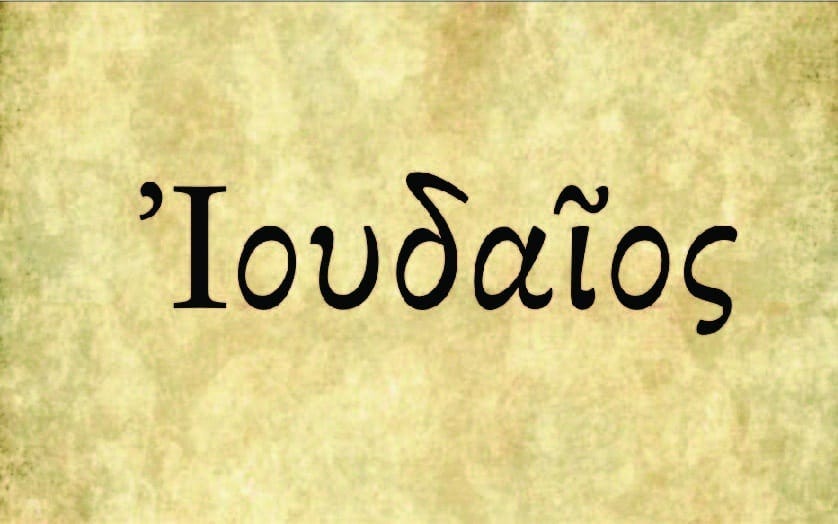
Koine Greek Ioudaios, Ἰουδαῖος, a loan from the Aramaic, which the Septuagint’s own Hellenistic Jewish translators chose to render Yehudi. Note something important here: the Greek term that supposedly “mistranslates” the Hebrew was selected by Jews translating their own Scripture.
Latin Iudaeus, following the Greek.
Old French giu, earlier juieu, which dropped the “d” from the Latin Iudaeus through ordinary phonetic elision (omission of a sound due to casual or fast speech).
Middle English, in which the word appears from about 1000 to 1600 in a bewildering variety of spellings: Iudea, Gyu, Giu, Iuu, Iuw, Iew, and finally Jew, with the J spelling predominating from the sixteenth century as the letter J itself differentiated from I across European orthography.
That is the whole pedigree throughout history. It is a continuous line of descent from the name of Judah, through four languages, into English. The 1906 Jewish Encyclopedia states it very matter of fact: the forms “were derived from the Old French Giu, which was earlier written Juieu, derived from the Latin accusative Judæum with the elision of the letter d,” the Latin from the Greek, the Greek from the Aramaic, and the whole “a gentilic adjective from the proper name Judah.” No serious source anywhere breaks this chain. They all agree on this history, so either countless scholars throughout the centuries are unilaterally wrong — or modern day truthers are wrong.
TECHNICAL OBJECTIONS
Two objections raised against this deserve a direct and honest response, because conceding them strengthens rather than weakens the case.
First, “Jew” is not, strictly speaking, a transliteration. A transliteration is a single deliberate act that carries a word letter-by-letter from one alphabet into another, as when Hebrew Yeshua was carried into Greek as Iesous. “Jew” is the product of something messier: a long phonetic evolution across Aramaic, Greek, Latin, French, and English, with sounds eroding and letters dropping at each stage. But this simple fact only strengthens the case. Transliteration and phonetic evolution are both forms of derivation. A word that evolved from Judah’s name across a thousand years is no less descended from Judah than a word transliterated from it in a single stroke (like Iesous). If anything, the long organic evolution proves a deeper and more continuous connection, not a weaker one. You cannot appeal to the length and messiness of the chain to argue that the chain does not exist.
Second, in many New Testament passages “Judean” is genuinely the better English rendering, and the Gospels frequently use Ioudaioi to mark a geographic and factional distinction, the people and authorities of Judea over against Galilee. This is a fair and scholarly point. In John especially, “the Ioudaioi” who oppose Jesus are often best understood as the Judean religious establishment centered on Jerusalem, not the whole ethnic body. Paul refers to these as the “circumcision party” in several places. So, I have no quarrel with rendering it “Judean” in those contexts, and doing so often clarifies the text. But here we need nuance. It is a point about translation choice in particular contexts. It is not a point about etymology, and it does nothing to sever “Jew” from “Judah,” because “Judean” is itself derived from Judah by way of Judea. Whichever English word one prefers, both trace to the same root. Those who want the “Judean” reading to prove that “Jew” is illegitimate are in error, because “Judean” and “Jew” are two English descendants of the same Greek word Ioudaios, which is one Greek descendant of the same Hebrew name. Preferring one cousin does not orphan the other. They are equivalent terms, and read in context there is no issue because context determines the meaning of a word.
WHERE THIS ARGUMENT ACTUALLY COLLAPSES
The mistranslation thesis makes a specific, testable claim: that Ioudaios in the New Testament means, in most cases, a resident of the Roman province of Judea, or more narrowly the elite of Jerusalem, and that it carries no tribal or ethnic sense tied to Judah. This claim is simply false to the text, and the counterexamples are as clear as day:
The Samaritan woman at the well calls Jesus a Ioudaios in John 4:9, and He does not correct her. He was raised in Galilee, yet the term is applied to Him on the basis of His people and lineage, not His province of residence, and He lets it stand.
Paul calls himself a Ioudaios in Acts 21:39 and Acts 22:3, and in Romans 11:1 grounds the claim explicitly in descent: “an Israelite, of the seed of Abraham, of the tribe of Benjamin.” The term for him is a matter of bloodline, not postal address.
Aquila is called a Ioudaios in Acts 18:2, though he was a native of Pontus, not Judea. Apollos is called a Ioudaios in Acts 18:24, though he was of Alexandria. Neither was a “resident of Judea” or a member of the Jerusalem elite. The term attaches to their people, not their location.
In Romans 2 and 3, Paul builds an entire argument on the distinction between Ioudaios and Greek, a distinction that is meaningless if the word denotes mere provincial residence. He is contrasting two peoples defined by covenant and bloodline descent, not two zip codes.
Once these are on the table, the “resident of Judea, in most cases the Jerusalem elite” thesis collapses. The word demonstrably ranges over people identified by ancestry, by covenant membership, and by religion, applied to a Galilean, to a man of Pontus, to a man of Alexandria, and to a Benjamite from Tarsus. It cannot be confined to a Roman administrative category.
THE REAL ISSUE IS SEMANTIC RANGE, NOT ETYMOLOGY
What the conspiracy narrative has actually stumbled onto is a genuine linguistic phenomenon, but it is (as usual) taken in the wrong direction and off balance. That is, the word “Jew” does carry meanings today that have nothing to do with the tribe of Judah. It can mean for example an adherent of rabbinic Judaism, a religion that took its developed form centuries after Christ. It can also mean an Ashkenazi or Sephardic ethnic identity. It can mean a citizen of the modern Zionist state. Since the 1600’s or so it also has been slur to describe a greedy, scheming person. These meanings are real, and they have inflated the term far beyond its origin.
But this is not corruption of etymology. It is expansion of semantic range, and it is the most ordinary thing in the world for a living word continuing through thousands of years of history. The remedy for this problem is context, and the parallel that settles it is the word “Christian.” I have talked about this several times in my presentations. If someone says “Christian” today, the term now covers Roman Catholics, Mormons, prosperity preachers, and a hundred mutually contradictory groups Paul would not have recognized. It is also highly ecumenical because of this fact. But now, does the modern misuse of “Christian” make it wrong to call Peter a Christian, or to call ourselves Christians? Of course not. Peter tells us not to be ashamed to suffer as a Christian in 1 Peter 4:16. The word simply has to be contextualized so the reader knows which sense is meant. And when someone tells you about a “Christian church” or a “Christian book” or a “Christian author” or a “Christian event” — you are right to raise your eyebrow just slightly and ask, “What do you mean by that?” Well, the word “Jew” is identical. It is entirely accurate to call Paul a Jew, because that is the English descendant of the word he applied to himself, provided one contextualizes that he means a man of the tribe and covenant, not an adherent of a religious or political system that did not yet exist. What is not accurate is to call Abraham or Isaac a Jew, or Moses a Jew, or Debrah a Jew or Samson a Jew or a myriad of other biblical heroes Jews because they were either predating Judah or not from that tribe.
So this is the whole answer, and it is more honest and balanced than the conspiracy version. The word is not fabricated. It is not a mistranslation. It is a legitimate and ancient descendant of Judah’s name whose range has widened over two millennia, and which therefore requires the same contextual care that “Christian,” “church,” and a dozen other loaded terms require today. What’s the lesson? Context, context, context.
THE COMPLICATION OF JUDEA AND EDOM
There is one further layer that the conspiracy narrative distorts, and it is worth going deeper on because it is where the real history is genuinely complicated.
By the time of Christ, “Judea” as a Roman province name did not correspond cleanly to the tribal area of Judah. After the Babylonian exile destroyed the genealogical clarity of the northern tribes, and after the Hasmonean, or Maccabean, dynasty in the second century BC forcibly circumcised and absorbed the Edomites, the descendants of Esau, into the body of Judah rather than expelling them, with a further issue being that the population calling itself by this name was already mixed by that point. Herod the Great and Herod Antipas were Edomites, Idumeans, who had bought their standing. So by the first century, a man calling himself Ioudaios might be a genuine descendant of Judah like Jesus and Paul, an Edomite convert, or some blend of the two, and the records to distinguish them had largely been destroyed in AD 70 and again after AD 135 with the various Jewish revolts and Roman judgments.
This is real history, and it matters enormously for how we read the Gospels and for the modern chosen-people question. But notice what it does and does not do to the etymology. It explains why the referent of the word became muddy — why the people the word pointed at (Jews/Judeans) were no longer a pure tribal body. It does not change where the word itself came from. “Judea” is still named after Judah; the province took its name from the tribe whose territory it centered on, which is precisely why the syllable Jud/Yud binds all these words together through time. The Edomite absorption complicated the bloodline the word described. It did not sever the word from its root in Judah. The conspiracy narrative confuses a complication of reference with a fabrication of etymology, and they are two entirely different things.
THE FUNDAMENTAL PROBLEM OF TRANSLATION
A final point to mention is that when you’re dealing with translation you will always balance two things that are mutually exclusive. On one side is accuracy and on the other is intelligibility (understanding). Regardless of the languages themselves, nouns and verbs, adjectives, even descriptions for experiences — these cannot be 100% transplanted into another language. If you are too accurate and literal, it will be almost impossible to understand. If you are too paraphrased, the meaning will get lost. And regardless of what you do there is always something lost in translation.
Now add a layer of fundamentally different cultural, spiritual and geographic realities. Now add over a millennia of time difference. This is what you get with Greek, Aramaic, Hebrew and English — all of the languages that come into play in Bible translation. By the time English was even a language, a lot of time had passed since the cross, and with it many significant changes. The word “Judean” today has no meaning, because Judea doesn’t exist anymore. The word “Jew” means way more things than what it meant for Paul or Jesus 2,000 years ago. So this is the problem.
But even if you were to replace every instance of “Jew” in the New Testament with “Judean” — your problem still wouldn’t be solved. Do you think Darby or Scofield or the Jesuits would not have been able to deceive the world with dispensationalism if the text in English read “Judean” instead of “Jew”? Do you think people would have not frothed at the mouth for a Jewish revival, Zionism, the rapture or a 7 year tribulation if these words were different? The answer is no, because the deception going on with these things has to do with something real in the world — it replaces the true, invisible Church with a fleshly people group. Whatever you call that group doesn’t matter, it’s the sleight of hand that is the problem.
So at the end of the day the same solution is what we arrive at, which is context. Context solves these problems because context is the ability to consider social and political realities of the author, what they were trying to convey, who they were writing to and why, what was the original language and what other things that author said. If people employed these skills consistently it wouldn’t matter what translation they used and deception wouldn’t exist. But they don’t, and as a result they get snagged by various schemes of the devil because they cherry pick, ignore the intent of the author, do not compare his other writings and ignore the cultural and historical context or the audience it was written to.
CONCLUSION
The burden of proof in this debate lies exactly where it has sat unmet throughout, which is etymology. Anyone claiming that “Jew” is a fabrication or a mistranslation must produce an etymology in which “Jew” does not descend from “Judean,” and “Judean” does not descend from “Judah.” If you want to claim that it is a medieval contrivance or some made up word that secret reptilian Zionists created to rewrite history and trick everyone into believe they are actually relatives of Judah — where is your evidence? The answer is that you do not have evidence. No such etymology exists, because the descent is unbroken and unanimously attested from the Hebrew Yehudah forward. Every dictionary, including the Jewish sources the narrative would presumably trust least to serve a Zionist agenda, records the same chain. In other words they all agree, and consensus puts the burden of proof on the one challenging it.
So the honest position is the boring one. “Jew” is a real, old, legitimate English word for the people and, by extension, the religion that descend from Judah. It is not made up. It is not a mistranslation. It entered English late only because English itself is a late language, and it looks different from its Hebrew ancestor only because a thousand years of ordinary sound-change stand between them, exactly as “Jesus” looks different from “Yeshua” for the same reason. What has genuinely happened is that the word’s range has swollen to cover peoples, politics, and a religious system that the biblical term never contained, which means the word must always be handled with context. That is a call for careful reading, not for conspiracy. And it is a far stronger foundation for critiquing Zionism and dispensationalism than a fabricated etymology could ever be, because it rests on the truth, and the truth does not collapse the moment someone checks a dictionary.
For a treatment of these and other theological topics in detail, please see my book “The Seven Transformations: Finding the Narrow Road by Pursuing a Sovereign Christ.”


