In the last 20 or so years, it has become increasingly fashionable to question everything. Not that questioning is itself wrong, because we should question and examine all things. However with the rise of the Internet, social media, trutherism and conspiracy culture -- it has become ‘hip’ to be extreme in one’s views on practically any topic. In other words, it has become trendy to be totally against the mainstream, which in and of itself is a psyop that Satan uses to direct people away from actual truth.
One great and relevant example of this is Satan’s Little Season eschatology, which I have debunked from both biblical and historical foundations. Biblically, SLS has nothing to stand on other than equivocations and inconsistent hermeneutics. Historically it also has nothing to stand on, other than a few lone and extreme voices (who were not even Christians, like Anatoly Fomenko in the 1970’s) who sowed the seeds of extreme historical revisionism, Tartaria, timeline paranoia, etc. Today as a result, the notion that ‘everything’s a lie’ or ‘all history is fake’ is all too trendy, and I have dedicated ample time to addressing these deceptions because they have power. They have power because dispensationalism is collapsing and there is great evil and deception in the world. This is easy to discern even without much theology. It is therefore all too common to go from one delusion (Zionism) into its opposite (preterism), with SLS being a very thriving and budding branch of the preterist framework. It certainly seems hip and cool and academic, at least compared to people frothing at the mouth for Zionist Israel -- and that’s why it has the seductive power that it does.
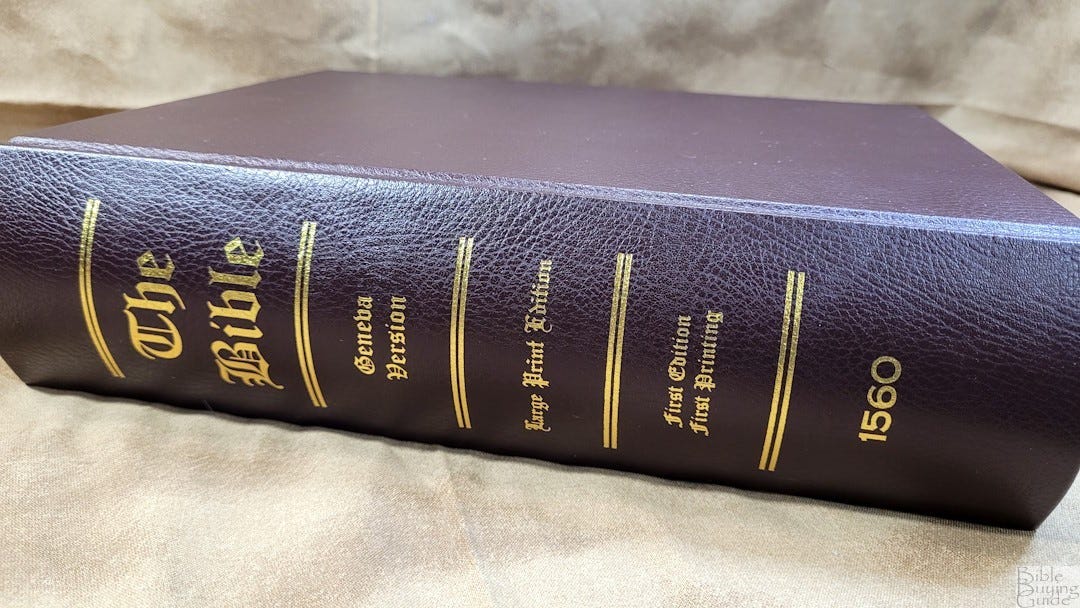
However as is the case with many of these things, history is a very nuanced and complicated forest. As someone who has worked hard at documenting history thoroughly and without bias, I have found myself having to issue updates or corrections occasionally because new information comes to light that requires better depth. With that in mind, recently someone brought to my attention an important fact, and as usual I need to clarify some things so that we can walk the narrow road. The fact is that in the 1560 Geneva Bible, the marginal notes on Revelation 20 comment that these people believed Satan was loosed around the year 1073 AD (around the time of Pope Gregory VII) so as to wage war on the saints and cause havoc. This fact is presented by SLS proponents as proof that their claim is not some modern contrivance, but is actually historically traced to original Protestantism, and as such they attempt to validate Satan’s Little Season eschatology as having a basis in Church history.
To the unsuspecting mind, this fact (presented without context, of course) can sway the person into SLS and all the wild theories associated with it, so today I want to reiterate my position in light of this information and provide added clarity -- because SLS is still wrong and modern extreme historical revisionism is not at all a historically Protestant tradition. In fact it’s the other way around, and when we see these footnotes in their proper context, we see how SLS is refuted even by the very thing they attempt to justify their views with.
Nevertheless, I have said before that ‘nobody in Church history believed these things up until modern day.’ This is partially true, and that is why this fact of history needs clarification -- because the topic is highly nuanced.
HISTORICAL CONTEXT
First, we have to transpose ourselves in the time of these people. Luther had just penned his 95 theses in 1517, and Europe was in turmoil. About a decade later Tyndale published his translation of the New Testament into English in 1526, and of course paid the price for it by being executed about a decade later before he could finish the Old Testament. The Catholic Church was losing its grip over the minds of people, and the luxurious living of the papacy, the selling of indulgences, the legalism and the bloodlust of the institution were all becoming quite obvious. Paul’s words that the man of lawlessness had to be ‘revealed’ were being fulfilled, because people were finally waking up en masse to the true antichrist power of the world, which is the papacy.
It is here that we take a pause to acknowledge an important point: all of the Reformers, at least initially, saw the papacy and Rome as the fulfillment of antichrist. Despite their errors on historical interpretations, which we will get into, they agreed on this matter. This is the first point of distinction between the 1560 Geneva Bible and the modern SLS crowd. I have yet to encounter any SLS proponent who believes the papacy is the fulfillment of antichrist and the warnings of Revelation 13 or Daniel 7, based on the historical case. Why? Because they utterly reject history as it is told so they cannot make that case (and they don’t). Rather they hold to an entirely preterist framework where they see ancient Roman emperors as antichrist candidates, and all of the events of Revelation 13 with the Beast having already been fulfilled -- because their eschatology demands that this is the case since Satan’s little season is the last thing to happen before the arrival of Christ.
Either way, the Reformers who put together the Geneva Bible, like William Whittingham (brother-in-law of John Calvin’s wife), Anthony Gilby and Thomas Sampson, rejected Augustine’s institutional amillennialism because of the problems I just cited. Amillennialism is the belief that the millennium in Revelation 20 is spiritual, an appointed time for the Church Age until Christ returns. Catholicism and Orthodoxy of course still hold to this view today because it justifies their institutions. This was classically illustrated by Augustine in his book, The City of God. The basic notion is that Christ has granted the Church dominion over all things and the Church will continue to rule and conquer its enemies during the Church Age. This is the view of Rome, of modern Christian nationalists, and it was the predominant view for a great deal of Christianity because most of history has been institutional Christianity.
It is also the view that the Reformers rejected, because they saw how Rome abused the scriptures to justify her existence. However, and this is an important lesson for our day also, one imbalance leads to another very easily if we are not nuanced in our approach. The rejection of institutional amillennialism by the Reformers was sound, yet because of a variety of factors (their own biases, lack of technology and information and the sheer fact that history had not yet played out to reveal more truths) -- these men went in a different direction to try to explain what they saw. They rejected the figurative interpretation of the millennium therefore in favor of a literal one, because the literal one seemed more grounded in history and history testified against Rome.
An important reminder is that history in general has always been used by the Church as a witness to prophecy, from early fathers who saw the 4th Beast of Daniel as Rome to those who wrote the Geneva commentaries. So people looked in history and compared it to the scriptures, and also discerned that the papacy was the fulfillment of these warnings -- therefore they rejected the papacy’s version of eschatology and decided to discover their own because they had been deceived.
However in the process they also drifted off of the truth in various ways and that is another important overarching theme in this analysis. They rejected Rome’s twisting of the figurative interpretation and went with the literal, but the literal is incorrect also. What they should have done is reject the institutional angle of the figurative interpretation, not the hermeneutic. Nevertheless, when an SLS proponent cites the Geneva Bible as proof of their ideology, kindly remind them that the people who wrote those commentaries also believed the papacy was the antichrist power, not some ancient Roman emperor in the time of the Apostles. A second thing to remind them is that these very Reformers saw history as a consistent and reliable testimony to be compared with scripture, whereas modern SLS proponents do the opposite: they see history as an unreliable witness because Satan has been loosed and he’s tampered with everything. Therefore the Geneva argument fails in two ways, not one, and any proponent of SLS that wants to cite it must be aware that it only reveals their position as heterodox, not vindicates it. But moving on.
The time is the 1500’s and many crazy things were happening. The Reformation was lighting a blaze in Europe, the printing press had just started to become mainstream, the Bible was getting translated into English (although the first translation was technically in 1382 by John Wycliffe), people were leaving Europe to the Americas, the Inquisition was in full swing, the Ottoman Empire was a real threat, the Jesuits were being formed to subvert and destroy Protestantism and the papacy was magnifying itself as the presence of Christ on Earth by which all peoples must bow down in submission to.
In this atmosphere, and given the need for a new eschatology, many original Protestants believed that it was likely Satan had been let loose at some point in the (relatively recent) past and that they were now in the final generations before Christ’s return. They rejected Augustine’s spiritualized view of the millennium (which is partially true), because of its weaponization by Rome to justify her institution. But instead of merely dropping the institutional aspect and keeping what was good -- many of them at first went in the opposite direction, treating the millennium as a literal 1000 year period, and placing it at some point in the past, since they judged all of these evil things in their day as being part of Satan’s final activities before the return of Christ. John Foxe (who wrote Foxe’s Book of Martyrs), Heinrich Bullinger and James Ussher (who also calculated the date of creation as 4004 BC, but this was wrong because he used the Masoretic text) -- all of these prominent Reformers figured that Satan was bound during the early Church and loosed roughly a millennium later, around 1073 AD when the papacy reached (in their minds) its peak political and spiritual power under Gregory VII.
I’ve documented the blasphemies of Gregory VII extensively in my series on the popes, like his Dictatus Papae (The Dictates of the Pope) and how he styled himself as the Vicar of Christ among other things under the papal supremacy umbrella. The point is that this was a seemingly relevant connection for the people of the 1500’s. From the judgment of Jerusalem in 70 AD to Gregory VII was indeed a period of 1000 years, and given the turmoil of their lives and lack of perspective -- you cannot fault them for entertaining the idea that the evil they were experiencing was the result of Satan being let loose.
But we return to the ongoing point of this analysis: this was not Satan’s Little Season eschatology. This was historicism, because they looked toward history as a second witness to the scriptures and believed that God, in His sovereignty, had preserved the testimony of history enough such that His words could be proven true. They rejected institutional amillennialism (at first, but this quickly changed within a few generations, more on that later) -- and turned away from the figurative interpretation to a literal interpretation. This is the error. But today people error in a totally different direction. Modern SLS proponents deny God’s sovereignty over history by basically giving Satan full reign over the timeline to the extent that nobody can discern what year it truly is. So yet again, there are many important differences between the original Reformers and modern SLS proponents. The Reformers were historicists, modern SLS proponents are conspiracy truthers and historical revisionists. These two attitudes on history are diametrically opposed to each other.
Nevertheless, the Geneva Bible was the most widely read English Bible for nearly a century (until the KJV), and therefore it influenced many important people of the time like John Bunyan, Oliver Cromwell, the Puritans and others. That means these ideas were not fringe ideas but rather, at one point, deemed very orthodox in Protestantism -- albeit short-lived because things changed rapidly, which is another important point.
THE COUNTER REFORMATION
But now we come to another important piece in this puzzle which are the Jesuits. What narrative of history and eschatology and Protestantism would be complete without them? In 1540 the Jesuit Order was formalized and went rapidly to work on destroying Protestantism, with one of the first orders of business to attack Protestant eschatology. After all, if people can be convinced that Rome is not the enemy, then the other threads can be taken care of in their due time. But as long as people are suspicious of Rome (because of eschatology), then everything else she does suffers friction. So, what do you see?
What you see is an all-out attack from many angles, not unlike what we see in the early Church and Satan’s assaults through Roman persecution, gnosticism, Judaism, fasting controversies, mass pagan conversions, superstitions and so on. In 1586 Robert Bellarmine published his treatise ‘On the Antichrist’, putting forward his framework for a future, personal antichrist in a rebuilt Jewish temple. A few years later, in 1590, his comrade Francisco Ribera published his futurist commentary on Revelation also, and in 1614, Luis de Alcazar’s commentary was published posthumously. Together these men set the foundation for dispensationalism and preterism as it is taught and believed today, and I have documented this extensively.
But there was another Jesuit who is not as well known by the name of Jean Hardouin. Hardouin lived and wrote about a century after the Geneva Bible, and he existed in a time of growing historical skepticism. This is because that, by his day, the efforts of the Jesuits to corrupt eschatological understanding were well underway -- and you also saw lots of fracturing in the Protestant historicist position. In other words, the main strategy of the Jesuits in response to the Protestant recognition of history was to attack history. They did this through dispensationalism and preterism, by pushing events either all to the future or all to the past. They also weaponized the disagreement among Protestants when it came to the exact timeline of their beliefs. Protestants agreed that history identified the papacy, because that much was clear, but how the time periods of Daniel and Revelation (1260 years, 1000 literal years) all came together was a matter of sharp disagreement -- and this was the Jesuits’ opportunity.
THE 1260 YEAR AND 1000 YEAR CONFUSION
Before we zero in on Hardouin, it’s important to understand the problems Protestant historicists faced and how they were exploited by the Jesuits. You had two main periods being discussed in Protestant circles, and as such things got confusing very quickly. On one thread you had the literal interpretation of the millennium, so 1000 literal years, which was a result of rejecting Rome’s institutional amillennialism. This period was originally considered from about the judgment on Jerusalem to Pope Gregory VII in 1073, as we previously discussed.
However this itself had problems, because the text says Satan is loosed for ‘a little while’ (mikron chronon). The Greek word ‘mikron’ is the word we use as a basis for ‘micro’ or even the unit ‘micron’ -- and in context it is always used as a matter-of-fact description of something that lasts a little while. It is never used by the authors of the New Testament as a parable or figure of speech for long periods of time. So for someone to interpret the millennium literally yet refuse to interpret the little while literally is inconsistent, and this is indeed one of the main refutations of SLS today.
But during the Reformation they also had problems with this, because people eventually argued that 500+ years of time is too long for a ‘little while.’ Some defended the position with a proportional argument, in the sense that 500 years is a fraction of time compared to all of human history (which is true to an extent, but misses the context), and many leaned on 2 Peter 3:8 (a day with the Lord is as a thousand years), which is what people still (erroneously) do today. Peter was not making a literal statement about how to measure prophetic time, but rather poetically describing God’s timelessness, because when you live forever and are self-existent time is meaningless.
These problems with reconciling history eventually led to sharp divisions in Protestant thought. John Foxe and the Geneva Committee held the traditional view that Pope Gregory VII was the marker for when Satan was let loose, and they argued that the season was little because God was actively shortening the days for the sake of the elect (Matthew 24:22) to prevent Satan from completely obliterating the true Church.
But many weren’t convinced, and as time went on people became frustrated with an ever-expanding ‘little season’. Thinkers like Brightman and Mede figured that the timing must have been off in these original calculations, so they pushed the 1000 years forward -- arguing that the millennium didn’t start with Christ’s birth or death, or even the judgment on Jerusalem, but rather with Emperor Constantine in the 4th century. This seemed plausible, since that’s when the Church became institutionalized, and it pushed the release of Satan to the 1300’s. As a result, the new timeline seemed more reasonable because the period of Satan’s little season shrunk down to 200-300 years by the time of the Reformation.
Yet another faction retreated entirely from the literal interpretation and back to amillennialism, but rejecting Augustine’s institutional doctrine. Rather they saw the plain truth: Christ is ruling right now, in heaven, and His enemies are being put under His feet. This is what the New Testament teaches unequivocally. That doesn’t mean He has shared His power with an institution (in fact the scriptures only say this of Satan, not of Christ), but rather that the millennium itself is spiritual in nature because conquering is spiritual, ruling of the saints is spiritual and the thousand years is not a literal number but a long appointed time.
This version amillennialism maintained the papacy as the antichrist and history as a second witness, but rejected the literal interpretation of the thousand years. This was amillennial historicism in its infancy, a doctrine I have worked hard to perfect and refine over the years. It is the true eschatology because it walks the narrow road of acknowledging God’s sovereignty and reconciling evil with history. Unfortunately, this too did not last very long. As Protestants themselves got a taste of institutional power, they gravitated back toward institutional eschatology to justify that power, and post-millennialism was born within the next century or so afterward. Especially with the proliferation of Jesuit ideas of preterism and dispensationalism, this abandonment of the truth became easier and easier, with a great deal of people today subscribing to Christian nationalism, ‘seven mountain mandate’, theonomy, theocratic ideas and similar frameworks all justified by the wrong eschatology.
In great irony, but in fulfillment of God’s word, Protestants quickly returned to Mother’s ways not long after they left.
Regardless of these developments, the point is clear: Protestant historicism was in major flux. To add to these challenges we also consider the 1260 period in Daniel and Revelation. Some said it began with the Fall of Rome in 410 AD, others with 538 AD and Justinian’s decree elevating the papacy as the corrector of heresies, others still later in 606 AD when emperor Phocas declared the pope the universal bishop. Everyone had a plausible theory of when this 1260 year period actually began, and combined with the previously discussed issues on the 1000 year period, it made for a very confusing time with ample opportunity for Satan to completely discredit historicism.
But now you may be wondering, did they confuse these two periods? Isn’t the 1000 year period supposed to be after the 1260 year period, since the latter occurs in Revelation 13 and the former in Revelation 20? You would be correct, but Protestant Reformers of that day generally saw these as overlapping periods for several reasons. They did not confuse the two, but rather saw them as part of the same narrative. The 1000 year period was seen as a span of time where Satan was restrained from total global deception, and the 1260 period was seen as the duration of the true Church being forced to flee into the wilderness while the visible, corrupted institutional Church grew in power through the papacy.
Another facet of this belief system was the view that the first beast in Revelation 13 was the Roman Empire and the second beast was the papacy. They saw the pope healing the Roman Empire’s wound by seizing all power and exercising world domination. You can’t fault them, because at that time America had not come into being, nor had the papacy been arrested by Bertier and declared to come to an end (the real mortal wound). So they judged according to what they had and discerned as best as they could.
But it is here that we repeat the divergence between historic Geneva Protestants and modern SLS proponents. The latter argues that a literal 1000 year reign of Christ happened at some point in the past (often mapped to the medieval ages) and as a result we are living in the ‘little season’ where Satan has been let loose and causing more havoc than usual (despite history showing a consistently high level of shenanigans throughout, but I digress). Either way, for the SLS proponent, the papacy doesn’t factor into anything other than collateral generic Satanic damage as part of the little season, whereas for the Geneva Protestant it was the fulfillment of the Bible’s warnings and a direct result of interpreting history.
For the Geneva Protestant, both beasts in Revelation 13 related to the Roman throne, and a continuous thread of evil was seen throughout time. People disagreed on the specifics, but they didn’t abandon history altogether. In comparison, the divergence in theories as to the specific start and end of the millennium or when Satan was released in modern SLS circles is even worse than Reformation era Protestants, because when your entire thesis is founded on ‘everything is a lie’ then the possibility for wild theories increases exponentially. Today there is no unified view of Satan’s Little Season because it has become a mish-mash of all sorts of ideas, and yet again Rome wins because it makes historicism look ridiculous.
JEAN HARDOIN & HISTORICAL REVISIONISM
But it is here now that we return to the Jesuits, and specifically to Jean Hardouin. I have given you all of this context so that you understand both how the Protestants thought and evolved (or devolved) in their beliefs, and how the Jesuits took advantage of these disagreements to discredit historicism. With Bellarmine, Ribera and Alcazar the tactic was to argue these historical interpretations were wrong, that in fact the Bible was speaking of literal days and therefore something either far in the future or the past. In either case, don’t examine the present and don’t look at Rome, because there’s nothing to see here.
But in the case of Jean Hardouin, history itself became the target. Rather than attacking scriptural interpretations -- Hardouin developed the foundations for major historical revisionism, the notion that entire centuries of time were missing and that you couldn’t trust the timeline at all. In my series debunking Satan’s Little Season eschatology I trace this history through the modern era, with people like Anatoly Fomenko (New Chronology) and Heribert Illig (Phantom Time Theory), who postulated that 300 years were missing from 614 AD to 911 AD and never actually happened. There are others, but the point is that these ideas do not come from historic Christianity or even historic Protestantism.
So when I say that ‘nobody believed these things up until recently’ -- I stand by my words. But what I mean specifically is that nobody believed history was an outright lie or that you couldn’t trust the history books at all. Even the most vocal critics of Rome, who had every reason to be suspicious of her activities, not once suggested that centuries of time were missing, that Satan had manipulated time itself and we couldn’t know for certain where are or that the popes were actively fabricating the timeline. These are ultimately denials of God’s sovereignty, and Protestants by and large (at least in the beginning) had a very high view of God’s sovereignty. They saw history as valid and useful, and they used it to confirm God’s word and reveal the papacy. Were they wrong on some specifics? Yes, but in some ways you can’t blame them given their circumstances. It is God’s will that revelation happens gradually. What we understand today is more than what people understood 500 years ago, at least in terms of eschatology -- since eschatology cannot be divorced from history. This simple truth requires that history must pass in order for eschatology to become clearer, and indeed today it is very clear because we have not only technology but perspective, two things that the original Reformers lacked and therefore fell victim to error.
CONCLUSION
The Geneva Bible commentary on Revelation 20 does not support Satan’s Little Season theories for several reasons. First, the Protestants who believed these ideas drew on history and trusted the records as being real and preserved by God as witnesses for His word. Modern SLS proponents do not consider history a reliable witness (even though, ironically, they appeal to history constantly). Reformation era Protestants also had a consistent view of Roman power throughout time, connecting the succession of pagan powers in Daniel through imperial Rome and into the papacy -- whereas modern SLS proponents have no such view.
So to present a commentary from 500 years ago on Satan being let loose as proof that Satan’s Little Season eschatology was espoused by Reformers is disingenuous to say the least. It completely divorces these commentaries from their cultural and political context. This is ironic, because SLS proponents pride themselves on supposedly respecting the cultural and political context of the scriptures (because they think preterism accurately does this, it does not). At best what it does show is that people considered the idea of Satan being loosed as an explanation for the extraordinary evil they were experiencing. That’s not something to fault them for given the context. But that’s all you can extract from this example, and with now 500 more years of history -- we have ample more evidence to correct these errors and see more clearly.
You do not need a dedicated period (especially one that is centuries long) of Satanic activity to explain the evil in the world. Historicism does this naturally because the warnings tell of a final world order where Satan is allowed to deceive most people on Earth into worshipping him. That means, by definition, that history is getting worse -- not better -- and we are to expect greater and greater delusion as the time nears. You do not need Satan’s Little Season eschatology to reconcile this, you need proper understanding of hermeneutics and history. And when you do exercise that understanding, you see why SLS is nonsense and not at all what the Geneva Protestants believed.
For a treatment of these and other theological topics in detail, please see my book “The Seven Transformations: Finding the Narrow Road by Pursuing a Sovereign Christ.”


