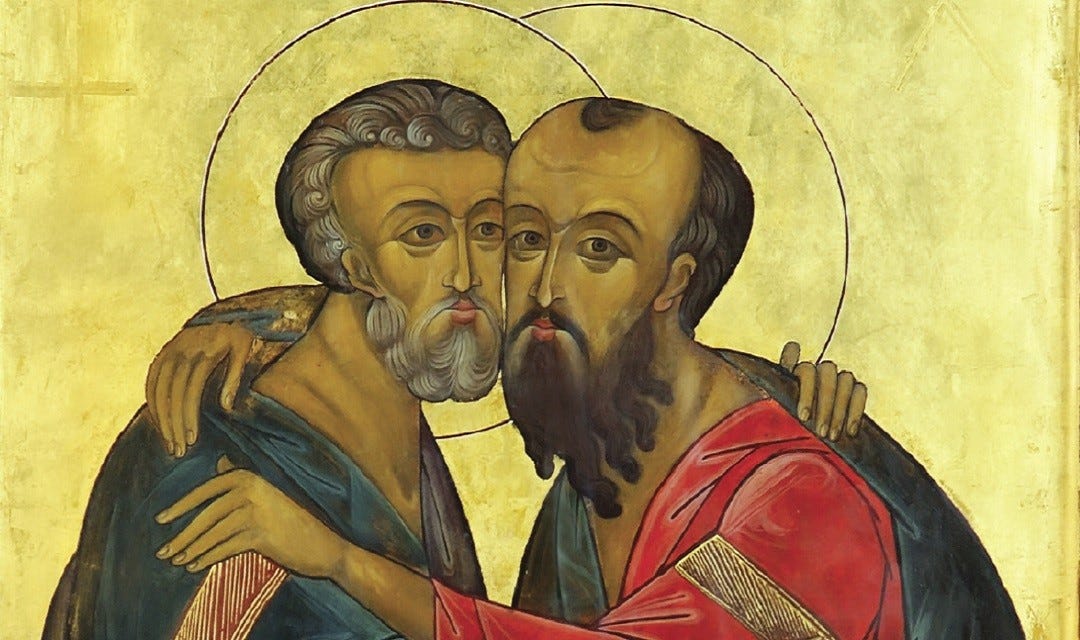


There are many predictable challenges that Catholic or Orthodox apologists will offer to the “faith alone” position, but perhaps the most common one is by misusing James to argue that the only time the actual words “faith alone” appear in the Bible is when it is describing that one is not justified by faith alone at all:
“You see that a person is justified by works and not by faith alone.”
James 2:24
This is the darling verse of every institutional apologist, because in their mind it is the ultimate proof text for their works based legalistic systems. However as usual, context is the killer of error and the king of hermeneutics, and context reveals to us that James is not contradicting Paul in his famous words in Romans 3:28 as Rome would like us to believe:
“For we hold that one is justified by faith apart from works of the law.”
So then how do we resolve this seemingly blatant contradiction? First, we need to examine how not to think by looking at what people do in response to this problem.
Some people see these things and say that “Paul hijacked Christianity” and was a “Roman plant” and that modern Christianity is “Paulianity.” This is stupid for countless reasons, not the least of which is that Peter endorses Paul as a beloved brother (2 Peter 3:15) and Luke testifies of Paul also. Throw out Paul and you throw out most of the New Testament.
Others don’t deal with the problem at all and just pay attention to the one that suits their personal flavor. Some focus on Paul and go toward hyper-grace, while others focus only on James and go toward legalism or institutional religion.
Rome does several things, and you need to be aware of them all because she is the main opponent here. First, she assumes that mankind has free will and is autonomous, because Rome’s soteriology is synergistic. As a result of this assumption, Rome makes the case that the only difference between the one who has saving faith and the other who does not (in James’ examples) is how each person chose to freely exercise their will and “capitalize” on their faith, so as to produce good works. It’s not that there is such a thing as “dead faith” and “living faith”, but rather only a general type of faith that everyone has, including demons, and really the only difference between you and the demons is that the demons don’t freely choose to produce good works. As a result of this assertion, Rome has to do even more violence to the text of Paul, so as to cover her tracks and harmonize the error. She will assert therefore that Paul isn’t talking about justification by good works in general but rather works of the ceremonial Levitical system of Moses, and also that justification as a legal process (penal substitutionary atonement) is a Protestant or medieval conjecture. This sleight of hand reinterpretation opens the door for Rome’s sacramental works based system of justification, and it makes it seem as if both Paul and James are teaching Catholic theology — theology that only arose and was ratified centuries after these texts were written.
So these are examples of what not to do or think, because all of this is error. Focusing just on Rome, we must address the shenanigans she plays with these texts head on — because, like all apparent contradictions in scripture, Paul and James are not in opposition but rather form a complementary dance to delineate a mystery, which is the mystery of faith.
The first thing to attack then is Rome’s assertion that man has free will, and therefore can choose free of all influence (including God’s). This is flatly contradicted by practically every book of scripture, as the writers all expressed a consistent view of God’s sovereignty and the monergistic nature of salvation. I will not provide many verses here because I’ve done so in countless places, but let the reader recall that scripture leaves no ambiguity in this area when it says that God works all things according to the counsel of His will (Psalm 119:91, Daniel 4:34-35, Job 42:2, Ephesians 1:11, Romans 9:19 and Philippians 3:21). These and countless other texts testify that the sovereign being of the universe can do as He pleases and none can tell Him otherwise or act, be, exist and change reality outside of His influence. To believe otherwise is not only to reject the testimony of God regarding Himself, it is also satanic because Satan’s temptation in the garden was this very idea of self-sovereignty.
It is here that Rome’s fragile foundation begins to crack under the pressure of the truth weighing down on her. Because if God is sovereign over all things (including the conscience), then salvation is monergistic and the entire synergistic ruse evaporates. In other words, God does not require the cooperation of sinners in order to demonstrate His glory as the Savior. He is perfectly competent to save without our cooperation, and in truth He does, because salvation is for God’s name sake. This means that when the scriptures talk about faith and repentance being granted by God (Acts 13:48, 2 Timothy 2:25, John 6:65, etc.) — what we are dealing with is a mystery. The sinner is unable to make a choice to believe in God, and the gift of God’s mercy is exactly this ability to choose, to repent, and to continue in endurance by good works and obedience.
Ephesians 2:8-9 is a well known set of verses in this conversation, but many don’t bother to read verse 10:
“For we are his workmanship, created in Christ Jesus for good works, which God prepared beforehand, that we should walk in them.”
Here we learn from this one simple verse two very profound realizations: these good works Paul mentions are part of the gift given to us (v. 8-9) and they were also predestined, so that we would experience them (“walk in them”) for God’s glory. Paul echoes these sentiments in Philippians 2:12-13, revealing the monergistic mystery behind our good works:
“Therefore, my beloved, as you have always obeyed, so now, not only as in my presence but much more in my absence, work out your own salvation with fear and trembling, for it is God who works in you, both to will and to work for his good pleasure.”
It is incredibly sad to me that so many are oblivious of the absolutely profound reality Paul is describing — a reality where God is the cause of both our desires and actions, and we experience them as our own as part of the gift of salvation. Therefore there is no conflict between works and faith, because both are a result of God’s gift. It is not that man chooses, then gets saved, and then has to choose some more in order to do good works or else be lost. Rather, proper biblical soteriology is such that God chooses and everything flows outward from that choice in our lives.
God chose to create you, to cause you to be born again, and to cause you to walk in His statutes (Ezekiel 36, Jeremiah 31) according to the good works He prepared for you to experience beforehand. Fun fact: Rome actually anathematizes anyone who believes such things (Council of Trent, Canon 24). Regardless, God is the center of proper theology, and if that’s the case then Rome’s view of James and Paul completely collapses.
It collapses because James is not describing a free will situation. In fact, for all the weaponization that legalists and institutional apologists do with James, they forget that elsewhere in his epistle he reveals his Israelite monergism very plainly:
“Come now, you who say, ‘Today or tomorrow we will go into such and such a town and spend a year there and trade and make a profit’—yet you do not know what tomorrow will bring. What is your life? For you are a mist that appears for a little time and then vanishes. Instead you ought to say, ‘If the Lord wills, we will live and do this or that.’ As it is, you boast in your arrogance. All such boasting is evil.”
James 4:13-16
One important rule of context is to always reference the entirety of an author’s writings, so that you understand their perspective. That means you can’t make James teach and believe a concept that was completely foreign to him as an ancient Israelite (i.e. a libertarian Enlightenment post-French Revolution philosophy). James cannot be telling people that God controls every aspect of their life in one chapter, and therefore they should submit to God’s timing — and then in another chapter be speaking about the necessity to exercise an autonomous free will so as to justify one’s self (and keep one’s self justified) before God through good works. If in chapter 4 he says that making plans outside of God is arrogant boasting, how much more would it count as arrogant boasting if he were telling people to justify themselves before God through their works?
Luckily we have Paul for that, and Paul tells us very clearly in the chapter following the one that people believe there is a contradiction in. That is, in Romans 4:1-12:
“What then shall we say was gained by Abraham, our forefather according to the flesh? For if Abraham was justified by works, he has something to boast about, but not before God. For what does the Scripture say? ‘Abraham believed God, and it was counted to him as righteousness.’ Now to the one who works, his wages are not counted as a gift but as his due. And to the one who does not work but believes in him who justifies the ungodly, his faith is counted as righteousness, just as David also speaks of the blessing of the one to whom God counts righteousness apart from works: ‘Blessed are those whose lawless deeds are forgiven, and whose sins are covered; blessed is the man against whom the Lord will not count his sin.’ Is this blessing then only for the circumcised, or also for the uncircumcised? For we say that faith was counted to Abraham as righteousness. How then was it counted to him? Was it before or after he had been circumcised? It was not after, but before he was circumcised. He received the sign of circumcision as a seal of the righteousness that he had by faith while he was still uncircumcised. The purpose was to make him the father of all who believe without being circumcised, so that righteousness would be counted to them as well, and to make him the father of the circumcised who are not merely circumcised but who also walk in the footsteps of the faith that our father Abraham had before he was circumcised.”
This now makes the picture abundantly clear. First, it is obvious from Paul’s own words that he was not, in fact, exclusively referring to the Levitical system of Moses when he said that we are justified by faith apart from works of the law in the previous chapter. Yes, it is true that Paul addresses his own kind, but the overarching case he builds in these chapters (Romans 3-5 especially) is that the “works” in question are any good works, not just Levitical works. Certainly Abraham existed before the Levitical system, so these qualifying words destroy any notion that Paul was addressing just the Jews and their legalism in his letter to the Romans, because Abraham was justified before he received the sign of circumcision, and Abraham was justified by faith instantaneously — not by any obedience or work he performed, so that he could boast. In this way he became the spiritual father of all who would be justified in the same way, that is, by faith apart from any merit.
This is all very straightforward. The fact that Paul leverages an everyday example (a worker getting paid a wage) shows that his intent here reaches far beyond the limited world of Judea and Judaism. Anyone who attempts to justify themselves by works has something to boast about, and God is not giving you a gift in that case but rather merely paying you your due wage — and since God owes nobody anything, nobody can be justified by works. Period. Therefore Paul is not talking about Levitical works but any good works, and now Rome has a serious problem because if this is the case then James and Paul are contradicting each other if they are talking about the same exact thing.
But they are not contradicting each other, because James was a monergist just like Paul and believed God was the primary cause behind all things, including salvation and faith and good works. So what’s going on then?
Here we move to dispel the other assertion made by Rome, namely that there is one kind of faith rather than two. In other words, Rome will always argue (because of her synergism) that faith itself is not the cause of the good works — it is man’s free will choice to capitalize on faith that produces the good works. This is an inversion of what the Bible teaches, which is that God is the cause of good works and faith for His glory, which means that what really matters is whether faith is living faith or dead faith.
If one has living faith, and is truly born again, then one will experience good works because that is part of the gift of salvation promised by God. We are not saved by our works, nor are we perfect, but a true and living faith produces fruits that are visible to those around you and which differentiate your life from what it was before you were saved. In this sense, there are many places in the New Testament that invite believers to confirm their election and to introspect on their own lives, to see if their faith is genuine or if they are deceiving themselves. The issue then is not “free will” but rather God’s will — has God moved in your life? Has God regenerated you and caused you to be born again? If He has then show it by helping your fellow man. This is the message James is preaching to his audience, because his audience was claiming to be Christian yet not showing it through their actions.
Therefore it can be understood that James is creating a distinction between two things: living faith and dead faith or false faith. Another way to think about this is the comparison between the true (regenerate) Christian and an unregenerate false convert. James is not accusing his audience of being false converts, he is speaking rhetorically to afflict their conscience and evoke a behavioral change. Those elect whom God had actually saved did respond to James’ words and did experience change, because change and transformation are not a product of free will but of God’s will. From a monergistic lens, God allowed the church in Jerusalem at the time to be lackadaisical so that James could then pen his words for future generations through their example, so there is no inconsistency as God uses all things for His purposes.
But now this distinction of false faith and living faith further reveals that what James means by “justification” is not what Paul is discussing when he uses the same word. To be clear, this word is even used with God as the object, for example in Luke 7:29-30 where the crowd responds to Jesus’ words regarding John the Baptist’s holiness:
“When all the people heard this, and the tax collectors too, they declared God just, having been baptized with the baptism of John, but the Pharisees and the lawyers rejected the purpose of God for themselves, not having been baptized by him.”
In this example, justification is appropriated to God Himself in the sense that God was vindicated. Obviously God does not require legal justification as the Judge of the Earth (Genesis 18:25), so that means this word has a semantic range that requires context to be understood properly. And if James is indeed making a distinction between false and true faith, then it further means that his justification in chapter 2 is not the legal, salvific justification Paul is describing (otherwise there would be a contradiction), but rather the vindication of one’s faith before others.
In other words, Paul is describing the big picture and James is describing the pragmatic, practical manifestation of that big picture: a truly justified person is vindicated before others as a true Christian by their works. If you claim to be a Christian, then act like it. That’s James’ entire thesis. It is not “to be a Christian and be made right with God you must continually exercise your free will for good.” This is Rome’s version of salvation, and it is not only contrary to the scriptures but has absolutely no good news to offer anyone.