




Today 500 years after the Reformation began, it is coming to an end (if not already). In 1999 the Lutherans signed a Joint Declaration on the Doctrine of Justification with Rome, officially undoing what Luther himself did 480 years prior. Major seminaries are compromised by Jesuit and Freemason infiltrations, and superstar pastors are also compromised either by their indoctrination at said seminaries, or financial interests, or even sexual blackmail. Meanwhile heretics like Paula White are platformed (on purpose) so as to expose the utter ridiculousness of Protestantism by way of straw man representations, and the collapse of Zionism is actively funneling fresh, disillusioned blood into the ranks of Orthodoxy and Catholicism.
Let’s face it, the Reformation is all but officially undone — and the Counter Reformation has been successful. It has been successful because God decreed it to be successful, so that the wicked would prosper and be deceived by the final trick.
And with that in mind it sets today’s important precedent, that you cannot espouse the foundation of Protestantism (the 5 Solas) and be a synergist, because the 5 Solas are monergistic and must be monergistic in order to work. Personally I do not identify as a Protestant, at least not in the conventional way, because I think institutional Protestantism is a harlot daughter of Rome. However, the essence of Protestantism is to protest Rome’s blasphemous doctrines — to protest the inversion Satan has done to the body of Christ and the kingdom through his counterfeit, and to return to the truth of God as the foundation of our life.
It is true that Protestantism, and the men who founded it, has many problems. Calvin and Luther were very compromised men, and compromise itself was the theme from the very beginning. All of the traditions of men that Rome had build its empire on ironically survived in a movement that was, in essence, against these traditions. Sunday sacredness, institutional hierarchy, the Platonic soul, philosophy — these and other problems polluted Protestantism from the very beginning, which is why I do not identify as a Protestant and neither should you.
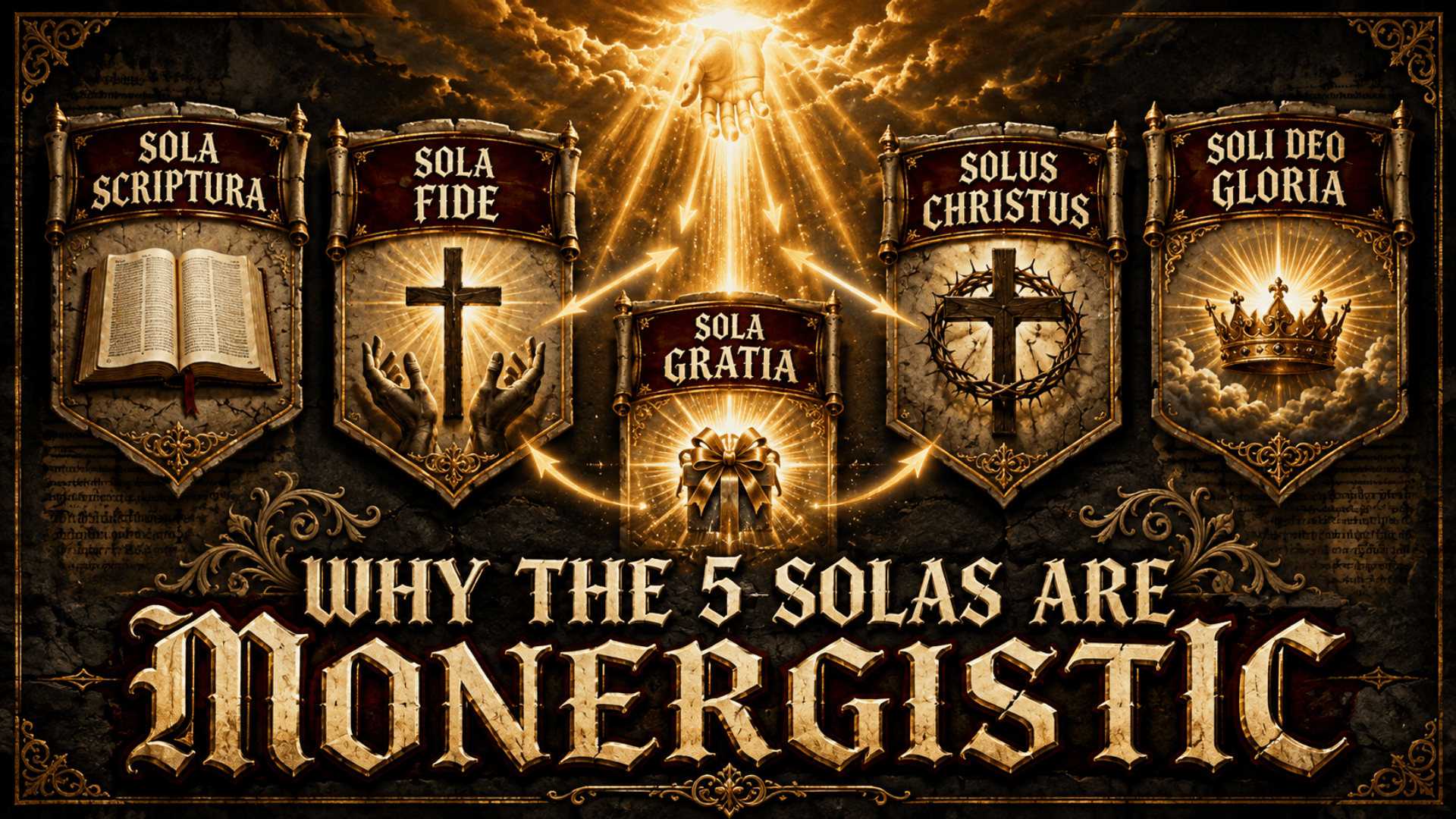
However at the heart of Protestantism was genuinely something good, genuinely a move of God, and that move can be seen in the 5 Solas. “Sola” is Latin for “alone”, and the word after describes 5 major principles of thought that distinguished early Protestants from Roman ideology. The 5 Solas are:
Sola Scriptura (Scripture Alone): The Bible is the ultimate and supreme authority for faith and practice, and it does not need the equal weight of church tradition.
Sola Fide (Faith Alone): Justification (being made right with God) is received through faith in Jesus Christ by itself, apart from any human works or merit.
Sola Gratia (Grace Alone): Salvation is an unearned gift from God. It is entirely a product of His grace rather than human achievement.
Solus Christus (Christ Alone): Jesus Christ is the sole mediator between God and humanity. His finished work on the cross is completely sufficient for salvation.
Soli Deo Gloria (Glory to God Alone): All honor, praise, and glory for creation, redemption, and the entirety of life belong to God and no one else.
To be clear, anyone who believed such things was declared anathema and a heretic by the Catholic Church at the Council of Trent (and other places). Those anathemas have never been rescinded, so they still apply. All that has changed (especially as of Vatican II) is the facade that Rome puts on for the sake of ecumenism, but don’t let that fool you — she still hates any who dare believe such things. Therefore this is a dividing line, because Rome teaches the exact opposite of these doctrines. It teaches that scripture is not the sole authority, that the Church is the authority that interprets scripture. It teaches that we are justified (made right) with God by faith that produces works and cooperates with God, so by faith and works (which really means by works). It teaches that salvation is not entirely a product of God’s grace, but rather a product of the cooperation between man and God’s grace. It teaches that Christ is not the only mediator, because you have Mary, your priest, the saints, etc. that all mediate for you in various ways in the cooperative model.
And, as a consequence of these teachings, all honor and praise and glory do not (and cannot) go to God alone because He is not the only actor (in a causative sense) in the outcome of salvation. You are, along with God, and therefore man and God share the glory together — whether Rome wants to admit it or not.
Sadly, today most Protestants believe this Roman theology of synergism, and as a result they are one step closer to reuniting with Mother. Indeed synergism is the world’s paradigm, and if we know one thing about God it is that He is not like the world and therefore does things completely differently. So then, if the Reformation was a move of God — then these pillars of thought which originally distinguished the Reformers from Rome show us how God thinks. The various creeds and philosophies and traditions of men that came afterward were human inventions, yet these 5 simple truths were a return to God’s word and God’s ways, because this is what the Bible teaches.
And as such, the only way to reconcile them (and therefore be a Protestant or protest the teachings of Rome) is to be a monergist.
SOLA SCRIPTURA
Sola scriptura is the simple teaching that God’s word, as revealed in scripture, is the final authority on all matters for the Church and Christian life. It is here that Rome attacks in many predictable ways. One tactic is to straw man the position by equivocating on the meaning of “alone”. In other words, opponents will present this belief as being such that only the Bible is authoritative, to the rejection of any authority whatsoever outside of scripture. But that’s not the position, because that’s actually antinomian (which is what opponents are trying to present it as, rebellion). Those who believe in sola scriptura do not believe the Bible is the only authority for the Christian life. The New Testament tells you to submit to a variety of authorities: elders, masters, the State, your husband (as a married woman), your parents as a child, etc. So if someone uses this claim with you, correct them quickly with the truth: we do not believe the Bible is the only authority — we believe the Bible is the final authority. That’s a meaningful difference, because it allows for the natural existence of other authorities in the Christian life, while establishing God’s word as the final arbiter and source of truth.
Another tactic is to argue that scripture has “divine obscurity” and therefore cannot be understood by the average person without the assistance of some priest or ecclesiastical authority (like the Pope or Magisterium). This is the appeal to authority fallacy that the Catholic and Orthodox Churches rely on to justify their heirarchy. Yet another tactic is to argue that it was the Church that determined the canon, and therefore you cannot possibly know what is scripture outside of the Church’s authority (often referred to as the “canon conundrum”). We will examine later how this becomes a circular problem and why, in reality, it is a problem for these institutional churches — not for us who hold God’s word as the final standard. A fourth, more subversive tactic, is to attack the Bible’s objectivity — by pointing to all of the countless denominations and arguing that “this is the result of interpreting the Bible without a Magisterium.” This relies on assuming the conclusion, and it doesn’t follow either.
All of these cases have very simple responses, but they require a monergistic foundation. Again I will reiterate that this is not Calvinism or Reformed tradition, because monergism is what even the Old Testament teaches. Nevertheless, divine obscurity exists, because we are dealing with God, but the Bible was written for the average person — not for theologians. The New Testament was written in a common version of Greek, and the proposition of the gospel (see 1 Corinthians 15) is very simple, as are the many imperatives to live a moral life, be generous, endure in faith and love God. You do not need to go to university to discern the basic truths of Christianity, nor do you need an “approved authority” with insider knowledge to help you understand who God is, what He has done and what He wants.
Besides these things, the real issue is that the Bible teaches that comprehension and wisdom are granted by God and not something we directly control — therefore divine obscurity is not a problem because God provides for His children the wisdom and understanding they need in due time. I will expand on this more in a future section.
As for the “canon conundrum” that Rome loves to leverage, she actually doesn’t escape this conundrum herself for several reasons which we will explore. One glaring reason is that there is no external authority to justify and validate her Magisterium. You cannot argue that the Church has authority to interpret what is scripture and what isn’t, or what scripture is saying, and ground that authority in your own interpretation of scripture. This is circular reasoning, and it is what Rome’s power is founded on because Rome is the seat of antichrist and deception.
In other words, Rome says that those who reject her authority have a canon problem, because the Church gave us the Bible and therefore by acknowledging the Bible (the canon) as it is today we acknowledge the authority of the Church as the external source which validates God’s word. If we reject her authority, on what basis can we empirically say that we have a canon or recognize which books belong in the Bible? This is the clever argument you will hear from both Catholic and Orthodox apologists, but it fails for a variety of reasons:
First, the statement “the Church gave you the Bible” has to be defined properly, because it sneaks in institutional assumptions. Jesus equated the Church to the kingdom (like Catholics’ favorite verse for papal supremacy, Matthew 16:18-19), and also said that one cannot enter the kingdom (Church) unless they are born again, or born from above (John 3:3). He also makes it clear that this process is supernaturally administered by God (John 3:8, John 6:44-45, etc.) and that those in the Church can never be lost (John 10:28-29). In fact even in the chapter where we see the Church being created, at Pentecost, it is the Lord who is sovereignly adding to their numbers (Acts 2:47). Therefore the meaning of the word “Church” is those who are grafted into Christ supernaturally by God, as the elect, and can never be lost. Any institution claiming to be the true Church yet suffering apostasy is not the Church, because Christ can lose none of His sheep. Therefore the Church is not a hierarchy or institution that claims to be the Church but rather an invisible fellowship administered by God that has no title or label. So yes, the Church gave us the Bible — but you should always ask a Catholic or Orthodox, what do you mean by that? What the Bible itself would mean is that God selected who would be part of the Church, and therefore who would write, read and spread the canon, as well as recognize it.
A second qualification needs to be made with the word “gave”. It is a true statement to say that Paul gave us the letter to the Romans. It is also a true statement to say that God gave us the letter to the Romans. Both are true because of primary and secondary causes. Catholicism and Orthodoxy will acknowledge that both of these statements about Romans are true, which testifies against their favorite argument of “the Church gave you the Bible.” This is because it acknowledges that in the plan of salvation there are both primary and secondary actors. The primary actor is God, who predestined the canon and wrote it through individuals like Paul, and then revealed it through the preaching and dissemination of the disciples and further recognized it through the Church body at large by causing people to perceive it. The secondary actors are the ones I just listed (collectively, “the Church”). Where Orthodoxy and Catholicism stumble is that they see man as having free will, and therefore as the primary actor in a situation — giving credit to something like the creation and revelation and recognition of the canon to mankind, when in fact it is God who is due the credit. To these people it is almost as if God was helpless to do anything about His word, but thanks to a bunch of men who happened to make a series of good choices we were lucky enough to get the Bible. But that’s not reality, because God is sovereign and therefore God is due the credit for the canon. And if God is due the credit, then the canon happened according to His will and plan, not according to the free will choices of a collective hierarchy or institution. That means “the Church gave you the Bible” is only true in a secondary sense, not a primary sense, and that further destroys the institutional proposition.
Yet a third qualification that needs to be made is with the word “Bible.” The 39 books of the Old Testament were not written by the Church, they were written by Israel. The 27 books of the New Testament were written by Jews in the first century, Jews that did not believe in the distinction between bishops and presbyters or a papacy or infant baptism or Sunday Sabbath or prayers for the dead or praying to Mary or transubstantiation or numerous other things. So a more accurate statement would be that the “Church gave you the New Testament” — but even so, we come back to the problem at the start: what do you mean by Church?
Once you have eliminated the equivocations on the words “gave”, “Bible” and “Church”, the Catholic or Orthodox position immediately crumbles. A final killing blow comes from history, because both of these Churches are in error in different ways. Catholicism as of the Council of Trent recognized the apocryphal works (Tobit, Judith, Wisdom, Sirach, Baruch, 1–2 Maccabees, etc.) as scripture, yet these books run contrary to the canonical books and that is why they were historically rejected. Therefore Catholicism’s canon is wrong and that proves that Catholicism is not the “one true Church” who gave us the Bible.
Orthodoxy has a different problem, because it has no officially agreed upon universal canon. Different groups recognize different books. Clever apologists like Jay Dyer will bring up the Council of Trullo in 692 AD (especially Canon 2) as supposedly an official proclamation of the canon, but this is not accurate. Canon 2 of Trullo endorsed a list of prior canonical authorities, ratifying the “85 Apostolic Canons” and the decrees of previous regional councils (such as the Council of Carthage in 419, which listed 73 books plus a few additional texts). Regardless, the main problem with Trullo is that it ratified mutually inconsistent lists. The 85th Apostolic Canon counts 1–2 Clement and the Apostolic Constitutions as New Testament scripture and omits Revelation. The Council of Laodicea also omits Revelation, yet Athanasius’s 39th Festal Letter includes it. So the very council Jay Dyer and others cite as closing the Orthodox canon ratified lists that contradict each other. Trullo (or the Quinisext Council) was also primarily convened to deal with matters of discipline, law and various pastoral issues unaddressed by the previous 5th and 6th Ecumenical Councils — it was not convened for the sake of determining the canon. Canon 2 of the council just accepted prior traditions rather than formulating a fresh “closed canon” checklist. But again, those traditions were wrong because several of the books were not canonical. Eastern Orthodoxy traditionally recognizes a broader scriptural collection that includes the apocrypha, but throughout history the attitude toward the canon has not been as dogmatic as other doctrines.
So do you see how the “canon conundrum” is actually an institutional problem, not a problem for a biblical Christian? The burden of proof lies on the one making the claim, and because both of these institutions demand you acknowledge their authority alongside the authority of scripture — it is they that have the burden of proving their authority. All Christians agree that God’s word is authoritative, so there is no burden for me as a biblical Christian to prove that I need to rely on God’s word as the final authority in all matters. Rather it falls on the Catholic or Orthodox apologist, who claims that I must also submit to decrees of various councils or traditions or the papacy as I would submit to God and His word. Therefore when you are presented with the canon conundrum, point the problem right back at the accuser and remind them that, in fact, it is their problem — not yours.
As monergistic, biblical Christians we see the canon as something God predestined and administered through time. The body of elect was caused to recognize God’s word after it was written down, as history shows with examples like the Muratorian Fragment from the late 2nd century, which already had a list of the 22 canonical books being recognized. Granted that some argue the dating of the fragment to be later (~4th century), and this listing also recognized non-canonical works, like the Wisdom of Solomon or the Apocalypse of Peter (with a caveat), but the recognition of scripture was a consistently developing process after the first century — beginning with the gospels and Paul’s letters and eventually solidifying into what we have today through the attestation and collective recognition of believers being guided by God to recognize His word.
Eusebius, around 320 to 330 AD, lists 22 as accepted and five as disputed: Jude, James, 2 John, 3 John, and 2 Peter (all short works with correspondingly thinner attestation). Cyril of Jerusalem in the fourth century lists 26, omitting Revelation. Athanasius, in his 39th Festal Letter of 367 AD, lists exactly the 27 books held today. The Council of Laodicea (4th century) recognized 26. Gregory of Nazianzus in 390 AD also recognized 26. Jerome, Augustine, and the Synods of Carthage and Hippo, between 393 and 397 AD, all recognized 27 books, ratifying the list Athanasius had published three decades earlier, whose core (The Gospels, Acts, Paul) had been recognized for well over a century.
So the process began long before Constantine, and a few decades after his death it was relatively finalized, with Revelation being the last to be accepted due to its cryptic nature. Regardless, even by the time all 27 books were finally recognized — it is long before the papacy or other modern elements found in Catholicism or Orthodoxy were ever seen. So then how can any of these churches claim to have given us the New Testament?
This is why for the institutional churches who do not submit to the sovereignty of God in all things, the canon conundrum is a real problem. Catholicism and Orthodoxy are not the true Church because they suffer apostasy and the true Church is not a hierarchy, but rather a fellowship of equals with elders. These institutions also can’t take credit for creating the Bible (really, the New Testament) because God predestined the canon and revealed it and administered it through His Spirit. And even after all of that is accounted for, both Churches fail at the canon issue in their respective ways anyway. Catholicism has an incorrect canon because it recognizes writings that are not scripture (so as to justify its practices like praying for the dead), and Orthodoxy has never made an official proclamation on what the canon actually is in a universal sense for all its churches. Neither of these institutions then are in any position to dictate to anyone what the canon is or to claim they have the true canon, and if they can’t dictate to you what the canon is — how can they satisfy the burden of proof to validate their authority? Therefore the problem is theirs, not ours.
But now doesn’t 1 Timothy 3:15 say that the Church is the pillar and buttress of the truth? You will hear this verse thrown around by Catholics or Orthodox quite frequently in these discussions, as the ultimate prooftext that scripture resigns its authority in the Magisterium or institutional Church. Yet this couldn’t be farther from the truth. The Church is not infallible nor self-evident, nor is it the source of truth. God is all those things, and by extension His word is also. But God's word does not say God has extended these properties to the Church, in the sense that God has communicated self-evidence and infallibility to the Church. The Church is guided by the Holy Spirit, but this is a mysterious dance, because the Church is full of error and human. But in fact the scriptures tell us very clearly how to understand 1 Timothy 3:15: the Church's role is to uphold the truth of God's word. That means:
Relying on God's word (Matthew 4:4, “man does not live on bread alone but by every word that comes from God”).
Preaching God’s word (2 Timothy 4:2, “…preach the word; be ready in season and out of season; reprove, rebuke, and exhort, with complete patience and teaching”).
Referring to God’s word to resolve matters (see all the appeals to the scriptures that Jesus and the apostles made for moral issues).
Testing something to see if it is true or from God (Acts 17:11 Bereans, Hebrews 4:12, “For the word of God is living and active, sharper than any two-edged sword, piercing to the division of soul and of spirit, of joints and of marrow, and discerning the thoughts and intentions of the heart”)
Upholding and defending God’s word (1 Peter 3:15, “…but in your hearts honor Christ the Lord as holy, always being prepared to make a defense to anyone who asks you for a reason for the hope that is in you; yet do it with gentleness and respect”).
Absolutely none of these functions necessitate the bloated institutional hierarchy of Catholicism or Orthodoxy, or the existence of a Magisterium. These commands are given to all believers, not just men or the theological or academic elite, because all believers are part of the Church and have a responsibility to uphold the truth in their own lives and circles. So the scriptures are very clear as to what it means to uphold the truth, but that does not mean scripture gives the Church the authority to define what God’s word says — otherwise God’s word is not the final authority on all matters, man is.
In order to circumvent this obvious problem, the institutional harlot churches (like Catholicism and Orthodoxy) will claim that things like ecumenical councils are infallibly guided by the Spirit and also that the Church has apostolic succession. The latter is easy to disprove, with one simple reason being that the hierarchy of these churches is not the hierarchy prescribed in the New Testament. The New Testament makes no distinction between presbyters and bishops, they are both words for “elder” and elders are prescribed to be married, whereas both of these churches forbid marriage to bishops and above. There is also the matter of the papacy in Catholicism, which I have spent many hours documenting how it is the fulfillment of the warnings of antichrist. Regardless, these simple truths invalidate any claim to “apostolic succession” or continuation back to the time of Christ, because these hierarchies are invented traditions not biblical commands.
But Catholic and Orthodox apologists are very clever, and they weaponize scripture in various ways to justify their institutions. One go-to argument you will hear is that Matthew 18:18-20 sets up the authority of ecumenical councils, and by rejecting them you are rejecting Christ’s command:
“Truly, I say to you, whatever you bind on earth shall be bound in heaven, and whatever you loose on earth shall be loosed in heaven. Again I say to you, if two of you agree on earth about anything they ask, it will be done for them by my Father in heaven. For where two or three are gathered in my name, there am I among them.”
The claim here is that Christ is speaking of the gathering of bishops, and therefore whenever these councils meet to deliberate dogma it is an authoritative situation where God is moving. But is this true? Of course not, and for several key reasons:
Councils have decreed doctrines contrary to scripture, such as the veneration of icons at Nicaea II as a salvific issue.
Councils have contradicted each other. One example is The Second Council of Ephesus in 449 AD, convened by Emperor Theodosius II and attended by over 130 bishops. This council officially endorsed monophysitism (the view that Christ had only one divine nature, swallowing up His human nature). Two years later The Council of Chalcedon in 451 AD reversed Ephesus, declared Christ to have two distinct natures (fully God and fully man), and labeled the 449 council a “Robber Synod” (Latrocinium). A second example is with The Council of Hieria (754 AD), which was attended by over 300 bishops and explicitly condemned the veneration of icons. It declared that making images of Christ or the saints was a form of idolatry and a christological heresy. Yet just 33 years later in 787, The Second Council of Nicaea completely reversed Hieria. It anathematized (cursed) those who rejected icons and decreed that honor, bowing, and burning incense before images was a mandatory part of the Christian faith. Apologists will claim that Second Ephesus and Hieria were not actually ecumenical, so they don’t count — but that’s a circular argument, because it means reception after the fact is what the true test of infallibility is. In other words, if no one can know whether a council is infallibly guided by the Spirit until later generations decide on that council, that is completely subjective and circular, depending entirely on whichever perspective dominates (i.e. like the iconoclastic issue of Nicaea II).
Since the Great Schism in 1054, there have been no more universally recognized ecumenical councils. The Eastern Orthodox argument is that a council is infallible if it is recognized by the Pentarchy (Rome, Constantinople, Alexandria, Antioch, Jerusalem), but this has not happened for about a millennia after the East and West mutually excommunicated each other. Individual churches have had their own councils, but without universal agreement these cannot be considered infallible. Catholics hold that papal confirmation makes a council ecumenical, so they count their own councils (Trent, Vatican I and II, etc.) after the schism. But the Orthodox don’t have a pope, and that means by their own standard they haven’t had an ecumenical council for over 1,200 years (since they recognize Rome as part of the Pentarchy), which means that Christ has basically lost control of the Church’s direction because nobody has agreed for over a thousand years. But Jesus says the gates of hell will not prevail against His Church (Matthew 16:18), which means then that the institutional position on this issue is wrong.
This is why the meaning of Matthew 18:18-20 is not about ecumenical councils. The immediate context is about Church discipline, and while apologists will try to make the case that ecumenical councils are a matter of discipline (sorting out doctrine, correcting heresy, etc.) — this command is not explicitly for bishops, it’s for all believers. We are to sort the matter out with our brother in person, then if that fails bring a witness, and then if that fails bring it before the local community. There is a sequence of escalation, but that sequence says nothing about councils or special offices. Jesus’ statement that He is there where two or more are gathered is therefore a statement of provision — not a statement of infallibility. Where two or more born again believers are gathered to deliberate, God will guide the process and handle things. These words are designed to give us confidence with difficult matters, so that we can let God guide and trust it will all be worked for the good. They are not a statement of Church hierarchy nor are they a claim that Jesus has passed inspiration or infallibility to an ecumenical council, giving it the authority to serve as extra-biblical revelation.
And this is exactly the problem with this entire proposition. It is essentially a claim about extra-biblical revelation. It is no different than Joseph Smith or Ellen White claiming to be prophets and receiving messages from God as to how to interpret His word, binding the consciences of unsuspecting people with traditions of men rather than the truth. Ecumenical councils are in practice the same thing, because they claim infallibility and reveal some new doctrine that is binding on the conscience, and often in contradiction of scripture — especially as history progresses (such as the Council of Trent).
So really what these churches want to claim is that man, and this extra-biblical revelation through the councils and popes and whatever else, is the final rule of authority — not the Bible. Religious people have a real problem with the position that the Bible alone is infallible and therefore the final authority. Why? Because they are programmed with authoritarian thinking. If there’s no outside authority to interpret the Bible for you, how can you possibly understand what you’re reading? This is the mentality, a mentality that denies the truth in many ways and to which there is only one solution, that is, an act of God to change the heart and mind:
It denies that God is the primary source of the canon and therefore has administered it’s preservation and recognition through time.
It denies that scripture was made for the average man to read and enjoy.
It denies that scripture is self-evident and therefore one does not need an authority but rather instead to learn the rules of interpretation and dealing with self-evident information (i.e. context).
It denies that comprehension is supernatural and God will account for all His children.
We will touch on these issues again, but for now recall the main ways Rome (and by extension institutional religion) attacks sola scriptura: it creates a straw man by claiming that we do not respect any other authority except the Bible; it claims that scripture is too obscure to be understood by the average person; it appeals to the canon conundrum; it appeals to the fallibility of man and the countless denominations, as a way to subtly assert that scripture is subjective without the voice of the Magisterium.
We have already addressed the first three, so let’s now address this last point briefly. Just because there are countless denominations with countless interpretations of scripture does not mean that scripture is itself subjective. It means Satan is at work in many ways, not the least of which are Jesuit and occult infiltrations that have created such twisted interpretations — like the Freemasonic founder of the Black Israelites, Frank Cherry, or the Jesuits who created dispensationalism. The flesh alone is a problem to reckon with, but on top of this you have relentless attacks from Satan to destroy the notion that man can find the truth in the Bible without the need for an external institution.
These debates are exceedingly common today, and their specifics are beyond the scope of this article. However what is more fundamental comes back to the two paradigms of synergism and monergism. At the heart of the sola scriptura question is something very simple, yet profound: do you believe (and trust) that comprehension is supernatural and of God? Or do you believe that comprehension can only happen if one cooperates with God? How you answer this question for yourself will determine if you are walking toward God or walking toward Rome.
In the Roman model, because it is the tree of knowledge and Satan’s false synergistic counterfeit gospel, the notion is that inspiration has to be proposed to you by an external source outside of scripture, because comprehension is a cooperative act between God and man (just like justification). In other words, you need someone to tell you what is inspired and what isn’t. It also means that you cannot comprehend what is in God’s word unless you have a mediator, and that mediator must be someone in the institution — not the Holy Spirit.
But if comprehension is supernatural and controlled by God Himself, then the entire Roman proposition falls apart. Scripture is self-validating and objective, because God is 100% consistent and cannot lie or make mistakes. That means when you interact with scripture, you can compare other texts or claims to it so as to see if it is from God or aligning with God. This is what it means to test something, which is what the apostles tell us to do (1 Thessalonians 5:21-22, Romans 12:2, 1 John 4:1) and what the early Bereans did (Acts 17:11). It is even what the Israelites believed for centuries (Isaiah 8:20), which is why they did not need a Magisterium to understand what Jesus meant by “the Law and the Prophets.”
In fact even the early Church recognized these things, much to the chagrin of Rome’s apologists. Consider the following:
Hippolytus of Rome (3rd century), prominent thinker of his time, said the following in his letter against the heresy of Noetus (cited in Alexander Roberts and James Donaldson, The Ante-Nicene Fathers, vol. V, Hippolytus, Against the Heresy of One Noetus, Chapter 9; Grand Rapids: Eerdmans, 1951, p. 227):
“There is, brethren, one God, the knowledge of whom we gain from the Holy Scriptures, and from no other source. For just as a man if he wishes to be skilled in the wisdom of this world, will find himself unable to get at it in any other way than by mastering the dogmas of philosophers, so all of us who wish to practice piety will be unable to learn its practice from any other quarter than the oracles of God. Whatever things then the Holy Scriptures declare, at these let us look; and whatsoever things they teach these let us learn.”
Basil the Great (4th century), bishop of Caesarea wrote in The Shorter Rules, Answer #267 that:
“What seems to be said in an ambiguous and veiled way in certain passages of inspired Scripture is made plain by the obvious meaning of other passages.”
Gregory of Nyssa (4th century), the bishop of Nyssa and brother of Basil the Great, wrote the following in his On the Soul and the Resurrection:
“But while the latter proceeded, on the subject of the soul, as far in the direction of supposed consequences as the thinker pleased, we are not entitled to such license, I mean that of affirming what we please; we make the Holy Scriptures the rule and measure of every tenet; we necessarily fix our eyes upon that, and approve that alone which may be made to harmonize with the intention of those writings.”
Athanasius the Great (4th century), bishop of Alexandria, also had some bangers that Catholics and Orthodox should take heed of. In his De Synodis, Part 1, Section 6, he writes:
“Vainly then do they run about with the pretext that they have demanded Councils for the faith’s sake; for divine scripture is sufficient for all things; but if a Council be needed on the point, there are the proceedings of the Fathers, for the Nicene Bishops did not neglect this matter, but stated the doctrine so exactly, That persons reading their words honestly, cannot but be reminded by them of the religion towards Christ announced in divine scripture.”
In his 39th Festal Letter, section 6, Athanasius wrote:
“These [canonical Scriptures] are fountains of salvation, that they who thirst may be satisfied with the living words they contain. In these alone is proclaimed the doctrine of godliness. Let no man add to these, neither let him take ought from these. For concerning these the Lord put to shame the Sadducees, and said, ‘You err, not knowing the Scriptures.’ And He reproved the Jews, saying, ‘Search the Scriptures, for these are they that testify of Me (Matt. 22:29; John 5:39).’”
John Chrysostom (5th century), wrote in his 9th homily concerning 2 Timothy the following:
“‘All Scripture is given by inspiration of God, and is profitable for doctrine, for reproof, for correction, for instruction in righteousness’ . . . ‘For doctrine.’ For thence we shall know, whether we ought to learn or be ignorant of any thing. And thence we may disprove what is false, thence we may be corrected and brought to a right mind, may be comforted and consoled, and if any thing is deficient, we may have it added to us. ‘That the man of God may be perfect.’ For this is the exhortation of the Scripture given, that the man of God may be rendered perfect by it; without this therefore he cannot be perfect. Thou hast the Scriptures, he says, in place of me. If thou wouldest learn any thing, thou mayest learn it from them. And if he thus wrote to Timothy, who was filled with the Spirit, how much more to us!”
Augustine (5th century), revered by both Catholics and Orthodox as one of the greatest theologians of all time, says in De Trinitate the following:
“Do not follow my writings as Holy Scripture. When you find in Holy Scripture anything you did not believe before, believe it without hesitation. But when you find in my writings something you are not sure about, do not hold it firmly unless your mind has understood it to be true.”
Even well after the Great Schism and Reformation, we see these attitudes continue, at least in the East. Cyril Lucaris, the Ecumenical Patriarch of Constantinople in the 17th century, in the second chapter of his Confession wrote:
“We believe the authority of the Holy Scripture to be above the authority of the Church. To be taught by the Holy Spirit is a far different thing from being taught by a man.”
These and other witnesses throughout history demonstrate that the teaching of sola scriptura is not a Protestant invention or modern contrivance, but rather what Christians throughout time believed because it makes perfect sense. If you are dealing with an absolute being who is omnipotent and omniscient, it stands to reason that His revelation of Himself will itself be perfect and self-validating. All one need to do is consult this revelation carefully, understand proper rules of interpretation so as to do justice and honor to the text, and he or she will be guided to the truth in due time. Some things remain mysteries, but God provides for us wisdom and understanding appropriate for His purposes, and all believers receive the basic understanding of the gospel so they can be saved — despite theological differences or errors.
Now at this point you may run into another popular tactic, which is to accuse you of holding to circular reasoning. That is, appealing to scripture to prove that scripture is the final authority is circular. This is actually true, however it has no impact for one simple reason: in the final analysis, you always need an ultimate arbiter of truth. There needs to be a singular source that validates all claims, because it is the standard. It goes without saying that the standard itself does not have another external standard that it must be compared to. The final measuring rod is its own standard, because it is self-evident.
If I am using a ruler to measure distance, I do not go to another ruler to measure my ruler and double check that the inches are in fact inches. By that reasoning, you would never stop referencing other rulers because there would be no absolute standard. This is why the absolute standard in any situation is always self-referential and self-evident, because it must be. Scripture is God’s word, and as such it has the self-evidence and self-testimony that God has of Himself — and because of this the circular reasoning is justified.
This also applies to the argument that interpreting the Bible makes one the ultimate source of truth. This is false. Interpreting something does not make one the source of truth, because even Catholics have to read their own doctrines and use their reasoning faculties to interpret what the Catechism has to say about a given issue, with an example being how different Catholics view Mary. Although veneration of Mary is generally pretty high in Catholicism, whether she is considered the “Co-Redemptrix” depends on one’s interpretation of various Church doctrines, with the traditionalists generally skewing toward this position, even though the Catechism does not claim Mary is Co-Redemptrix and in late 2025 the Vatican’s Dicastery for the Doctrine of the Faith issued a doctrinal note discouraging the title Co-Redemptrix.
So even within Roman Catholicism, people interpret doctrines that are not officially Church position (and biblically are blasphemous), yet they are not rebuked for it. But when someone picks up a Bible, written in common language for the common man, and dares to read it for themselves — suddenly there’s a problem. Yet Paul expected exactly this from his churches, telling them to judge for themselves regarding his various arguments on things (1 Corinthians 10:15; 11:13). The Bereans in Acts 17 are another famous example, and there is nothing in the New Testament that commands the existence of an “authorized Magisterium” that Christians needed to consult to get the “right interpretation” of what the apostles wrote. That doesn’t negate the need for instruction, teachers, elders and Church authority — but it also doesn’t mean that the existence of these lesser authorities justifies an institution that claims it itself is the authority to interpret scripture. That’s the sleight of hand that these institutions engage in.
But the simple reason why a Magisterium is not required is because, returning to the previous point about circularity, the scriptures are self-referential and self-evident. The accusation therefore that we make ourselves the sole authority when interpreting scripture is a straw man. It misrepresents the sola scriptura position. We make the scriptures the final authority, and because the scriptures are self-evident and consistent, we go to them to judge, test and learn. You can’t do that with a body of information that is not completely consistent, like for example the writings of the Church Fathers. These men had some good things to say, but they also contradicted themselves and each other, as well as the scriptures, countless times. They also had historical inaccuracies, like how Irenaeus claimed Jesus’ ministry continued until He was nearly 50 (Against Heresies 2.22.5-6).
Thomas Aquinas is another great example, having been a fanatic for papal supremacy and a supporter of executing heretics — yet the current Catechism (2267) teaches that the death penalty is inadmissible. The same pattern of inconsistency applies to the rest of the body of work collectively referred to by these institutional churches as “sacred tradition” — that is, the various councils and decrees and theologians over the centuries that have piled on doctrines of men which contradict the Bible and even themselves. These things do not have the consistency and self-evidence that scripture does, so how can they be the measuring rod to interpret the former? It makes no sense.
So that is why the problem is that Rome ultimately tries to appropriate this self-evidence to herself, by claiming that the Magisterium has the ultimate authority over how scripture is interpreted. Ironically this is really the circular issue, because what apologists are actually claiming is that the Magisterium has the final authority based on their own interpretation of scripture as upholding them as the final authority. That is circular reasoning, not picking up your Bible and indulging in exegetical study. If the Magisterium is the final authority, then the problem stands: on what basis can we say that this is so? What gives them the authority to have the final word?
We can surely agree that God is the source of truth and self-evident, so circularity is dissolved with God. But on what basis can we say that about the Magisterium? You cannot, because it always boils down to appealing to their own interpretations as justification for their authority, which requires the belief that the Magisterium is infallible and self-evident just like God. But it’s proclamations are clearly contrary to scripture and soundly refuted by scripture, and nowhere does scripture say God communicated His infallibility or self-evidence to a Magisterium. Therefore the circularity problem is actually Rome’s, not the monergist’s.
So scripture is self-validating because it is perfect information. That doesn’t mean translations are perfect, and that is why it sometimes takes study and work to get at a particular truth when original language nuances or context or translation issues are involved. But in general the average person can understand the gospel and who God is and what He wants, as well as what He has chosen to do. This is because the scriptures were written for the average person and they present a simple proposition: God is a just Judge who is wrathful against our sin, we deserve hell because we are guilty, yet Jesus Christ died in our place and we can be forgiven and live forever if we believe and trust in Him as our substitute before God.
These truths are not “divinely obscure” such that you need an institutional mediator to understand them. What people need is the move of the Spirit in their life to soften their heart and not see the cross as foolishness (1 Corinthians 1:18), and scripture has countless testimonies that such supernatural movement is God’s prerogative alone. I have documented dozens upon dozens of examples, but a few are: Acts 13:48, 2 Timothy 2:25, John 6:44, Romans 11:29, Romans 12:3 and countless others. Throughout the Bible, and especially in the New Testament, the act of faith and even the good works that we produce are all ultimately attributed to God. This is monergistic soteriology, and it is what the scriptures teach.
When Peter famously confesses Christ in Matthew 16:16, Jesus immediately attributes his revelation to the Father, telling Peter that his flesh and blood would have never revealed this to him — it was a work of God for Peter to comprehend who Jesus was. We see the same awareness-granting even after the resurrection, where Jesus deliberately hides Himself in plain sight, converses with His disciples for a while, and then grants them supernatural awareness to see Him truly (John 20, Luke 24, etc.).
Jesus also promised the apostles that the Spirit would come after He ascends, and He will guide them to all truth (John 16:13). Notice that Jesus does not say, “He will guide you into some truth” or “He will guide you into mostly truth.” How ridiculous to think such a thing, yet this is the synergistic belief — because in rejecting God’s absolute primacy over comprehension, a wedge is inserted that justifies an entire hierarchy of men and traditions and extra mediators, all of which are flawed themselves and also motivated to maintain their power by interpreting the scriptures in their favor.
Now some argue that John 16:13 is only about the apostles, in the sense that only they were guided into all truth because they had inspiration. This hinges on a literal interpretation of the word “all” — but this interpretation fails. Peter was rebuked by Paul after the cross, so obviously Jesus’ promise in John 16 is not a literal promise that the Spirit will restrain them from all error every moment of every day for the rest of their lives. It’s figurative, in the sense that God will guide them to everything they need to know. Much like the issue with Matthew 18:18-20 discussed previously, the sense is completion of understanding and total provision, not total prevention of error. That doesn’t mean the scriptures they wrote have error or the possibility of error, it just means that this statement is a figurative statement.
Why this matters is for two reasons. First, it addresses the institutional myth of apostolic succession because apostolic succession claims a connection back to the apostles and therefore benefits from their inspired guidance by appropriating that authority to modern offices like ecumenical councils or the papacy. But we have shown that apostolic succession is false and so is the infallibility of the ecumenical councils, and because the apostles weren’t free from all error all the time means any claim of oral transmission of information outside the scriptures is unsubstantiated, because even if such things were true — there is no support from John 16:13 to guarantee these transmissions would be infallible. What is written down is what is infallible, and the apostles were inspired in their efforts. But they also were still human and made mistakes. Paul laments in Romans 7 at his constant failures, so then John 16 is not a literal statement but rather figurative and that eliminates the claim of apostolic succession or the claim of oral transmission of infallible traditions.
The second reason why it is important to understand the promise of John 16:13 as figurative is because it upholds monergistic soteriology. Sadly, I have seen today even those who believe in monergism approach this verse as being exclusively about the apostles — but this gives Rome way too much ground without even realizing it. The truth is that this promise is a promise for all generations of believers from the apostles, just like Jesus’ high priestly prayer in the next chapter is a promise of unity and faith for all those linked to Him through the apostles and their efforts. Similar statements are found in 1 John 2:20, when he writes to his church (“But you have been anointed by the Holy One, and you all have knowledge”) or Matthew 28:20 (“…And behold, I am with you always, to the end of the age”). These are encouraging statements, like John 16:13 or Matthew 18:18-20 that together show Christ’s unwavering support of His Church in all things, as well as His provision of knowledge, wisdom and discernment. They are nothing less and nothing more, and if we see that John 16 is a promise for all believers, without it being a literal statement that God will give everyone perfect theology, it removes one more argument from Rome while also upholding the biblical pattern that God is the one who causes comprehension in the believer without their cooperation.
So this is why “sola scriptura” is monergistic, and it has to be. If you want to lean on the Bible alone as the final authority for all matters, then you must renounce synergistic soteriology. You can’t have both. Either you trust that God is in charge of comprehension and will reveal things to the patient and studious in His time, or you do not trust that God will provide for His elect in this way, and therefore comprehension requires some kind of cooperative activity between man and God. If you believe salvation is cooperative, then you cannot believe in sola scriptura. Therefore you cannot be an Arminian and remain a Protestant, because the foundation of what it means to protest Rome is to protest its view of God’s sovereignty.
This is also why at the heart of this issue, like every other, is a more fundamental question. So when you find yourself in these endless debates, sidestep the issue entirely by getting at the head of the snake: do you believe God is sovereign? If God is sovereign over the conscience, then He will provide for His elect the required awareness and theology they need. Not everyone gets equal awareness and that doesn’t matter, because God has a purpose for everything He does. But if this is the case, and God is sovereign over this process just as He is sovereign over salvation, then nobody will be lost despite differences in theology. That also means that, in regard to the beloved “canon conundrum” that Catholics and Orthodox bring up, the canon of scripture was actually formed by God, before time began, and also recognized by people because of God moving in time and space to grant them awareness — blessing people with His Spirit and revealing the truth.
It was God who made the canon, God who awoke people to it (just like He awoke Peter to the Christ) and God who guarantees their knowledge sufficient for salvation and the purposes He has purposed for their life. It is also God who allows theological failures, just like He allowed the death of thousands of babies at the hands of Herod when Christ was born, so as to fulfill His purpose (Matthew 2:16-18). All of these things ultimately are under the providence of God for His purposes, so Rome has no ground to stand on if monergism is proven true.
That is why if you reject these plain truths, all you are left with is Catholicism and the Magisterium. If comprehension is not by God alone, then indeed the Church gave us the canon, and you need other external mediators and authorities to help you struggle with the text so that you can understand it, because free will means it depends on us and therefore humanity is the ultimate lynch pin of the result. God depends on man to administer His truths properly, because man’s will and efforts are the determining factor — not the supernatural, sovereign administration of the Church by the Holy Spirit. Furthermore, theological differences do not have a purpose in God’s plan and must be stamped out, whereas if God is sovereign then all of these things serve to further our mutual sharpening, compassion and understanding.
SOLA FIDE
“Sola fide” means “faith alone”, and it specifically refers to the way we are reconciled to God or justified. Justification comes from “justice” because it is a legal term, since God is the Judge of the Earth and you can’t have a Judge without a courtroom or law. Because we are all guilty of breaking that law, and because God has all of the records of our guilt, and because He is perfectly holy, justice demands our painful destruction. The gospel solves this by offering Christ as the payment, freely given in our place, and by faith in that payment we are united to Him and our legal sentence is dismissed. By having a clean slate we are declared innocent, and innocent people are adopted as children of God, given the Spirit, conformed to God’s character and eventually resurrected.
This line of thinking is rejected by Rome and Eastern Orthodoxy because these institutions reject penal substitutionary atonement. In Rome’s view, Jesus’ death afforded you the opportunity to cooperate with God (through His earthly institution), and if you successfully and consistently cooperate for the duration of your life — you will be saved on judgment day. Therefore Rome’s view of justification is ultimately a future reconciliation, not a past one. Nobody who is Roman Catholic or Eastern Orthodox can claim they have complete assurance of their salvation, because these institutions cannot provide such a thing. You could be a perfect Catholic in perfect standing, and one week choose willingly to miss mass — resulting in a mortal sin and falling out of your salvation. If you were unlucky enough to get into a car accident that same Sunday, you would be thrown in hell at the resurrection according to Roman Catholicism.
Therefore Roman (synergistic) soteriology puts the onus of responsibility on man. If you can lose your salvation, and if the final outcome of being reconciled to God is determined upon whether you cooperate with God, then the real determiner of salvation is you — not God. And if you have to work to maintain your salvation, then your trust isn’t in Christ as the payment and mediator and sustainer, but rather on your own efforts and works.
This is the religious paradigm in a nutshell, and in fact it is in all religions because all religions are synergistic. They are a paradigm of “doing in order to be” — where the gospel is a paradigm of “being in order to do”, — and that the new state of being is granted to you as an act of God for His glory. It is completely different than the world, because the world is backwards from God.
Here Rome has several maneuvers when she attacks this doctrine through her agents. Some attack the character of Luther, Zwingli, Calvin and others — claiming that these men had many faults (true) and therefore they gravitated toward doctrines that made them feel better about themselves. Another related attack is to argue that justification by faith alone is license to sin, because it means you can do whatever you want since you are justified already. Yet another attack is to point to all of the verses in the New Testament that command morality, or that state God will judge those at the end according to their works (Matthew 16:27, Romans 2:6, 2 Corinthians 5:10, Revelation 20:12, Revelation 22:12). And a final attack is to argue that “faith alone” is a modern, Protestant invention and not historically found in the Church.
As usual the responses to these attacks are simple, if you understand your basics and the real problem which is monergism vs. synergism. Attacking the character and associations of Luther, Calvin, Zwingli and others is an ad hominem strategy — it has no bearing on the merit of the truth claims of the Reformation. David took advantage of a married woman and murdered her husband, yet he wrote some of the most beautiful content in the Old Testament. I am not saying that the Reformers were divinely inspired, but what I am saying is that God can use anyone to reveal truth, so we should always judge the merit of a claim by what it says rather than by who delivers it.
But the other ways Rome attacks justification by faith alone are a little more clever. They argue that being justified gives one license to sin, and also that it is inconsistent with the New Testament because of the verses I cited above on being judged by our works. Here people get into the weeds of the age old “faith vs. works” debate and whether faith is a work and to what extent works matter, etc. etc. But as usual the problem is much more fundamental and underneath these things.
And that problem is whether God is the source of faith or not. Just like with sola scriptura, you have two paradigms. If God is the cause of comprehension, then you have a vastly different paradigm than if He depends on humanity’s cooperation for comprehension to occur. Likewise, if God is the source of faith and grants it to whomever He wills, you have a vastly different paradigm than if He depends on humanity’s cooperation in order for faith to occur and be maintained.
If God is the cause of faith, as so many scriptures testify to, then what we experience as believing in Jesus and doing good works is all happening because of God. Philippians 2:12-13 is perhaps the best verse to picture this reality. In verse 12 Paul urges those in Philippi to work out their salvation with fear and trembling, and if we were to stop there — we would believe the Catholic position. But Paul doesn’t give you time to make that error, because he qualifies that statement with a “for” (because) immediately: “…for it is God who works in you, both to will and to work for his good pleasure.”
So according to Paul, all of that striving and effort that he just commanded is not in the sense that it depends on you — but rather in the sense that God is doing this thing and therefore rejoice, because He is doing it in your life for His pleasure. God is the source of your desire and your good works, so when you feel that desire to do good things — lean into it and do it with conviction. After you do it you look back on the event and realize it was actually God working through you.
This profound dance of the conscience is only available in monergism, and monergism solves all of the clever challenges that Rome puts forward on this issue. If God is causing you to believe and to do good works, then there is no problem with being justified by faith alone and also being judged according to your works at the end. They are two different things, and they are complementary — not contradictory. For the monergist, justification happened already in the past, and in the future God will reward them for the good works God is doing in their life — not because they chose to do those good works of themselves, but because God purposed those works as part of the gift of salvation (Ephesians 2:8-10). Verse 10 in Ephesians 2 is one that many forget to include when they quote the gospel here, and yet it is so important. God gave us the gift of faith, so that no man may boast (because nobody can believe otherwise) — and He also prepared good works beforehand that we should walk in after being caused to believe.
If you reject these simple truths, as many Protestants today unfortunately do, you cannot be called a Protestant and you cannot claim to believe “sola fide.” This is because sola fide is strictly a monergistic understanding, because it can only be defended with monergism. If you embrace free will and synergistic soteriology, then with that comes the foundational belief that we are the primary causes of the good works in our lives. This is the conclusion Rome assumes in her argumentation, and because she assumes this conclusion then it seems that her arguments about being judged by our works at the end hold water. So if you have already bought into her premise (free will), you have no way to escape the inevitable result of that premise (justification by faith and works).
But thankfully Rome’s arguments do not actually hold any water, because God is the source of the good works and therefore God is doing the rewarding as part of the gracious gift of salvation, which includes both faith and works. If however we are the originators of the good works, then justification cannot be by faith alone because the good works factor into God’s judgment of every soul. Justification then must be a future reality, and cooperation with God is necessary to reach salvation.
Many Arminian or synergistic Protestants believe these things, and they unwittingly place themselves one baby step away from Rome in doing so. All it takes is a little ecumenism, a few crises, some social issues (like social justice or climate change), maybe some false signs and wonders — and it is not a difficult thing. That is because rejecting the sacramental system while espousing the very foundation that makes it possible in the first place (free will, cooperative salvation, synergism) is a contradictory position — and any good Orthodox or Catholic apologist will devour a “faith alone” Protestant that wants to play in their sandbox for free will salvation.
Now, the final strategy that Rome employs is to discredit the “faith alone” position as not being found in Church history. They claim that nobody held to this position until the Reformation, but this is in fact a lie. Despite the wild variance on some things between patristic sources, we can see consistent threads throughout time that people indeed believed in Christ as a penal substitute or that scripture is the highest authority, or that we are justified by faith alone apart from works or merit. Consider the following sources, which are just a few examples.
Clement of Rome (1st century) the alleged fourth pope of the Roman Catholic Church and a potential contemporary with Paul (Philippians 4:3) wrote to the Church at Corinth:
“Whosoever will candidly consider each particular, will recognize the greatness of the gifts which were given by [Jacob]. For from him have sprung the priests and all the Levites who minister at the altar of God. From him also [was descended] our Lord Jesus Christ according to the flesh (Rom. 9:5). From him [arose] kings, princes, and rulers of the race of Judah. Nor are his other tribes in small glory, inasmuch as God had promised, ‘Your seed shall be as the stars of heaven.’ All these, therefore, were highly honored, and made great, not for their own sake, or for their own works, or for the righteousness which they wrought, but through the operation of His will. And we, too, being called by His will in Christ Jesus, are not justified by ourselves, nor by our own wisdom, or understanding, or godliness, or works which we have wrought in holiness of heart; but by that faith through which, from the beginning, Almighty God has justified all men; to whom be glory for ever and ever. Amen.”
Ambrosiaster, or pseudo-Ambrose, an influential Latin commentator in the 4th century whose writings were attributed to Ambrose originally, wrote the following in his commentary on Romans 3:24:
”They are justified freely, because they do nothing, nor pay any recompense [or ‘nor given anything in return’]; they are justified solely by faith [or ‘by faith alone’] as a gift from God.”
Hilary of Poitiers (4th century) said the following in his commentary on Matthew 9:3:
“The tax collector is justified by faith alone, not by works of the law.”
Basil the Great (4th century) said the following in his Homily on Humility:
“Let him who boasts boast in the Lord, that he is not puffed up by his own righteousness, but knows that he is truly deficient in true righteousness and is justified by faith alone in Christ.”
John Chrysostom (5th century) wrote the following in his 27th Homily on Genesis:
“Hence blessed Paul also calls it a sign in the words, ‘He gave circumcision as a sign, a seal.’ You see, for proof that it contributes nothing towards righteousness, behold this good man too, before circumcision had ever been legislated, reaching such a height of virtue. Why mention this? The patriarch Abraham himself before receiving circumcision had been declared righteous on the score of faith alone: before circumcision, the text says, ‘Abraham believed God, and credit for it brought him to righteousness.’ . . . Thus right from the very beginning the human race gained salvation on the basis of faith.”
He also wrote the following in his 7th Homily on Romans:
“But what is the law of faith? It is, being saved by grace. Here he shows God’s power, in that He has not only saved, but has even justified, and led them to boasting, and this too without needing works, but looking for faith only.”
And of course our good friend Cyril Lucaris, Patriarch of Constantinople in the 17th century said the following, in the 13th chapter of his Confession:
“We believe that man is justified by faith and not by works. But when we say by faith, we understand the correlative or object of faith, which is the righteousness of Christ, which, as if by hand, faith apprehends and applies unto us for our salvation. This we say without any prejudice to good works, for truth itself teaches us that works must not be neglected, that they are necessary means to testify to our faith and confirm our calling. But that works are sufficient for our salvation, that they can enable one to appear before the tribunal of Christ and that of their own merit they can confer salvation, human frailty witnesses to be false; but the righteousness of Christ being applied to the penitent, alone justifies and saves the faithful.”
Orthodox apologists will point out that his Confession was condemned by Orthodox synods, most notably Jerusalem in 1672. But that’s beside the point: a sitting Ecumenical Patriarch held these views and they were consistent with Church leaders before him.
So then what does history show us? It shows us plainly that the “faith alone” position is not a Protestant invention. Rome will retort by saying these quotes are taken out of context and that the early Church did not subscribe to the ideas developed by the Reformers. To this we concede that theology takes time to develop. Early Christians after the apostles believed in the deity of Christ, yet it took several centuries to articulate the doctrines of the incarnation and Trinity. That doesn’t mean these doctrines are traditions of men made up at various councils, it means that theology takes time to articulate because God is instructing His Church throughout time, and often through struggles and heresy. Eschatology is similar, as it took many centuries for the papal antichrist to be revealed in time and for the Church to recognize in history what John penned 2,000 years ago in Revelation.
These things in no way detract from the significance of the quotes cited, but rather show that the substance of the doctrine always existed. It took many more centuries for Rome to pervert and blaspheme all that is good, inverting the gospel into a meritorious race and selling salvation through indulgences, to finally evoke a response in God’s people away from this system. That response was the 5 Solas of the Reformation, but these were not dogmas invented out of thin air. They were a return to the truth that countless beforehand had recognized, to the best of their ability, and more importantly the truth that is resoundingly articulated in the scriptures: that faith in Christ alone is what justifies the sinner before God and nothing else.
SOLA GRATIA
Next is sola gratia, which is the teaching of “grace alone” or that simply God grants salvation as a free gift apart from works or merit of any kind. The only way this works is in monergism, because if salvation is cooperative then merit is automatically introduced. Paul tells us that a worker is due his wage (Romans 4:4) and therefore wages earned from work cannot be considered gifts. If salvation is then dependent upon your consistent effort and cooperation with God’s grace — the ultimate determiner of the outcome is your work, and God cannot be said to be gracious but only just; because He either pays you with eternal life for doing a good job or pays you with hell and destruction for being wicked and not repenting.
Synergistic soteriology has another related problem with sola gratia in that it is inextricably tied to corporate election, the teaching that God chooses (in a corporate way) who is saved. Election in this model is impersonal and has no security to offer anyone, and it is also a function of merit. The synergistic model teaches that God responds to only those who exercise faith, and while there are many takes on this topic — it all boils down to the same chain of events. Man acts first, then God acts. The elect are therefore those who made the right choice, and this pool of people can change at any moment because, well, you can also make the wrong choice and fall out of salvation.
But if God is responding to only those who have faith, then God is rewarding performance. It does not matter whether faith is a work or not. If everyone has the capability to believe, but some freely choose not to and others do, then God is not the primary mover of reality or salvation — He is merely a cosmic trophy giver, waiting for those who will get over themselves and make the mental effort of repenting and believing, so that He can finally unleash all of His blessings in their life. This puts God in a subservient position, dependent upon His creations for His quality as the Savior to be actualized — and it also makes salvation meritorious, because God is responding to what you have done rather than you responding to what God has done.
It also elevates the human condition to a place it neither has nor deserves, because it teaches that man can ultimately choose free of the influence of evil and his flesh and make the right choice. And really, if you can choose free of all influence — even God’s influence — then you do not need God and you can govern yourself and manifest reality. This is Satan’s gospel from Genesis 3 dressed up as Christianity, yet sadly most Christians believe some form of this lie today.
Rome’s strategy here is the same as with sola fide — she attacks the idea that grace is completely free and she twists the verses on works to present a false gospel. But again we return to monergism and ask, what do you mean by grace? If salvation is cooperative, then “grace” is merely an opportunity, a coupon that you must take advantage of, and then God rewards you for doing what most did not do. But if God is the source of faith, then “grace” is not a passive opportunity but rather the supernatural work of God invading your life and transforming it.
This is why, when confronted with the accusation that “grace alone” is “cheap grace” you should always turn the accusation back on the heads of the accusers. The sola gratia position is not cheap grace for several reasons. First, grace is not cheap because it was exceedingly expensive — for God. God’s grace was the most expensive thing in history, purchased with Christ’s blood. To call this cheap is to blaspheme the Son of God and the gospel, because “cheap” means “low value.” Grace was infinitely expensive, priceless. But for us sinners, grace is free. Something that is free does not mean “low value” — in fact the things that have the highest value in life (our body, our relationships, wisdom, etc.) are all free. So grace is free but it’s priceless. That doesn’t mean “free grace” as in the sense of the heretical antinomian modern views of salvation (where one can do anything and live in sin), rather it means grace is freely given without expectations of repayment.
For context, “cheap grace” was popularized by Dietrich Bonhoeffer in The Cost of Discipleship (1937). He used it against complacent Lutheranism, where people claimed forgiveness without discipleship. Bonhoeffer himself wasn’t attacking grace alone, so when Catholic apologists use his phrase against sola gratia, they’re borrowing a Lutheran’s critique of Lutherans and taking it out of context.
Ironically, and consistent with all of the other inversions of religion, grace in these institutions is actually cheap. It is cheap because it is merely an offer, a coupon, that depends entirely on your effort, and offers no guarantee. In this model God is “hands-off” and cannot prevent you from apostasy. And because the human will is broken and tends toward sin, the entire offer is hedged on the side of the transaction that is most likely (biblically guaranteed because of total inability) to fail. That is not even a promise but an offer, and a cheap one because history has shown us humanity can never hold up its end of the bargain with God.
This is why religion is slavery. It in fact presents the gospel not as a freely given grace, but as a debt system. What more do you expect from Satan? The entire world runs on debt and debt has been used to subjugate nations, and it is no different in religion. Rather than God granting you a guarantee graciously, religion says God gives you an opportunity to perform — which is really a debt. The salvation Jesus provided for you at the cross must be repaid in good works and effort in order for God to resurrect you and bring you into His kingdom. In this model man becomes a debtor to God and God also becomes a debtor to man, because He must pay the wage of resurrection to the ones who perform. It is a completely upside-down view of reality, which is why it must be rejected.
Grace is the gift of believing, the gift of good works, the gift of endurance to the end and the gift of resurrection. It is the entire salvific process, because God is the sole and primary actor in salvation. Therefore there is no license to sin nor issue with being judged for our works, because neither applies to the situation in the way Rome wants to make them apply. The grace that God shows a sinner transforms their heart and they do not desire to be a sinner any longer. They still sin, but their identity and desires have changed. As a result they do have new works, through God, and those are rewarded as part of the gift.
SOLUS CHRISTUS
Although Rome teaches that Jesus Christ is God, it denies the Christ of the scriptures as the only mediator between God and man, and also denies His sovereignty over the fate of His sheep. Yet Christ assures us in many places, especially the gospel of John, that all power has been given to Him and that He gives His sheep life and preserves them until the end. To be “solus Christus” then is to not only believe Christ is God, but to believe that Christ is completely sovereign. Rome denies Jesus’ sovereignty over salvation, and therefore the door is wide open for endless versions and flavors of cooperation — which is why Catholicism has countless mediators from priests to Mary to the saints to the Pope. Catholic apologists deny that these things conflict with Christ’s mediatorial role, but any honest observer of Catholic practices (or even reading their catechism) comes to the conclusion that this is not the case.
Unfortunately, many Protestants today fall into this same category, which is why you again cannot be a synergistic, free will Arminian “sola fide” or “solus Christus” Protestant. There is no such thing, because these doctrines are monergistic. If salvation is cooperative, then Catholicism is true and therefore there are cooperative effects from others outside of you (like priests or saints) that can “help” your salvation, because you need as much effort and help as you can get to win the race. They don’t compete with Christ’s primary role, because Christ’s role isn’t the only exclusive one responsible for the outcome.
But if salvation is not cooperative, but determined by God, then you do not need anyone else’s help. You do not even need your own help, because God is causing you to walk in His ways and endure. All you need is Christ alone, and you trust in His saving power (Psalm 78:22). Therefore solus Christus can only be reconciled with monergism. A free will Protestant cannot claim to be solus Christus because they by requirement trust in themselves as the ultimate determiner of their salvation. If Christ needs you to cooperate in order for you to be saved, then it is you that must work to maintain your salvation — not Christ — and therefore you do not trust in “Christ alone.”
SOLI DEO GLORIA
The final point on this list is, of course, soli Deo gloria, “for the glory of God.” This is the teaching that all things serve the glory of God, and God seeks His own glory in all that He does, and also that salvation is for God’s glory — therefore all credit and honor for the outcome belong to Him alone. This is consistent with scripture, where God tells us that He shares His glory with no one (Isaiah 42:8, Isaiah 48:11), and the many times throughout both testaments where salvation is said to be for God’s namesake (1 Samuel 12:22, Psalm 23:3, Psalm 25:11, Acts 9:16, Romans 1:5, 1 John 2:12, Revelation 2:3).
This core truth wraps around all the previous four and is itself the foundation of them, because a God who does all things for His glory is a God who is completely sovereign. Rome’s soteriology cannot provide glory for God, even though ironically the motto of the Jesuits is “ad majorem Dei gloriam” (for the greater glory of God). Yet the glory that Catholicism offers is a false glory, dressed in tradition and architecture and superstitions. It is not the glory that brings the peace beyond understanding, because in Catholicism (or any synergistic path) there is no peace. You are the determiner of the outcome and you have no guarantee that you will make it. Therefore God is robbed of glory either way — because if you make it He is obligated to pay you your wage and share the glory of the outcome with you, and if you do not make it He is robbed of glory as completely incapable of preventing His child from perishing (despite His own promises to the contrary).
So synergism cannot claim to be for God’s glory or that God alone receives glory for the outcome of salvation. Cooperation by definition requires co-dependence, and co-dependence means that the final outcome requires the work of both parties, not just one. By default this makes the success of that outcome a shared thing, and that means God is not the only one receiving glory.
To make this satanic exchange even worse, man is robbed of the peace that such glory brings in his life if he were instead to believe monergism. When we place God at the center of salvation, as the primary cause and only mediator and sustainer, we give Him the glory He is due as the only self-existent being and Creator. And in doing so, we receive the peace beyond understanding, which is the doctrine of eternal security. This is because God doing salvation for His namesake means we have the highest possible guarantee that it will happen. God’s very name is on the line with our success, so He will see to it that we arrive — so that He receives His due glory and our joy is made full (John 15:11).
SUMMARY
We’ve now discussed quite a lot of points, so I want to summarize them here in a simple way for your edification and preparation. Below is each sola, along with Rome’s challenge and the real issue that needs to be addressed so that you do not get lost in endless debates.
SOLA SCRIPTURA
Rome’s challenge: You don’t know what the canon is without the Church, the texts have divine obscurity and therefore require an external authority besides your own conscience to be understood in full, the Bible is subjective without the interpretation of the Magisterium, and rejecting any authority besides the Bible is lawlessness.
The real issue: Is comprehension supernatural and performed by God alone, or is comprehension a cooperative act where God depends on man, institutions and other worldly authorities in order for His word to have any effect?
If you can always steer the conversation back to the real issue, which is whether monergism is true or not, then you will avoid all of the usual weeds (like the “canon conundrum”) that people get lost in. You can also ask, if the Catholic Church is the true bride of Christ — why then does she consider her word to be equal to or above the word of God? Scripture tells us that a bride submits to her husband’s word, yet the Roman Catholic Church claims to have authority over God’s word. So is she then the bride or the harlot?
SOLA FIDE
Rome’s challenge: If you are justified by faith alone then that means you have license to sin, and the Reformers were corrupt men that had every incentive to justify themselves. Besides, the Bible has numerous passages that clearly state we are judged by our works at the end and nobody in Church history believed the Protestant “faith alone” position.
The real issue: Is God the source of faith, or is man the source of faith? If God is the source of faith, then He is also the source of works and there is no conflict, because God is rewarding us for the works He Himself did in our lives, as part of the gift of salvation. If we are the source of our works, then God judging according to works at the end is irreconcilable with sola fide. Pointing to the Reformers’ character issues and compromises is an ad hominem distraction that has no bearing on the truth claim, and Church history is actually abundant with quotes that show the substance of the doctrine was believed and taught throughout time.
SOLA GRATIA
Rome’s challenge: Grace alone supposes that you have license to sin, and there is no responsibility on your part to do good works. Yet the New Testament tells us that we need to have fruit, and that we will be judged by our works at the end.
The real issue: As above with sola fide, the real issue is whether God is the source of faith or man is the source of faith. If God is the source of faith, then grace is an all-encompassing supernatural process. If man is the source of faith, then grace is merely an opportunity to exercise our free will that carries no guarantee, no hope and no real mercy, because God is merely paying you your due in response to correctly exercising your will.
SOLUS CHRISTUS
Rome’s challenge: Like the previous two, Rome assumes her conclusion of synergistic soteriology is true and that we have free will, which means that Christ isn’t the only one involved in the outcome of salvation and therefore you need to cooperate, have others help you (like the saints or the Pope) and so on.
The real issue: All forms of synergism deny God’s sovereignty, and even within the major groups that have a high christology (Jesus is God), they still deny Jesus’ sovereignty over salvation. Therefore you need absolute christology, where Christ is not only God made flesh but also the sovereign over all parts of the process, in order to defend solus Christus.
SOLI DEO GLORIA
Rome’s challenge: Here Rome’s approach is different, in the sense that rather than openly challenging this doctrine (like the others) — she offers a counterfeit glory. Traditions, processions, architecture, ancient appeal, emphasis on charity or good works. All of these things are given as proofs that Catholicism glorifies God in the way He intended, yet they are red herrings (distractions) from the real issue.
The real issue: Just as with solus Christus, the real issue is God’s sovereignty. One cannot claim they glorify God if they deny His sovereign role over salvation. Salvation is a central part of God’s identity, and by making it cooperative synergistic beliefs place God off to the side to share the glory of the final outcome with man. In so doing God is robbed of His due glory, and man in turn is robbed of his peace and joy, because there is no guarantee and no peace of mind in religion.
CONCLUSION
The 5 Solas are not a Protestant invention or a tradition of men, they are exegeted principles derived from scripture by the guidance of the Holy Spirit. Much like how it took several generations to accurately describe the mysteries of the incarnation or Trinity, so too did it take the rise of the antichrist counterfeit of the papacy to reveal what the gospel is not — and by extension, what it really is. The 5 Solas are a way to encapsulate these truths, because the 5 Solas are an extension of the monergistic gospel, which is the only gospel and the narrow road.
What came after the 5 Solas is a different matter, and history shows us that Satan quickly overwhelmed the Reformation with all manner of deception and shenanigans, just like he overwhelmed the 1st century apostolic Church with traditions of men and the superstitions that eventually gave rise to Catholicism in the 4th century. Yet the core is there and true, so we do not need to be “Protestant” to believe such things. We merely believe the testimony of scripture, that God is sovereign over the process of salvation and therefore does all things for His glory, that grace is a supernatural act which causes faith and good works, and that God administers His Church through the Spirit and appoints to each their share of awareness and gifts, with whatever differences that arise having a purpose in His plan of self-glorification. We trust in Christ as our payment, as all genuine Christians did, and we also trust in His saving power — because Christ is an intimate God, a God who suffers with His people and upholds them though they slip and fall.
These are biblical truths, not Protestant truths. To believe them is indeed to protest the teachings of Rome, because Rome declares any who believe such things anathema. So we are Protestant in that sense, but very loosely — lest the world ascribe a denomination or tradition to something that is beyond categories or traditions. That something does not have a name, because it is not a something or denomination or tradition — it is a Person, and that Person is the Way, the Truth and the Life.
“But this I confess to you, that according to the Way, which they call a sect, I worship the God of our fathers, believing everything laid down by the Law and written in the Prophets, having a hope in God, which these men themselves accept, that there will be a resurrection of both the just and the unjust.”
Acts 24:14-15
For a treatment of these and other theological topics in detail, please see my book “The Seven Transformations: Finding the Narrow Road by Pursuing a Sovereign Christ.”
