




“Do not call conspiracy all that this people calls conspiracy, and do not fear what they fear, nor be in dread. But YHWH of hosts, him you shall honor as holy. Let him be your fear, and let him be your dread.”
Isaiah 8:12-13
Recently someone brought to my attention an article by JD Hall on the supposedly (secret) Jewish origins of Islam. JD Hall is a former Reformed Baptist pastor who gained significant notoriety for his sharp polemical writing over the years, as well as being involved in the public eye in various ways. He founded Protestia (formerly Pulpit & Pen) around 2013 but years later was removed from the ministry and his church, Fellowship Baptist Church in Sidney, Montana, in 2022. In June 2026, Hall appeared on The Tucker Carlson Show to discuss the subversive history and collapse of Christian Zionism, a high-profile appearance that has served to re-launch his public platform as a commentator and polemicist. Today he writes on Substack and has garnered quite a following, particularly for his position against Zionism, Israel, the Talmud and dispensationalism.
In the article I am responding to (The Jewish Founding of Islam Part 1: The Conspirators Confessed in Writing) JD makes the claim that, based on an ancient document that was discovered, the Quran was actually written by Jews as a secret ploy to manipulate the Arabs against Christians. This is consistent with JD Hall’s general Jew-focused lens of history, as he also alleges in the article a common traditionalist Catholic talking point, which is that Jews infiltrated the Jesuits and (eventually) the entire Catholic Church, which is why it’s so corrupt (i.e. Vatican II). This is a convenient scapegoat to blame all the evils of Rome on an obvious boogieman and simultaneously glorify institutional religion, but it is incredibly divorced from reality and actual history, and I will address that as well in this response.
IMPORTANT CAVEATS: WHAT THIS ARTICLE IS & IS NOT
Before we break down the claims of JD’s article, I want to outline a few important caveats:
This article is not me “exposing” JD Hall or claiming he is a false teacher or that he is intentionally deceiving anyone. Hall obviously is very focused on polemics and I personally think that’s an imbalance, however I don’t think he is intentionally misrepresenting the truth for an agenda. It’s possible, like with anyone, but that’s not my claim here today. I do however believe he is incorrect on his eschatological views and history (as many well-meaning people are), as his talking points are more based on polemics and zeal rather than actual exegeted biblical truth or historical facts.
This article is not me defending Judaism, dispensationalism or Zionism. In fact I have countless hours and posts exposing the evils of all 3, and my video Why the Jews Are Not God’s Chosen People has (surprisingly) about 2 million views on YouTube despite its political incorrectness. I have talked and written about the truth of WW2, the evils of the Talmud and the shadowy origins of Zionism and dispensationalism. I have exposed the (coordinated) corruption of the Masoretic text by the rabbis and the occult connections of the Masoretic alphabet and its kabbalistic intricacies. My other videos on related topics have hundreds of thousands of views cumulatively. So just because I am correcting someone’s over-zealousness does not mean I support the thing they are attacking.
This also goes for Islam, as I have exposed Islam’s occult and pagan origins in several videos and discussed how Muhammad was the greatest false prophet in history, as well as how Islam was used as a judgment by God against the Beast and how, ultimately, its antichrist role will be fulfilled in the final analysis.
This article is however me defending proper biblical eschatology, which is amillennial historicism (the view that Jesus is ruling right now in heaven until He returns and that prophecy is fulfilled throughout history), and correctly framing the JQ (and Islam for that matter) that is so trendy these days in light of both history and proper eschatological hermeneutics — so that people are not deceived by inaccurate historical information and the increasing Jew-baiting or Muslim-baiting narratives that have arisen since 2023, all of which are designed to ultimately deceive people into a false paradigm of institutional religion.
My position is that the Zionist State of Israel will eventually collapse, as it must, because it was never intended to be a permanent fixture. The Vatican agenda in creating this State was a temporary (and final) papal crusade in the Middle East to simultaneously destroy Jews, Muslims and Protestants in one project — all the enemies of Romanism. The Protestants were destroyed with dispensationalism and drained of money through Christian Zionism, and the Jews and Muslims were destroyed with endless wars provoked by the forcing of an atheistic, warmongering identity on the Jewish people by a handful of extremists (many of which were secret society members), along with carefully cultured counter-extremists like ISIS or Hamas, both of which are connected to the military industrial complex and Mossad itself. It is all one big club, but the aim of this Zionist project is coming to an end. Dispensationalism has shown how foolish Protestants are, and as a result many are converting to Orthodoxy and Catholicism. American politics also has been destroyed because of the Judaizing beliefs and financial compromises of our representatives. All by design, which will only justify the Catholic reinvention of America. Meanwhile the Zionist State of Israel has a civil war between Orthodox Jews and Zionist Jews, and Islam is also suffering countless casualties from infighting and war, not to mention the countless more that are converting from Islam to Christianity because of the Internet and because Muhammad was a false prophet. So all of this is right on schedule with the New World Order. Israel and the Middle East will have a revival, because they must be converted. That’s not a fulfillment of bible prophecy, at least not in the way most people today believe. Rather, the Middle East will be destroyed by peace, social common good solutions, lukewarm ecumenical shenanigans and maybe even some false signs and wonders — like an appearance of “Mary” at just the right time to evangelize more Muslims into Catholicism. Therefore the future is not Zionist or Muslim, but Catholic. The future is Catholic Social Teaching, and the papacy will be marveled after by the world just as it was for centuries, and all the Jew-baiting narratives that are propagating throughout social media now will only serve to scapegoat the wrong enemy so that the final one can seem justified as it takes over. In the end Judea is not who rules the world despite what all the pundits (like JD Hall) tell you — all roads lead to Rome and they always have. Students of prophecy and history will find this is the case, which is why I am motivated to write articles like these.
History itself is extremely complex, and one thing I can tell you with certainty after my hundreds and hundreds of hours of study (and publishing many lengthy corrections on various topics) is that there are always nuances. Things are hardly ever black and white, which is why the “it’s the Jews” narrative simply fails out the gate for anyone that truly studies these things. The simple reason is that Satan has not exclusively worked through Talmudic Judaism or Zionism in history, because Satan has been around since the garden of Eden and so has his pagan mystery religion. Satan’s throne throughout time has always been handed down through countless empires, and the Bible does you a service by putting a spotlight on where that throne was given in the Church Age: the papacy. By understanding Rome is the seat of Satan and the continuation of empire from Babylon through time, it makes reconciling all the actions of the Zionists and occultists and bankers and secret society members much easier. Without that biblical foundation you are guaranteed to veer off the path into trutherism, conspiracies or endless polemical bias, all of which aid the enemy one way or another in the end.
So with all that out of the way, let’s proceed to the article. It is important to see all aspects of Satan’s empire — not just one. And the one that people always miss is the less obvious, false light aspect that is dressed in good intentions and talking about saving the world. Everyone can notice the obvious evils of Zionism or Islam or Communism. That’s easy. And while it’s true that there are still several that have yet to figure that out because of their upbringing, the tide has changed and continues to change rapidly. In that respect it is valuable to expose these things (as JD does) so that more wake up. But what they are waking up to also matters, because many of these people are leaving dispensationalism (one lie) for Catholicism or Orthodoxy (a bigger lie). So if all you focus on is polemics against the Jews, you aren’t actually helping anyone in the long run — because you are missing the bigger picture and also the destination of history, which is a golden age of counterfeit Christianity under Rome.
The format of this response will be to take pieces of the original article and either reproduce them (if shorter) or summarize them and respond. The first section has to do with some claims about the Talmud.
ARE JEWS & MUSLIMS SECRET PARTNERS?
“Historically, Judaism and Islam are the partners, and Christianity is the enemy. This is even coded in the Talmud itself, forbidding Jews from worshipping in a church, but not a mosque, and Halakha imposing tougher penalties for Christians (death) than Muslims (just don’t touch them).”
The first thing we have to qualify here is, what does JD mean by “Christianity”? Does he mean “Christendom”, which is institutional Catholicism? If that’s the argument then he is glorifying a version of Christianity that is evil. Catholicism and “Christendom” murdered countless in its quest for total domination. The Inquisition was very bloody, and so were various events in history like the European Wars of Religion (16th-17th century) that followed the Reformation — as when thousands of Protestant Huguenots were slaughtered at the St. Bartholomew’s Day Massacre for not bowing down to the papacy. And even when Protestants broke free — they followed in the footsteps of their Mother by persecuting those who did not want to bow down. Calvin’s Geneva was called “The Protestant Rome” for good reason, and Luther wrote a 1525 tract urging the princes to crush the peasants who had risen against their lords, and he was widely blamed for the slaughter that followed in the Peasants’ War. That is a chapter of history most Reformed adherents are either unaware of or do not want to think about. The Protestants loved the institutional power of the State just as much as Rome did, and both these men (and others) had significant compromises due to their financial backers.
In fact, the same exact polemics that JD regularly engages in are also engaged in by others to discredit Protestantism. Online Catholic polemicists today argue that the Reformation was secretly a Jewish invention to destroy the Catholic Church. They claim that Jewish communities, facing intense persecution and expulsions, stood to benefit from a fragmented Christian Europe. And because Jewish merchants and money-lenders were prominent in certain European financial networks due to medieval banking restrictions on Christians, these polemicists argue that this capital must have flowed into anti-papal movements, like those of Luther or Calvin or Zwingli. They also argue that the shift by Reformers toward sola scriptura (scripture alone as the final authority) and a renewed focus on Hebrew texts (like the usage of the Masoretic for creating OT translations) led some contemporary Catholic critics of the time to accuse early Protestants of “Judaizing” Christianity.
These things are of course soundly refuted with a little simple research. The Reformers’ turn to the original languages came from Renaissance humanism’s “back to the sources” movement: Reuchlin’s Hebrew scholarship, Erasmus’s Greek New Testament, etc. Catholics did it too. Cardinal Cisneros produced the Complutensian Polyglot Bible (printed between 1514 and 1517, before Luther’s theses), with the Hebrew text alongside the Latin. Even Jerome’s Vulgate was translated largely from the Hebrew. And as far as the money, it actually points in the other direction. The great financiers of the era were Christian houses like the Fuggers. The Fuggers financed Albrecht of Brandenburg’s debts, which the indulgence campaign Luther attacked was meant to repay. And Luther’s later On the Jews and Their Lies (1543) is hard to square with any theory that the Jews sponsored him.
So you see, history is rich with polemics on all sides — that is why you can’t base your understanding of history on polemics. In terms of JD Hall’s earlier description regarding Jews and Muslims being the enemies of Christianity, again I ask: which Christianity are we meaning here specifically? If we mean the institutional, bloodthirsty kind of Christianity then this is just a dialectic between two evils, one obvious and one not so obvious. If we mean the true gospel of Jesus Christ, then agreed. Everything in the world is an enemy to that gospel.
It’s not immediately clear to me which one JD Hall means, especially since he is selling limited edition pins of the Israeli flag with a Catholic Templar Jerusalem Cross instead of the Star of David on his website:

Nevertheless I will give him the benefit of the doubt and assume he means the latter, and I will also assume that he is not entirely up to speed with both the history of Catholicism or its dangers in the present day (otherwise he wouldn’t be promoting such products). But now, moving on to the other claims.
The Talmud was compiled over several centuries and largely complete by around 600 AD, which is actually before Muhammad was active (610-632 AD), so the Talmud itself has nothing about mosques because those did not exist when the Talmud was written down. What JD is thinking about is a writing from Maimonides, a famous and influential rabbi that lived and wrote about 600 years later in the 12th century — well after the Talmud had been written down. It is important to note immediately that Maimonides, though influential and respected even today in Judaism, was not without opposition in his time. A contemporary of his time, Rabbi Abraham ben David (the Rabad) wrote critical glosses on the Mishneh Torah (Maimonides’ comprehensive code of Rabbinic Jewish law) line by line. In the 1230s, some French rabbis opposed Maimonides’ philosophical writings, and copies of the Guide for the Perplexed (a philosophical document, not law) were burned in Montpellier.
So presenting Maimonides as the Talmud or general Jewish law (Halakha) is misleading. He was influential, but he was also disputed and his writings in Judaism are treated differently by different groups today. They certainly aren’t above the Torah, Mishnah (oral law) or Gemara (commentary on oral law) — although some small groups (like Yemenite Jews) follow him almost exclusively. Either way, Maimonides was enormously influential, but he was one voice among many and he is not a spokesperson for all of Judaism during his time. Now back to the issues with JD’s first few claims.
In his commentary on the Mishnah (Avodah Zarah 1:3) and Mishneh Torah (Hilkhot Avodah Zarah 9:4), Maimonides believed that Christianity was idolatrous for various reasons. In a responsum to Ovadiah the Proselyte (Blau edition, no. 448), Maimonides addresses this issue with a convert to Judaism (possibly from Islam), named Ovadiah. His teacher had told him that Muslims are idolaters, and had insulted him in the dispute. Ovadiah asked Maimonides who was right. Maimonides answered that Muslims are not idolaters, since they worship one God, and he rebuked the teacher for how he had treated Ovadiah. He acknowledges that some Hajj rituals, like the stoning of the pillars, may have originated in pre-Islamic paganism, but says Muslims direct their hearts only to God.
Islam also makes these kinds of claims about one God, because it denies the deity of Christ, and Islam had been around for centuries by that time. So these attitudes show a theological alignment of two unitarian-type religions, they do not show who the Jews favored politically or that there were political allegiances between Jews and Muslims in the shadows against Christians. I deal with unitarian “Christians” today who are just as bad and consider me an idolater for believing in the Trinity, so there is nothing new under the sun.
It is important to point out here that, in some respect, Maimonides was actually correct in what he observed, because by then “Christianity” (Catholicism and Orthodoxy) was exceedingly idolatrous with veneration of statues and icons, worship of Mary, veneration of relics, the papacy, the Eucharist, superstitions and all manner of blasphemies that even JD, coming from a Reformed creed, would hopefully condemn. Obviously Maimonides was wrong about the deity of Christ, but JD gives a free pass to what he rightly observed was a perversion, all for the sake of shaping the Jew narrative in a particular direction. That’s not accurate or honest reporting of history.
What further reveals this to be a highly skewed take on history is that the same Maimonides ruled in a responsum (Blau edition, no. 149) that a Jew may teach Torah to Christians but not Muslims. This responsum documents someone asking whether it is permitted to teach the commandments to Christians. Maimonides answers that it is permitted to teach Christians and draw them toward the truth, but not Muslims. His reasoning was that Christians accept that the text of the Hebrew Bible is authentic and unchanged; they only interpret it wrongly. If a Jew shows them the correct interpretation, they may come back to the truth. And even if they don’t, no harm results. Muslims however believe the Torah’s text has been altered. If a Jew teaches them something that contradicts their beliefs, they will dismiss it as part of the falsified text and may turn it into an argument against Jews. Today many Muslims (online at least) are highly skeptical and conspiratorial in debates and polemics against Christianity or Judaism, although it should be noted that Muslim thought has long distinguished corruption of meaning (taḥrif al-ma’na) from corruption of the text (taḥrif al-lafẓ). The overly strong emphasis on textual-corruption became dominant centuries after Muhammad, notably through Ibn Hazm in the 11th century.
Either way, if we use JD’s method of guilt by association, this would “prove” a secret Jewish-Christian alliance against the Muslims. Yet JD and I both know that’s far from the case, so then why is only one aspect of a man’s history presented?
A further point on this is as follows. In the Mishneh Torah (Hilkhot Melakhim 10:9), based on the Talmud (Sanhedrin 59a, the famous passage that says gentiles occupying themselves with the Torah are liable for the death penalty), Maimonides writes that a Gentile who studies Torah is liable for death, though he adds that such a person is not actually executed. Scholars have debated how to reconcile this with the responsum cited previously (no. 149), because these two have some tension. Notably, on the very same page, Rabbi Meir says that a Gentile who studies Torah is like the High Priest, citing Leviticus 18:5. The Gemara reconciles the two statements by explaining that Rabbi Meir’s praise refers to a Gentile studying the seven Noahide commandments that apply to him. Some have also argued that “liable for death” refers to divine judgment, not a death penalty, and these principles are directed at all gentiles (Muslims included) — not exclusively Christians.
Yet another relevant piece of history here is with the Tosafists. The Tosafists were a school of Talmudic commentators in France and Germany in the 12th and 13th centuries, many of them descendants or students of Rashi — another influential rabbi in Judaism. The most prominent was Rashi’s own grandson, Rabbenu Tam. The Tosafists’ glosses appear in the margin of every standard printed Talmud page, opposite of Rashi’s commentary, so their influence on Ashkenazi Jewish law is significant.
During the medieval ages they lived among Christians, depended on trade with them, and had to confront the Talmud’s restrictions on dealing with idolaters in practice. Why this matters is that it yet again shows you history is not so black and white. The Mishnah forbids trade with idolaters around their festivals. Tosafot (Avodah Zarah 2a) explain why their communities didn’t observe this with Christians. One reason they give is that the Gentiles of their day weren’t really devoted to idolatry. Another was more practical, because Jews needed the income and refusing to trade would provoke hostility.
The Talmud also forbids causing a Gentile to swear an oath by his god (Sanhedrin 63b). That created a problem when a Christian business partner might swear by the saints or by Jesus. But Tosafot permitted it (commentary on Sanhedrin 63b and Bekhorot 2b). Their reasoning was that when Christians swear by the saints they still have in mind the Maker of heaven and earth, and Gentiles are not forbidden shituf, meaning associating another being with God. How far this concept of “shituf” goes is obviously debated. One reading says it only means that a Christian’s worship, while idolatrous for a Jew, is not forbidden for a non-Jew. The narrower reading confines it to the oath issue. Later Ashkenazi authorities, including Rabbi Moses Isserles (the Rema) in his glosses on the Shulchan Aruch, cited it, and it became a basis for treating Christians more leniently in Ashkenazi practice. So the vein of Jewish law that lived among Christians found ways to classify them more favorably than Maimonides did (who spent part of his life away from Europe).
There is also the case of Rabbi Menachem ha-Meiri (13th century) who lived in Perpignan, then part of the Crown of Aragon, in the region of Provence. His major work is the Beit ha-Bechirah, a commentary on most of the Talmud. Of any medieval authority of his time, he took the most explicit position on these issues. He argued that the Talmud’s discriminatory laws about Gentiles applied to the idolatrous nations of antiquity. They did not apply to the nations of his own time, which he called “nations bound by the ways of religion.” By this he meant Christians and Muslims, peoples who worship God and keep moral law. On that basis he ruled that Jews owe them the same obligations as fellow Jews in matters like returning lost property, honest business dealing, and saving life.
These writings have been brought into the mainstream by Jews themselves, like historian Jacob Katz in his Exclusiveness and Tolerance (1961), and Moshe Halbertal (philosopher, professor, and writer, expert on Maimonides) who wrote a major study of Meiri of Provence. Importantly, most of the Beit ha-Bechirah survived only in manuscript and wasn’t widely printed until the 19th and 20th centuries. So for most of Jewish history, few authorities knew his lenient position. Since its rediscovery, some have embraced it, while others have argued it was an apologetic stance with limited legal force. So obviously this wasn’t consensus in Judaism nor is it consensus today. But taken together it paints an important picture of history as being complex and full of caveats and unexpected events.
Maimonides also wrote, in the uncensored text of the Mishneh Torah, Hilkhot Melakhim (Laws of Kings) 11:4, that both Jesus and Muhammad served God’s purpose by spreading knowledge of scripture and its commandments to the nations. To be completely transparent, in that same passage Maimonides blames Jesus for the sword and dispersion that came on Israel. So he is harsher on Christ than on Muhammad. However it does show that he put both in the same category: neither a true prophet and both used by providence to spread knowledge of scripture. The point is that he grouped them together rather than treating Islam as an ally, as JD suggests in his opening paragraph.
As far as Maimonides’ own writings though, he never actually wrote a ruling that a Jew may enter a mosque but not a church. That is a conclusion later authorities drew from his words. Many Orthodox authorities, especially Sephardic ones who follow him closely, do forbid entering a church while treating mosques more leniently. So these things are varied and they are a matter of practice.
Regarding not touching Muslims, the issue was about wine, not people. Wine handled by an idolater was forbidden even for commercial benefit (Mishneh Torah, Ma’akhalot Asurot 11:7). Under Maimonides, wine touched by a Muslim was forbidden to drink but it could be sold. Either way, it was a rule about wine possibly used in idolatrous libations, not a penalty on people. As far as the Talmud’s capital punishment rules for Gentiles under the Noahide laws (i.e. Sanhedrin 59a, 56–57) — these apply to all Gentiles equally, not just to Christians. In any case, Jewish courts lost capital jurisdiction in antiquity and were a powerless minority under both Christian and Muslim rulers. There was never a time in Europe’s history (or the history of the Middle East in the last 2,000 years) where Jews had taken over the courts and enforced Noahide Laws. In fact ever since the 70 AD judgment, the Jews were thrown to and fro under every empire that came and went, having hardly any political dominance to enforce their religious laws on anyone en masse over the last 2,000 years.
At this point I want to make it very clear yet again that I am not defending Talmudic Judaism. I believe the Talmud is an antichrist book and, the way it is written, predisposes religious fanaticism, separatist attitudes and can be weaponized. But you know what? The same has happened to the Bible, even though the Bible is God’s inspired word. The point here is not that the Talmud is an innocent book or that various rabbis or schools of thought never abused some of the more controversial passages. The point is that history is extremely complicated and there are always nuances and disagreements with every claim that is made. The pattern is what matters, and JD and I can agree that the Talmud, just like the Quran or the Book of Mormon, is a work of Satan and not of God. But we can come to that conclusion without being baited by Satan into false narratives and polemics either.
The other glaring issue with this claim of a secret friendship between Muslims and Jews is that history is rife with examples to the contrary. Consider the following, all easily verifiable history:
The expulsions of the Banu Qaynuqa and Banu Nadir, the execution of the men of the Banu Qurayza, and the conquest of Khaybar (628). Under Caliph Umar, Jews were expelled from much of the Hijaz (the western region of Arabia along the Red Sea, including Mecca and Medina).
Jews under Islam paid the jizya tax and lived under the restrictions of the Pact of Umar, as Christians did as Dhimmis. A Dhimmi is an Islamic legal term for non-Muslim subjects living in an Islamic state who were granted guaranteed rights, protection, and freedom of worship in exchange for loyalty and a special poll tax.
The Fez massacre (1033), the Granada massacre (1066), the Fatimid caliph al-Hakim’s destruction of synagogues as well as churches (c. 1009–1012), and the Almohads’ forced conversions in 12th-century Spain and North Africa. There were many Jews in these areas affected, and even Maimonides’ own family fled Córdoba because of the Almohads.
In his Epistle to Yemen, written to a people under a forced-conversion campaign, Maimonides says no nation had harmed and humiliated Israel as much as Ishmael (the Arabs). If you’re trying to present Maimonides as having Islamophile (Muslim lover) tendencies, this is completely inconsistent with that claim.
The Mawza exile in Yemen (1679), the forced conversion of the Jews of Mashhad in Iran (1839), the Hebron massacre (1929), the Farhud pogrom in Baghdad (1941), and after 1948, the departure or expulsion of roughly 850,000 Jews from Arab and Muslim countries, as well as all the obvious animosity between Jews and Muslims ever since the Zionist State of Israel was created — all of these things and more show a consistent track record of conflict between these groups just like there was conflict between Christians and Jews and Muslims and Christians.
Despite all of this, it is important to concede that for much of the medieval period Jews more often than not did fare better under Islamic rule than in Latin Christendom. They had no Inquisition, fewer expulsions, and the Ottomans took in Sephardic Jews expelled from Spain in 1492. Mark Cohen’s Under Crescent and Cross describes this difference of treatment extensively. It is also true that in various situations the Jews sided with Muslim conquerors. JD brings up several of those examples, but history as always is highly nuanced. In the 1099 Jerusalem example, the Jews of Jerusalem fought alongside the Fatimids against the besieging Crusaders, who massacred them when the city fell. But Jerusalem did not belong to the Catholic Church, the Catholic Church was an invading party, so of course the Jews were going to resist occupation. I’m not justifying any party here, but acting as if the Jews should willingly submit to Rome because Rome was the “good guys” is just parroting Catholic propaganda and painting history with a biased brush.
In general it is a fact that minorities will cooperate with whoever gives them more benefits. That’s not an inherently Jewish trait nor does it prove some conspiracy between Jews and Muslims against Christians. Many non-Chalcedonian Christians in Egypt and Syria, for example, persecuted by Byzantium over Christological issues (like the Coptic or Syrian churches who were miaphysites), accepted the Arab conquest with relatively little resistance — and some Christian sources from those communities described it as a relief from Byzantine rule. No one concludes from this that Coptic Christianity was secretly allied with Islam against Christendom. These were political realities of the time and allegiances can often be very circumstantial, especially when you’re dealing with life and death or economic or political survival.
So, in conclusion from just this early paragraph, we see some major red flags going forward. The article claims Halakha (Jewish law) treats Muslims favorably and Christians harshly, but the real picture is that medieval Jewish law was split on the question with a variety of perspectives. Maimonides, living under Islam, classified Christianity as idolatry on theological grounds, yet in other rulings favored teaching Christians over Muslims. The Tosafists and the Meiri, living among Christians, developed frameworks that treated Christians more favorably. Legal positions tended to align with these practical realities rather than reflect some hidden alliance. And considering all the historical tensions between Muslims and Jews, it is grossly inaccurate to portray that Jews and Muslims have always had some secret allegiance against Christians.
INTERLUDE: ROME & JUDEA ARE UNITED AGAINST CHRIST
I want to take a moment to build out some important context before proceeding into some other claims that JD makes. That context is the countless interweavings between Rome and Judea that I and many others have documented, like the bastard children born of Templars and Jews when the crusades pillaged the Middle East, who ended up being conversos or crypto-Jews and hated by both Catholics and their own Jewish kin. Or the loose financial cooperation between the Knights Templar and the Jews that had already been going on in the medieval ages as a result of the Templar’s immense wealth obtained from various crusades. Unbeknownst to most people today, who think central banking is a “Jewish thing”, the Templars are the ones who developed the foundations of the modern banking system, because they needed a system of notes and deposits to handle their immense wealth across massive territories. Templars had more dealings with Jews because the Jews could act as money lenders where Templars were forbidden from charging interest.
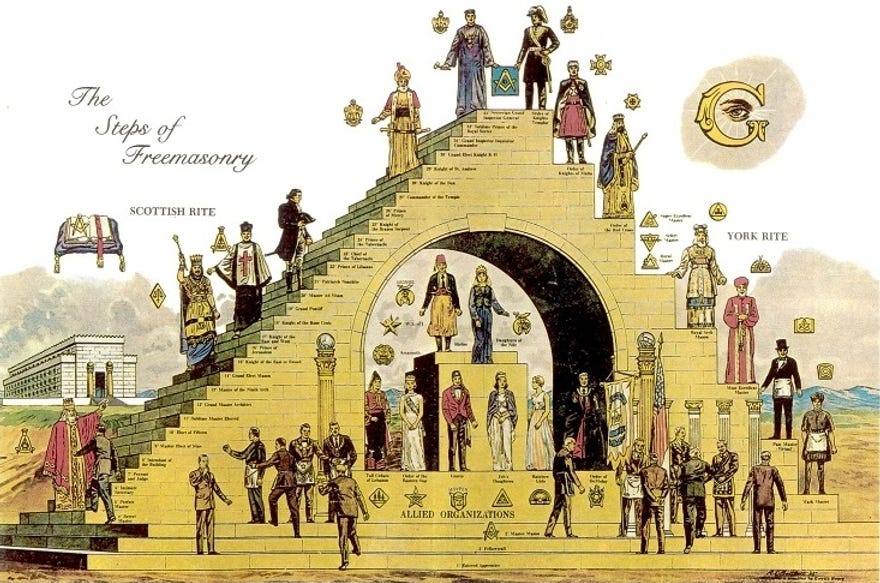
Then there is the Freemasonic cross-over, which can be traced following the expulsion of the Templars for their corruption, with several escaping to modern day Switzerland, Spain and Scotland. Switzerland today is the home of the Bank of International Settlements, which is the central bank of central banks and it resides in a country with a Templar cross as its flag. Spain I will comment on below, and Scotland is where Templar philosophers met with Jewish masons and gave birth to speculative Freemasonry (hence Scottish Rite) at Kilwinning. Several influential Jews have admitted that Freemasonry in its operant form (esoteric masonic arts) was a Jewish endeavor, like the influential Rabbi Isaac Mayer Wise, a Scottish Rite Mason writing in The Israelite (a publication he founded and edited) in 1855:
“Masonry is a Jewish institution whose history, degrees, charges, passwords, and explanations are Jewish from the beginning to the end. With the exception of only one by degree and a few words in the obligation, the beauty and pride of Masonry is its universal character, its tendency to fraternize mankind.”
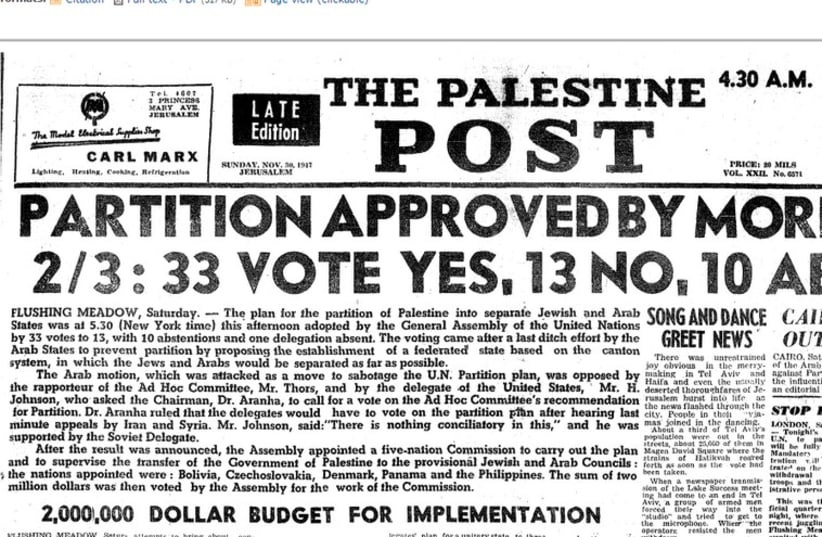
So the operant aspects of Masonry have a Jewish thread, but modern Freemasonry became a philosophical endeavor thanks to the Templars and their union with the Jews. Today modern masonry has both a Catholic (York Rite) and a Jewish (Scottish Rite) side, with both steps meeting at the top of “enlightenment” symbolizing a unity of the opposing sides. When Cardinal Spellman solicited the UN to vote to create the State of Israel, the vote was famously 13 (no) to 33 (yes) — symbolizing both sides of the occult involved in the project with the Vatican at the head as usual.
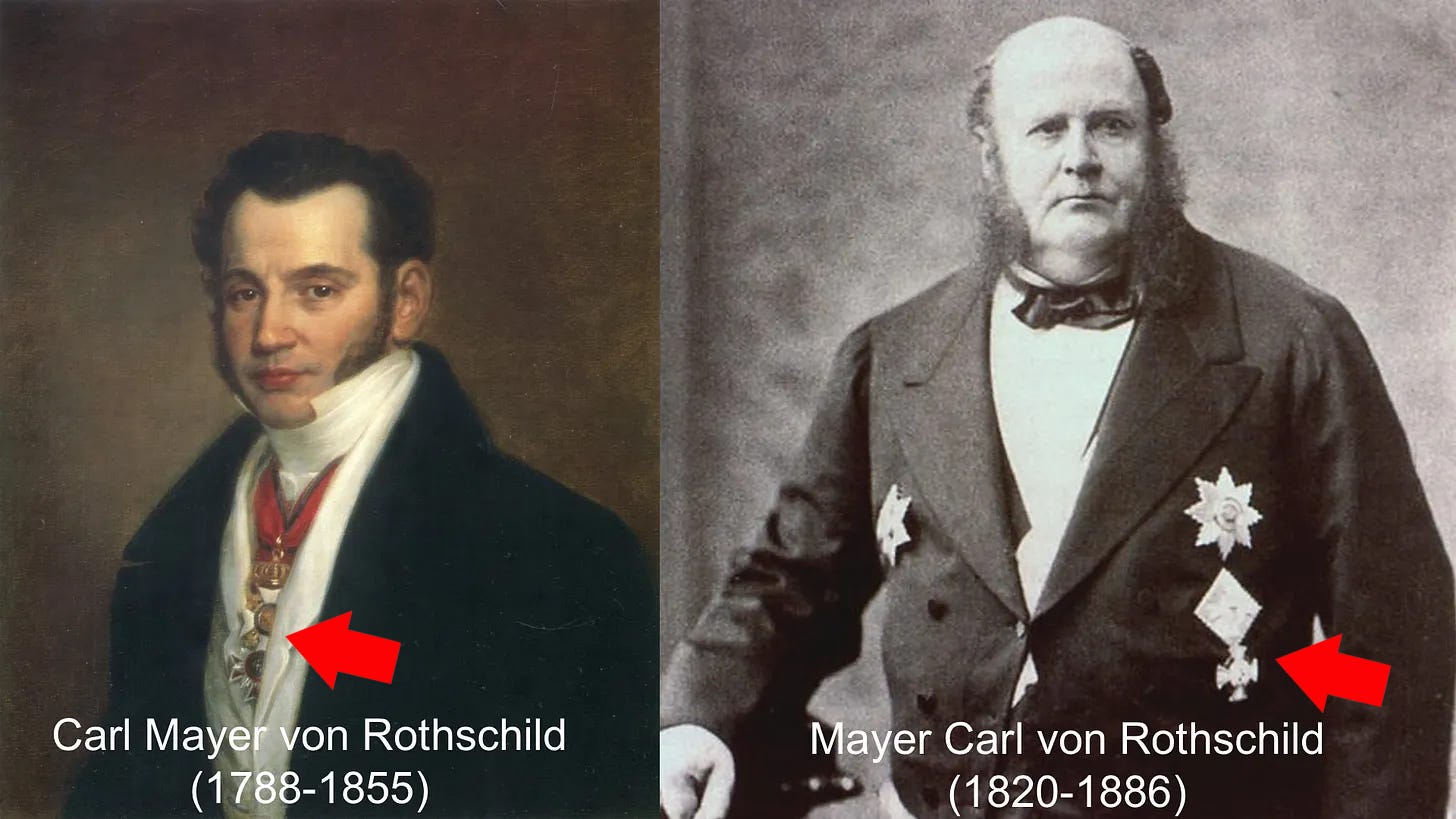
On the Spanish peninsula, the Templars were rebranded into various leapfrog orders, like the Order of Christ under King Denis I in Portugal, which promulgated through time and likely influenced other organizations, like the alumbrados (“illuminated ones”), of which Loyola was accused of partaking in (although the charges were dismissed), with Loyola of course going onward to found the notorious Jesuit Order. These threads were not Jewish but rather esoteric Catholic orders and endeavors. Even modern-day villains like the Rothschilds are married into the papal bloodlines (i.e. Aldobrandini), have received Catholic honors, like being the official bankers of the Vatican and being inducted into the Sacred Military Constantinian Order of Saint George (Carl Mayer von Rothschild) at a ceremony with Pope Gregory XVI. In fact if you look at pictures of Carl and his son, Mayer, they are both wearing Catholic templar crosses:
In an autobiography titled The Knights Of The Red Shield by the Rothschild family, originally published around 1874 and re-released by Legare Street Press on July 18, 2023, they call themselves “knights.” I have studied quite a bit of history, and in all my studies I have yet to see a “Jewish knight.” But there are Catholic knights. There are also no Jewish shields. The Jews were assassins and they certainly didn’t use heavy red shields. But you know who did? The Roman Empire. Hence the Rothschilds (“red shields”) are really just a shield for the Vatican’s illicit activities, so that the Jews could be a scapegoat.
Tupper Saussy in Rulers of Evil (p160-161) says the following:
“According to H. Russell Robinson’s illustrated Armour of Imperial Rome, Caesarean soldiers protect themselves in battle with shields painted red. Since the soldiery is the State’s most valuable resource (the Council of Trent admitted this in preferring the Jesuits to all other religious orders), it is easy to understand why the red shield was identified with the very life of the Church. Hence, the appropriateness of the name Rothschild, German for ‘red shield.’
The appointment of Rothschild gave the black papacy absolute financial privacy and secrecy. Who would ever search a family of orthodox Jews for the key to the wealth of the Roman Catholic Church? I believe this appointment explains why the House of Rothschild is famous for helping nations go to war.
It is fascinating that, as Meyer Rothschild’s sons grew into the family business, the firm took on the title Meyer Amschel Rothschild und Sohne, which gives us the notarikon MARS. Isn’t Mars the Roman God of War, whose heavenly manifestation is ‘the red planet’? There is powerful cabalah here, and there’s hardly an acre of inhabitable earth that hasn’t been affected by it in some way.”
Darryl Eberhart, former military vet and intelligence officer who has written many pieces on secret societies and history, and whom I personally interviewed, has said the following:
“International finance and banking are NOT primarily ‘Jewish’. Many of the most powerful banking interests in the world are run by ‘Gentiles’. One of the most powerful forces in international banking is the Knights of Malta, a Roman Catholic military order controlled by the Jesuit Superior General. Sadly, even a certain segment of the ‘alternative media’ helps to propagate the LIE that ‘the Jews’ run international banking.”
Sherman H. Skolnick, in a piece called, The Rockefellers and the Rothschilds, says:
“Seldom is it mentioned: that the Rothschilds, along with other western bankers and industrialists, financed the rise of Hitler as a bulwark against the Soviets. The ultra-right wing falsely describes the Rothschilds as ‘Jewish bankers’ when, in fact, the Rothschilds are interwoven with the Catholic Church, and, jointly with the traditional mafia and the American CIA, interlocked with the Vatican Bank, which was pro-Nazi.”
In medieval times there were also such things as Court Jews (hofjuden in German), who were Jews with special privileges because of sponsoring monarchs who kept them around for financial purposes. If the sponsoring noble died, his Jewish financier could face exile or execution — because the next people in power might not be so friendly. One of the most famous examples of this occurred in Württemberg in 1737–1738, when, after the death of his sponsor Charles Alexander, Joseph Süß Oppenheimer was put on trial and executed.
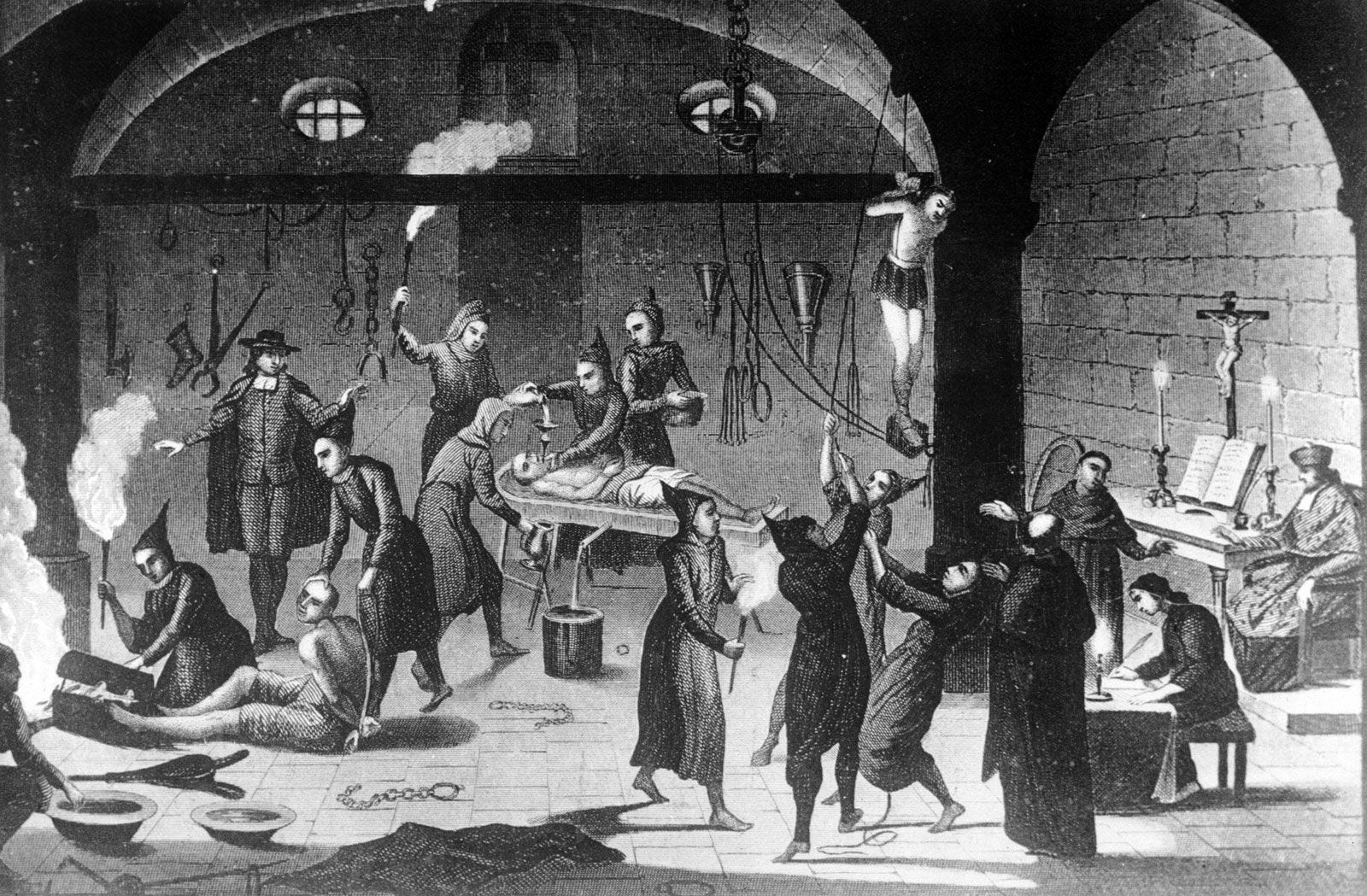
Besides this Satan used both pagan Rome and rabbinic Jewry to persecute the body of Christ in the early Church. The first persecutors of Christians were Jews, because the first Christians were Jews. Then the Jews revolted against Rome, and Rome persecuted both. Once Rome converted, institutional Christianity enforced its way of being on people and persecuted those who did not want to bow down to its idolatrous system, with voices crying for reform or fleeing into the wilderness centuries before the actual Reformation. In parallel to the persecutions of institutional Christianity (Rome) you had Judea and its usury, among other things (like the generally separatist attitudes of the Talmud and the refusal for Jews to assimilate), which made the Christian west very suspicious of Jewry. So both throughout time have been deeply involved in persecuting God’s people, the body of Christ, because it is a fulfillment of prophecy.
What all of this tells you, if you are honest with history, is that history is far more nuanced and complex than “it’s the Jews.” Typologically, Rome and Judea were united in killing Christ, and in the same way these two systems have been united against the true body of Christ throughout the ages in various ways both materially and spiritually. But the Bible does not say Satan gave his throne to Judea, it says he gave his throne to the Beast — and the Beast comes out of the 4th empire in Daniel 7, which is Rome, and that means the Beast is the papacy. The papacy is the only fulfillment of all the warnings of antichrist, something that as a Reformed adherent JD should at least know something about since practically all the Reformers were united on this issue.
Yet despite the anti-Jew polemics of Luther, Calvin or others — not a single one of them ever believed that the Catholic Church had been “infiltrated by Jews” and that’s why it was evil or the fulfillment of the Bible’s warnings. That’s significant, because they were living during the time that the Jesuits were formed and all these things were happening, and they certainly had no motivation to whitewash history in favor of the Jews. But using their discernment they recognized that the Pope was the man of lawlessness by the virtue of his proclamations to be the presence of Christ on Earth, by the papacy’s persecution of the saints, its bible-burning, its blasphemies and its inversion of all that is true. To deny these basic facts of history and demand that all of this boils down to “the Jews” is incredibly shallow and not at all honest with the evidence. But now on to another important and related item that we need to address.
INTERLUDE: DID THE JEWS CORRUPT THE CATHOLIC CHURCH?
Toward the end of JD’s article he makes several claims about the Jesuits and Catholic Church, and I want to respond to them now before jumping back to the main arguments. He says as follows:
“The story begins with one that repeats a “common antisemitic trope,” which is how you know it’s probably true because they usually are, and ten Jewish scholars claimed to be converted when they were not. I gave some facts about this aspect of Jewish history in my article on the Jesuit Order being taken over by Rabbinic Jews claiming to be converted, the infamous “conversos,” but were not. I told you then how Jews captured Ignatius of Loyola, played a prominent role in the development of the Illuminati (which is based on Jewish mysticism and Kabbalah), conversos who became priests to rule over a Catholic order, and continued to subvert the Catholic Church right up until Nostra Aetate in 1965 and Vatican II.”
In my Synagogue of Satan series I document the 2009 book, The Jesuit Order as a Synagogue of Jews: Jesuits of Jewish Ancestry and Purity-of-blood Laws in the Early Society of Jesus. It is a historical study by Robert Aleksander Maryks that examines how Christians of Jewish descent (conversos) moved from holding prominent leadership roles in the early Society of Jesus to being banned from membership under “purity of blood” laws. Maryks argues that by the mid-16th century, around 20% of the earliest members and leaders in the Society of Jesus — including co-founder and second Superior General Diego Laínez — came from Jewish converso (converted) families. However within just a few short decades after the Jesuits were ratified in 1540, the Jesuit General Congregation officially barred the admission of anyone with Jewish or Moorish ancestry in 1593, a policy that persisted until 1946. This is because Spain had purity of blood statutes and was also home to the famous Spanish Inquisition.
Many people take the historical fact that some (notice, a relative minority) of the early Jesuits were conversos or from Jewish lineage, along with the reality that crypto-Judaism was a thing in European countries, and expand that into a wild polemic that the entire Order was subverted by Judaism, and that by extension every evil thing the Jesuits did in history, really, should be blamed on the Jews. This is grossly inaccurate, and yet again parrots radical traditionalist (Catholic) propaganda rather than actually aligning with history.
Firstly, there is zero credible evidence that Ignatius himself was “captured by Jews” or a converso. Ignatius came from an old Basque noble family from northern Spain with no known Jewish ancestry. It is true that he had very favorable views toward Jews compared to his contemporaries, and because he opposed the purity of blood laws he recruited several conversos into the early ranks of the Jesuits. One can speculate as to why he had such favorable views toward Jews, but Ignatius was a very deceived individual, having visions of shimmering lights and a bright serpent with many eyes, and developing the Spiritual Exercises, which are nothing more than mysticism and obedience training for all Jesuits. To argue that his favorable views toward Jews is absolute proof that he was a converso or crypto Jew is nonsense, when it could have just been an obsession that Satan used for his advantage to weave the Rome and Judea threads tighter and tighter.
Regardless, does that mean the Jesuit Order itself was “taken over by rabbinic Jews”? Or that the Catholic Church was subjugated by Jews? Far from it for a variety of reasons, not the least of which was the Spanish Inquisition.
Initiated in 1478, the Inquisition prosecuted conversos suspected of secretly practicing Judaism, while the crown expelled Spain’s unbaptized Jews in 1492. About 30 years prior in 1449 in Toledo, the Sentencia-Estatuto established purity of blood statutes which were eventually adopted by cathedral chapters, military orders, colleges and religious orders. These statutes propagated the cultural notion that baptism couldn’t wash away the fault of having the wrong blood, and therefore if you were of Jewish or Muslim descent you should not be allowed to participate in any offices or institutions. As a result, these statutes locked anyone of Jewish descent out of universities, government offices, and older religious orders (like the Franciscans and Dominicans). Because the early Jesuits ignored these rules (due to Loyola’s favorable pro-Jewish position), Spain viewed the young Order with extreme suspicion.
This led to a fracturing of power, because the Inquisition saw the Jesuits’ protection of conversos as a loophole in their total control over Spanish society. Archbishop Juan Martínez Guijarro (Silíceo) aggressively promoted anti-converso laws. He routinely attacked the Jesuits, and his efforts added to the general cultural critique at the time of the Jesuits being a “synagogue of Jews” and a refuge for heretics. The Inquisition also monitored Jesuit writings and preaching. Any Jesuit who defended conversos or argued that Jewish heritage didn’t matter spiritually risked being investigated or accused of alumbradismo (a mystical heresy targeted by the Inquisition, of which Loyola was also accused of participating in but cleared in the 1520s).
For the first few decades of its inception, the Jesuit Order used its direct line to the Pope to bypass the Spanish Inquisition and its stringent policies. However, as the Inquisition solidified its power in Spain, opposition to the liberal policies toward Jews arose inside the Order due to outside pressure. Anti-converso Jesuits began arguing that the Society’s reputation was being ruined by the Inquisition’s constant scrutiny. They argued that the only way to save the Jesuit Order’s prestige and ensure its survival in the Spanish Empire was to capitulate. Maryks documents that in 1573 the order elected Everard Mercurian rather than the converso Juan de Polanco, under papal and Spanish pressure. Mercurian then removed conversos from leadership. So, under pressure from King Philip II, the Inquisition, and internal factions, the Fifth Jesuit General Congregation passed a decree in 1593 that barred anyone of Jewish or Moorish ancestry from entering the order.
That decree wasn’t rescinded for another 350 years. During this time, the Sixth General Congregation in 1608 softened it to Jewish ancestry within five generations, meaning people with distant Jewish ancestry could enter. But that’s still a fairly strict window and hardly facilitates “infiltration”. Combined with this fact, we also add the following simple historical realities:
Throughout the Church Age, Christians were highly suspicious of Jews and there was consistent animosity between the two groups in Europe and abroad. All one needs to do is read Church Father quotes on the Jews to get a general idea of people’s attitudes toward Jews, which was consistent from the early Church through the medieval ages and into the Reformation (like Luther’s, On the Jews and Their Lies). Historic Christianity was generally not progressive toward Judaism or Jewishness. There were various exceptions, like the papacy repeatedly issuing Sicut Judaeis, a bull protecting Jews from forced baptism and violence, or Bernard of Clairvaux intervening to stop massacres during the Second Crusade, or Pope Clement VI defending Jews against Black Death accusations in 1348. But this doesn’t prove some Jewish conspiracy, because these paradoxical efforts of both restricting and degrading Jews while also protecting their survival were in perfect alignment with Augustine’s “witness” doctrine, that taught that God wills the survival of the Jewish people as a dispersed and subordinated group to serve as living proof of Christian truth.
Perhaps the most famous exception to Europe’s historic treatment of Jews was Napoleon Bonaparte. His armies opened the ghettos of Ancona and Venice in 1797 and Rome in 1798, and in 1806 and 1807 he convened an Assembly of Jewish Notables and a Grand Sanhedrin, the first such body in roughly 1,800 years. Jews in French territories responded with gratitude, composing synagogue prayers for his success, and the Austrian ambassador Metternich reportedly wrote in 1806 that Jews looked on Napoleon as their Messiah. In 1799, during his campaign in the Levant, the Paris Moniteur reported that he had invited the Jews of Asia and Africa to restore ancient Jerusalem. A full “proclamation” to that effect circulates today, but its authenticity is widely doubted; among other problems, it is datelined from Jerusalem, a city Napoleon never reached. Nevertheless, by the standards of his time, this was a real divergence from mainstream European attitudes, and his contemporaries saw it that way. Russia’s Holy Synod denounced Napoleon as an enemy of the Church, even as Antichrist, partly for convening the Sanhedrin, and his own uncle, Cardinal Fesch, reportedly warned that granting Jews equality would hasten the end of the world. But it was not general benevolence, and the record shows clear political and financial motives that he had. The same 1806 decree that convened the Assembly also suspended debts owed to Jews in Alsace for a year, responding to peasant complaints about Jewish moneylenders. Napoleon’s questions to the Assembly pressed Jews on intermarriage, usury, and whether they regarded Frenchmen as brothers. The goal was assimilation into the French state, not Jewish autonomy. In 1808 he issued what Jews called the “Infamous Decree,” restricting Jewish commerce and residence for ten years; some regions were exempted, but it remained in force in Alsace until it lapsed in 1818. In exile on St. Helena, Napoleon reportedly told his physician, Barry O’Meara, that he expected emancipation to bring “many riches” to France as Jews flocked to the country. And his famous line that “if I governed a nation of Jews, I should reestablish the Temple of Solomon” came in an 1800 speech to the Council of State boasting that he had played Catholic to end the war in the Vendée and Muslim to establish himself in Egypt. This shows Napoleon’s political opportunism, not devotion to the Jews. He adopted whatever religious posture served his rule. A final point to make is that Napoleon was not of Jewish descent. He came from a Catholic Corsican family of minor nobility of Italian origin, and no credible evidence suggests otherwise. And when his empire fell, his reforms largely fell with it: the Papal States restored the Rome ghetto, and many German states revoked Jewish emancipation. Napoleon’s Jewish policy was the project of someone zealous for his own aims, wrapped almost immediately in prophetic speculation by people on both sides of the issue. It was not the product of Jewish infiltration.
As an aside, I personally have connected the Jesuits to the French Revolution, and the necessity to destroy monarchy in Europe at the time because of various critical developments happening (like the dissolution of the Jesuits by Clement XIV and the growing threat perceived by the monarchs due to the Jesuit reductions in South America). I find it relevant that the Jesuit perversion of eschatology, which eventually led to dispensationalism, through the works of Jesuits Bellarmine, Lacunza and Ribera, had begun to be propagated by this time. These counterfeit interpretations by necessity required a progressive stance on Jews and a Jewish State, as well as a rebuilt Temple, so I believe there may be some crossover in that regard with Napoleon’s reforms, which only would taint these developments even more as being not authentic but calculated.
A fun fact is that Jesuit Manuel Lacunza, a Catholic and a Criollo (a person of pure Spanish descent born in the Spanish colonies of the Americas), whose father (Carlos de Lacunza Ziaurris) came from an established family with roots in the Basque region of Spain (same as Loyola), and whose mother (Josefa Díaz Durán) belonged to a wealthy influential Chilean family of Spanish colonial elite — this individual put forth his commentary on Revelation with a Jewish pseudonym, “Juan Josafat Ben-Ezra”, pretending to be a Jew instead of who he really was. This commentary is the one that landed in Irving’s lap, where Irving translated it in 1827 and spread it through the Albury and Powerscourt prophecy conferences, where Darby developed dispensationalism. The rest, as they say, is history. So dispensationalism is a Jesuit invention, and one of the most influential Jesuits in its history was not a Jew pretending to be a Catholic — it was a Catholic pretending to be a Jew.
Continuing on this thread to address another point that is made, Adam Weishaupt was not a Jew nor was the Illuminati founded on the kabbalah. Weishaupt was Catholic-raised and taught Canon Law at Ingolstadt beginning in 1773, a position that prior to this was only held by Jesuits. Some sources, including Wikipedia, state that he was of Jewish descent, but local archival research presents a different picture: Gerhard Brökel’s study of the family’s records in his father’s hometown of Brilon traces the Weishaupts back to a Catholic choirmaster in the early 1600s (Gerhard Brökel, Adam Weishaupt. Der Gründer des Geheimbundes der Illuminaten und seine Vorfahren in Brilon, published in the Jahrbuch Hochsauerlandkreis, Vol. 20 [released 2003 for the 2004 edition], pp. 75–81). Catholic Encyclopedia says he was born of Westphalian parents, and Brilon is in Westphalia. It is probable that the “Jewish convert” narrative originally emerged as part of 19th and 20th century anti-Illuminati polemics designed to discredit Weishaupt by tying his secret society to Jewish origins, much in the same way you will see Muslims using the exact same tactic to discredit their Muslim opponents. For example, the early anti-Illuminati writers of the 1790s, Jesuit Augustin Barruel and John Robison, blamed the intellectuals and Freemasons for the creation of the society, not Jews. The Jewish element entered through the “Simonini letter” sent to Barruel in 1806, and it was later popularized in the 20th century by writers like Nesta Webster. The letter was written by Jean-Baptiste Simonini (or Giovanni Battista Simonini), a Piedmontese military officer, and sent to Barruel, who had previously written Mémoires pour servir à l’histoire du Jacobinisme (1797–1798) blaming the French Revolution on a plot by radical philosophers, Freemasons, and the Illuminati (ironic considering he himself was a Jesuit). Simonini praised Barruel’s work but criticized him for leaving out the Jews. Simonini claimed that, while posing as a Jew to win the Jews’ confidence, he learned that both Freemasonry and the Illuminati were founded by Jews who were actively conspiring to take over Europe and infiltrate the Catholic Church. Sound familiar? Barruel never published the letter, and some historians suspect it was a police fabrication.
Returning to the main thread of European history and the Jews, Rome (the papacy) formalized identifying dress for Jews across Latin Christendom, putting Jews in ghettos and demanding they be identified in society. In 1215 at the Fourth Lateran Council, Pope Innocent III (who I have documented many blasphemies from in my series on the papacy) convened the bishops and proclaimed an official church decree that stated Jews and Muslims in all Christian lands must be publicly distinguished from the rest of the population by their clothing (Canon 68). The stated purpose was to prevent accidental intermarriage and sexual relations between Christians and non-Christians. The pope’s decree did not specify how to make this distinction, but the European kingdoms quickly adopted various methods like yellow or red circular badges, yellow hats, or variations of stars. Prior to this, Muslims had been engaging in this practice for centuries, with the Abbasid caliph al-Mutawakkil mandating distinguishing marks for all non-Muslims (Christians and Jews) around 850 AD (yet another proof that the “Jews and Muslims are partners in crime” thesis is wrong). So just when you thought Nazi Germany was the originator of such things, think again.
A few centuries later, in 1516, Venice confined the city’s Jewish population to a segregated neighborhood. This is in fact where we get the word “ghetto” from, because it was named after the gheto (the Venetian copper foundry) that previously occupied the island where the neighborhood was built. Within 40 years, Rome had its own ghetto of Jews. The papal bull Cum nimis absurdum enforced it and it took about 300 years (1870) for this ghetto to be abolished. Pope Paul IV forced Rome’s Jews into a walled-off, flood-prone area along the Tiber River, and the ghetto enforced harsh daily humiliations. Jews were entirely barred from owning property, restricted to selling second-hand clothes, and forced to wear distinct yellow caps and scarves when leaving the gates of the ghetto.
Throughout European history and parallel to all of these previously described events, you had countless expulsions of Jews and confiscation of their property. In England in 1290 you had King Edward I who issued an Edict of Banishment, expelling all Jews (several thousand) and seizing their properties. Jews began returning in 1656 under Cromwell, though the readmission was informal rather than a legal repeal. In 1306 King Philip IV of France expelled over 100,000 Jews to seize their wealth and liquidate their assets. Over the next century, French monarchs readmitted Jews strictly for tax revenue purposes before enacting a final, sweeping expulsion decree in 1394. In 1492 you had the Alhambra Decree issued by King Ferdinand and Queen Isabella in Spain. Up to 160,000 Jews were forced to convert to Catholicism or leave within four months. Five years later in 1497 in Portugal, King Manuel I followed Spain’s precedent, but instead of forcing the Jews out of the country he enacted mass baptisms, effectively keeping them trapped in the country as conversos. Throughout these events and Inquisitions, estimates from various archives put total executions of these conversos at a few thousand, not counting death by other means like starvation from displacement and confiscation of property.
The bloodlines that ruled Rome and the papacy trace their lineage back to Italian noble families and beyond. Orsini, Medici, Aldobrandini, Farnese, Colonna — these are not Jewish bloodlines nor do they have Jewish infiltration. At no point in any of the basic history I just outlined did Jews ever penetrate into these controlling families, reproduce, and keep their lineage intact long enough to manipulate political events or policies in their favor. And if they did, history certainly doesn’t show it. There were successful conversos, like Pablo de Santa María (a former rabbi) who became Bishop of Burgos, but there is no proof that these people were secretly crypto Jews. The highest example I can find is the Pierleoni, a converted Jewish family who became one of Rome’s leading noble houses in the 11th and 12th centuries. One of them was elected Pope as Anacletus II in 1130, but the Church now counts him as an antipope. His opponents used his Jewish ancestry against him, which shows you that one of the best possible examples for the “Jewish infiltration” narrative still fails. And whatever success conversos had was limited anyway because of the purity of blood laws, which only afforded them a relatively small window of time for social climbing.
Yet another accusation that is made as “proof” the Jews infiltrated the Catholic Church is that the Talmud was legalized for printing by two popes, Leo X and Pius IV. You may recognize Leo X because of his association with the Reformation, and how he sold indulgences to fund the rebuilding of St. Peter’s, while his court was notoriously lavish (as well as all the blasphemous things that were stated about him, which I cover in my series on the papacy). Daniel Bomberg, a Christian printer from Antwerp working in Venice, obtained exclusive rights to print the Talmud from the Venetian Senate, along with Leo X’s endorsement. The result, printed 1520–1523, was the first complete printed Babylonian Talmud, and it was largely uncensored. Papal licenses for Bomberg’s Hebrew printing continued under Clement VII and Paul III, in briefs dated 1518–1537. But this was short lived, as history shows us the Catholic Church reversed course quickly. In 1553 Julius III ordered the Talmud and related works destroyed, with Rosh Hashanah that year seeing thousands of Talmuds and other Jewish books burned in the Campo de’ Fiori in Rome. A little later that year in Venice, the very city where Bomberg had printed it, the books were burned in Piazza San Marco. Burnings followed in other Italian cities also. In 1559, Paul IV’s Index of Prohibited Books listed the Talmud. In 1564, Pius IV eased that ban, but with an important condition: the Talmud stayed on the Index, so it could only be printed without the word “Talmud.” The resulting editions, notably the Basel edition of 1578–1581, were heavily censored, with passages deemed offensive to Christianity removed. In 1593 Clement VIII’s bull Cum Hebraeorum malitia banned the Talmud again outright, reversing Pius IV’s allowance. The 1596 Index reaffirmed the ban.
But leading up to these events are also a variety of documented Talmud bans and burnings that show you the general sentiment around this book in Europe. In 1239 Gregory IX ordered copies of the Talmud seized across Christendom, thanks to charges brought forward by Nicholas Donin, a Jewish scholar and a student of Rabbi Yechiel who converted to Catholicism. France, a large territory, was the main kingdom to comply. A year later in 1240, The Disputation of Paris (a public debate) put the Talmud on trial for charges of blasphemy and other crimes. Two years later (some sources date it between 1241-1244, I’m going with 1242), cartloads of Talmud manuscripts (thousands of volumes) were burned in Paris. From 1244-1248 Innocent IV ordered further burnings. After a Jewish appeal in 1247 he allowed a re-examination, but a commission under Odo of Chateauroux condemned the Talmud yet again in 1248. Several decades later around 1320 John XXII ordered the Talmud to be burned, and in 1415, after the famous Disputation of Tortosa (over a year-long debate between Christians and Jews on the issue, in Catalonia), the Avignon pope Benedict XIII (now counted as an antipope) banned Talmud study.
All of this history plainly shows you that taking one or two events out of the countless just listed and presenting them as evidence the Catholic Church was infiltrated by Jews is just absurd. The Talmud for most of Christian European history was banned or censored, and heavily debated and resisted. Even when the short window of allowance to print it was given — the printer was a Christian businessman, and Venice barred Jews from owning presses. The license was a commercial printing privilege in a city that dominated European publishing. It was not a Jewish printer nor was it being financed by Jews, nor was it even propagated throughout culture to convert people to Judaism. The printer and his money were Christian, though like any Hebrew press he relied on Jewish scholars for editing. Even the motive runs against the polemic argument, because the reality is that Christian scholars wanted Hebrew texts, partly for scholarship and partly to mine them for arguments against Judaism, as Raymond Martini had done in Pugio Fidei (1278). Besides this, the Catholic Church ran the Index Librorum Prohibitorum (Index of Prohibited Books) from 1559 until it was abolished in 1966. That’s four centuries of authoritarian information control. It banned Protestant writings and much else. Under the 1564 Tridentine Index, reading the Bible in the vernacular required permission. Earlier, the Council of Toulouse (1229) had forbidden laypeople to own most books of scripture. I have documented these and other unsavory truths in my series on the papacy. A church that controlled what laypeople could read, including their own Bibles, wasn’t being steered by a book it repeatedly burned.
Last but not least, the belief that Vatican II is proof the Jews corrupted the Catholic Church (because of liberal documents like Nostra Aetate) is absolutely preposterous. This is actually a radical traditionalist Catholic talking point, which is espoused by Sedevacantists. Fun fact: one of the first books on Sedevacantism was written by a Jesuit (Joaquín Sáenz y Arriaga’s Sede Vacante in 1973). Regardless, the Catholic religion was corrupted long before Vatican II. Papal supremacy, the immaculate conception, purgatory, prayers for the dead, prayers to dead saints, the Eucharist and transubstantiation, meritorious justification, recognition of apocryphal books as scripture, infant baptism, celibacy of priests, veneration of relics and a thousand other blasphemous teachings all existed long before Vatican II. So to argue that the Catholic Church was just “corrupted by Jews” and blame all of these evils on Jews who neither had the power nor the means to infiltrate the Roman elite is not at all honest with history.
All of this now paints an important picture of how JD structures his arguments, a picture that we will see reiterated time and again as we proceed forward. The next section will deal with an extensive history of polemics in the Islamic world, to make the case that what JD puts forward is actually a common political strategy used by Muslims themselves throughout time to discredit their opponents (i.e. accusing them of being Jews or of Jewish descent). We will also look at the arguments surrounding the manuscript that JD puts forward as proof the Jews authored the Quran, and in both of these instances you will find the same pattern: polemics are placed over rigorous treatment of the facts. Rather than surveying the entire breadth of history and being honest and balanced, JD takes one or two details out of context and presents an entire set of conclusions based on preconceived notions and a desire to elicit a particular emotional outcome out of his readers. Moving on.
MUSLIM POLEMICS: 5 HISTORICAL CASES
The next section of JD’s article spans several paragraphs, so rather than reproducing them here I am going to simply summarize the arguments as faithfully as I can and respond to them that way. However before I do so, I want to discuss five highly relevant examples to this situation of polemics in Islamic history, which will add some meaningful context to the overall picture. The first situation is when I myself have drifted too far into polemics thinking they were true, and had to issue corrections as a result. The others are polemics in the Islamic world, old and new, used by Muslims against other Muslims and which parallel the claims JD Hall makes in his article. Together I hope these things will illustrate an important point.
As for my own situation, the topic is actually identical to the issue being addressed by JD, that is, the origins of Islam — only that in the realm of historicism it isn’t the Jews who are often blamed for Islam’s creation but rather Rome. A testimony by supposed ex-Jesuit priest Alberto Rivera, popularized by fundamentalist and KJV Onlyist Jack Chick in the 1980’s alleged that secret documents revealed the papacy was behind the creation of Islam as a military project to subjugate the Middle East and take over Jerusalem for the pope — only for Islam to eventually go rogue and backfire on Catholicism. These claims hinge on the many similarities between Islam and Catholicism, as well as allegations that some of the main people in Muhammad’s life (Khadija, Waraqa ibn Nawfal, Bahira and Tamim al-Dari) were all Catholics, with Khadija having been a nun and very wealthy agent of Rome secretly positioned to sponsor the young Muhammad and give life to his movement.
All of that sounds very seductive when you already expect Rome to be the mother of harlots and abominations of the Earth, but this is why zeal can lead you astray and you must always exercise sound judgment — even if you have a case in general (as historicists do against Rome). With that said, I have debunked and corrected these claims in my video, Did the Catholic Church Create Islam?, but it took a lot of deeper investigation and time to realize that the sources I had originally believed were more polemical than they were historic. Khadija was never a nun nor Catholic. Waraqa was a Christian but affirmed Muhammad’s call, though died shortly after. Tamim converted to Islam around 630 AD. Bahira remained a Christian monk throughout his life according to Islamic tradition, although many historians consider the Bahira story legendary.
Nevertheless, the Church at that time was very disorganized and diverse culturally. Following the councils of Ephesus and Chalcedon, several of the communities in the East split off (Coptic and Syrian churches, for example) and the Roman papacy was barely coming into power. In 533 AD Justinian elevated the bishop of Rome to the corrector of heresies, and 5 years later the Ostrogoth siege of Rome ended, which began the 1260 year prophecy of Daniel and Revelation (the little horn plucking up 3 horns before it: Vandals, Heruli and Ostrogoths). However the Church as a whole was far from united as one body under the papacy at this time. That means by the time Muhammad came around, it had only been about 70-80 years of the papacy taking control — hardly enough time to wield an entire empire and resources for such an endeavor.
The point with all of these things, without going too much into depth (because I reserve that for my presentation cited above), is that history is very nuanced and full of caveats and complex situations. I maintain that, prophetically, Islam is a harlot daughter of Mystery Babylon, because essentially it is just unitarian Catholicism and they both have the same source spiritually, which is Satan — so there is a connection between Islam and Catholicism that is very defensible. But in the interest of intellectual honesty and academic rigor, I disagree with other historicists who have argued Alberto’s perspective because it simply doesn’t stand up to scrutiny, and in the process it only discredits historicism and makes it look conspiratorial.
The next examples concern the Wahhabis, Abdullah ibn Maymun, the House of Saud and Abdullah ibn Saba. In all cases there are polemics old and new, blaming Jews for these institutions or movements, claiming that they are secretly Jewish or have Jewish ancestry. Hopefully by illustrating these examples in detail you will see a consistent pattern.
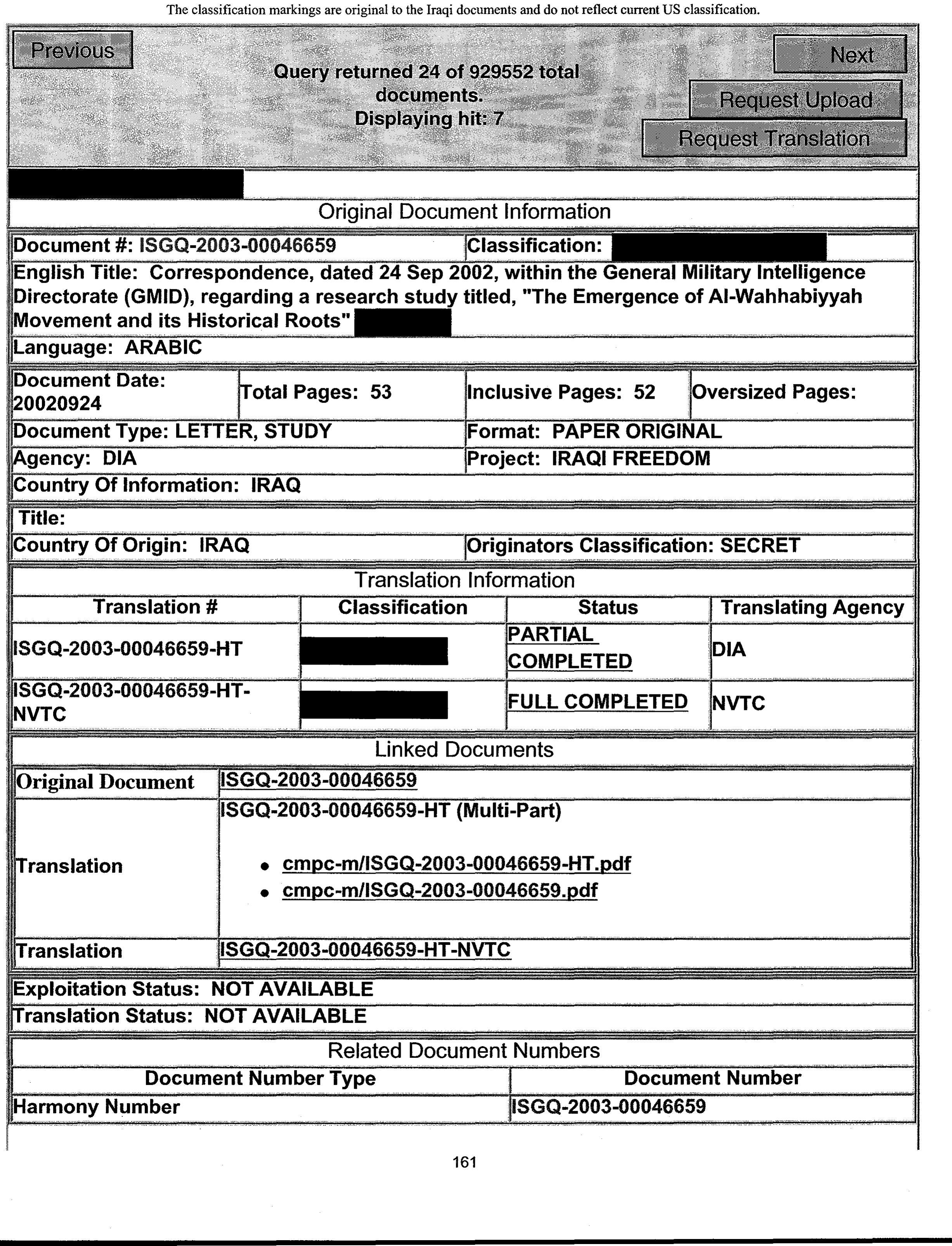
In regard to the Wahhabis, or Wahhabism, named after Muhammad ibn Abd al-Wahhab, it was a fundamentalist Sunni movement founded in the 18th century, and was characterized by extreme religious puritanism, absolute literalism and was historically hostile toward Shia, Sufis, and other Muslims it considered idolaters. Opponents of the movement (modern examples being the Ba’athist Iraqi intelligence reports from the Saddam Hussein era, or Iranian state media) circulated stories claiming that Muhammad ibn Abd al-Wahhab was actually the descendant of a family of Dönmeh Jews from Turkey. For example, a September 2002 Iraqi General Military Intelligence Directorate report titled, The Emergence of Wahhabism and its Historical Roots pushed the narrative. The full translation is public on the Federation of American Scientists site, dated September 24th, 2002, running 53 pages and was prepared by Intelligence Colonel Sa’id Mahmud Najm al-Amiri. The full report became public in 2008. Its stated purpose was to study the history of the Wahhabi movement and its harmful elements. The same report also propagated allegations that the Saudis were crypto Jews, which I will address below. Both of these claims are wrong for several simple reasons.
First, we consider the Dönmeh, a group of historical followers of the Jewish false messiah Sabbatai Zevi who publicly converted to Islam in the 17th century but secretly maintained their own beliefs. It is true that crypto-Judaism was a common phenomenon in both Europe and the Middle East because of the oppressive institutional control of Catholicism and Islam, so this mythology about Wahhab used genuine political realities to base an unsubstantiated rumor so as to destabilize the movement. But Ibn Abd al-Wahhab was born in 1703 in Uyayna, in central Arabia, into a family of Hanbali scholars. Hanbalis were jurists, theologians, and traditionalists who followed the Hanbali school (madhhab) of Sunni Islamic jurisprudence. In other words, they were very authentically Muslim. Abd al-Wahhab’s grandfather, Sulayman, was a well-known judge in Najd. The Dönmeh only formed after Sabbatai Zevi’s conversion in 1666, in Salonica. By most accounts Sulayman died around 1668, just two years after Zevi’s conversion and before the Dönmeh community had formed. A Turkish Dönmeh grandfather is therefore essentially impossible, as the difference between Zevi’s conversion and Wahhab’s birth is only about 37 years. The Iraqi report even claims his grandfather’s name, Sulayman, was originally the Jewish “Shulman.” But Sulayman is simply the standard Arabic form of Solomon, a common Muslim name, and the Sulayman in question is the documented Najdi judge who died before the Dönmeh community even existed.
That is why historians and genealogists agree that Muhammad ibn Abd al-Wahhab belonged to the indigenous Banu Tamim tribe of central Arabia, and there is no credible historical evidence to support the claim of Jewish ancestry. Despite this, in a 2019 speech, the late Iranian IRGC Quds Force Commander Qasem Soleimani (the one killed in a U.S. strike ordered by President Trump in January of 2020) claimed that “Wahhabism has Jewish roots” in order to politically link Saudi-backed movements to Israel and Western powers.
Another example is the story of Abdullah ibn Maymun. When the Ismaili Fatimid Caliphate rose to power and conquered Egypt in the 10th century, their political rivals — the Sunni Abbasid Caliphate in Baghdad — mobilized a significant resistance. In November 1011 AD, the Abbasid Caliph al-Qadir organized a formal propaganda campaign to counter the expanding ideological and military threat of the Ismaili Fatimid Caliphate (then ruled by al-Hakim bi-Amr Allah). Al-Qadir assembled the leading scholars, jurists, and genealogists of Baghdad — including prominent Twelver Shia scholars like al-Sharif al-Radi and al-Sharif al-Murtada — to issue an official state document. The manifesto (“The Baghdad Manifesto of 1011”) formally denied the Fatimids’ Alid descent from Fatima and Ali, declaring their lineage fraudulent. Instead of prophetic descent, the manifesto was based on the polemical genealogy tracing the Fatimids back to a certain man named Daysan ibn Sa’id (an early heretic). It claimed the dynasty’s true ancestor was an impostor who sought to overthrow Islam from within. These efforts built upon the momentum of anti-Fatimid polemicists decades beforehand (most notably Ibn Rizam and Akhu Muhsin), who had published various tracts and propagated the mythology of Abdullah’s involvement as well as his Jewish descent and the supposed illegitimacy of Ismaili Fatimids.
A notable point is that even the famous medieval Sunni historian, al-Maqrizi, condemned both Akhu Muhsin and Ibn Rizam as unreliable.
Yet Vladimir Ivanow, a founding father of modern Ismaili studies and one of the most authoritative scholars in the subject, in his landmark 1946 study, Ibn al-Qaddah: The Alleged Founder of Ismailism, completely dismantled this centuries-old anti-Ismaili narrative that Abdullah ibn Maymun was of Jewish descent or was even involved with the Ismaili movement whatsoever. Ivanow argued that the historical Abdullah was an 8th-century Shia traditionist from Mecca, a companion of the imam Jafar al-Sadiq, dying long before the Ismaili movement emerged as a distinct branch in the late 9th century, meaning he could not possibly have engineered or founded it.
Some also report that later Druze texts adopted a version of the Qaddahid genealogy for their own theological purposes, and their example adds another dimension to this already complex narrative. The Druze movement emerged in Cairo during the reign of the Fatimid Caliph al-Hakim (d. 1021) as a radical offshoot of Ismailism, eventually evolving into an independent religion. The general idea is that Druze texts adopted the Sunni polemic to justify their religion’s legitimacy and continuation, showing that, interestingly, the same polemics can be used in both positive and negative ways.

For the royal House of Saud, the fact is that they have never claimed to be Jewish. Officially they trace their lineage to the Banu Hanifa; some genealogies also link them to the Anizah. They practice Sunni Islam. But then if they never claimed such things, where do the claims come from? In a January 2022 speech broadcast on Iran’s Bushehr TV, General Alireza Tangsiri claimed that they “are the same Jews who were in Arabia back then” (translation from MEMRI, Middle East Media Research Institute). Sound familiar? This is important because Iran is Shia Muslim, and Iran and Saudi Arabia are political enemies. Iran has every incentive to delegitimize the Saudis, so an easy polemic is to spread the belief that they are crypto Jews or of Jewish lineage.
To date there is no convincing evidence, not that I have found at least, that this claim has any weight to it. Much like the claim that the Jews infiltrated the Catholic Church and drove it into the ground, these are typical generalizations with an emotional hook designed as social weapons against a particular enemy for political gain. So we always have to follow the paper trail and see who stands to benefit.
When we do that we see that the Jewish-ancestry rumor also has an older Arabic source: a book titled The Wahabi Movement: The Truth and Roots by Abdul Wahhab Ibrahim al-Shammari. Importantly, I have been unable to find any publication details for the book; nearly every reference to it traces back to the 2002 Iraqi report I cited previously. Personally I find this to be a suspicious detail considering its political aims, but I make no claims about its authenticity because I haven’t evaluated the evidence. Nevertheless, the report describes the content of the book and it claims that Ibn Saud descended from Mordechai bin Ibrahim bin Mushi, a Jewish merchant from Basra. According to the report of this book, this merchant forged his identity to blend into the Arabian Anizah tribe.
It’s important to understand that its use by Iraqi Intelligence in 2002 was a highly deliberate political maneuver. Following the Gulf War and leading up to the 2003 invasion of Iraq, geopolitical tensions between Ba’athist Iraq and Saudi Arabia were at an all-time high. Just as the 11th-century Abbasids under Caliph al-Qadir commissioned a fabricated genealogy to combat the Fatimid threat, Saddam Hussein’s intelligence apparatus drew on al-Shammari’s book to portray their political enemies as illegitimate. By painting their regional Saudi rivals as crypto-Jewish infiltrators, the Iraqi regime sought to destroy Saudi Arabia’s claim to Islamic leadership and custody of the Holy Mosques.
Middle East historian Bernard Haykel, analyzing this specific declassified document, noted in a 2008 post on Harvard’s Middle East Strategy blog that the Iraqi document echoes a well-known Turkish conspiracy theory, probably fabricated by Ayyub Sabri Pasha, that the British created the Wahhabi movement to weaken the Ottoman Empire. He adds that an Iraqi officer repeating this in 2002 in a “top secret document” shows how desperate the regime was to vilify the Saudis and Wahhabis.
Mirroring the exact historical playbook of the Baghdad Manifesto centuries prior, the primary motivation behind the Iraqi intelligence report using al-Shammari’s text was total genealogical and religious delegitimization of its political enemies. Whatever al-Shammari’s own intent, the claims function to strip the Saudis and Wahhabis of their Islamic and Arab credentials. The report’s argument was that Wahhabism was not an indigenous Islamic reform movement, but rather a Western colonial tool and non-Islamic conspiracy manufactured to fracture Muslim unity and undermine Arab-Islamic civilization from within. The internal 2002 Iraqi intelligence report repeated the Jewish-ancestry claims about both the Saudis and Ibn Abd al-Wahhab, at a time of intense hostility between the two regimes, and later it became public after the US released captured Iraqi documents. Today this story still makes the rounds in various circles propagating the “it’s the Jews” narrative with its pseudo-historical appeal and controversy.
The final example concerns Abdullah ibn Saba. In Sunni historical tradition, he was a Jew from Yemen who outwardly converted to Islam during the caliphate of Uthman (644-656 AD). The story generally credits him with three things:
Stirring up the revolt against Uthman. This ended in the caliph’s assassination in 656 and helped trigger the First Fitna, Islam’s first civil war.
Inventing exaggerated doctrines about Ali. Ali was the first cousin, son-in-law, and one of the closest companions and early supporters of Muhammad. The story of Abdullah ibn Saba says that he claimed Ali was Muhammad’s designated heir (wasi), that he would return after death (raj’a, a resurrection before the final judgment in Islamic eschatology), and in some versions that Ali was divine.
Founding a sect called the Saba’iyya. This sect is often treated as the seed of the Shia “extremists” (ghulat).
The tradition explicitly connects his ideas to his Jewish background. In one well-known version, he argues that just as Joshua was Moses’ designated successor, Ali was Muhammad’s. As a result of this story, his teachings are presented as Jewish ideas smuggled into Islam. The full narrative of Ibn Saba as the mastermind of the revolt comes mainly through Sayf ibn Umar (died ~796), a historian preserved in al-Ṭabari’s famous history. Al-Tabari (died 923) was a prominent Sunni Muslim scholar and theologian in the Islamic Golden Age. Nevertheless, Sayf wrote more than a century after the events, and medieval Muslim hadith critics themselves rated him as weak, with some accusing him of fabrication.
As far as how modern scholarship addresses these narratives, scholars generally fall into two camps, and medieval Shia sources add a third perspective. The Egyptian scholar Taha Hussein, in al-Fitna al-Kubra (1947), doubted Ibn Saba’s role, and possibly his existence. The Shia scholar Murtada al-Askari argued he was largely Sayf’s invention, not a real person. Many Western scholars, including Marshall Hodgson and, more recently, Sean Anthony in The Caliph and the Heretic: Ibn Saba and the Origins of Shiism (Brill, 2012), think there was probably a real figure in Kufa associated with extreme veneration of Ali. But they consider the story of him orchestrating the revolt against Uthman a later construction rather than a true historical reporting. Shia sources do mention him, but they do so as a heretic whom Ali himself condemned and expelled. They reject the idea that he founded Shiism.
Either way, most modern historians regard the dramatic version (a Jewish fake convert who engineered Islam’s first civil war and invented Shiism) as a later polemical construction, not established history. This is important for several reasons. First, it fits the consistent pattern we have seen, as well as the angle that JD approaches his claim about rabbis starting Islam: a Jew fakes conversion, gains lots of influence and then corrupts the religion from within. It is practically identical to the 10 sages story yet with a different package and told by Muslims against other Muslims.
Another reason why this particular example is significant is that it is very early. These events are in the 7th century, shortly after Islam was established by Muhammad, and the narrative that was spun on them dates to the 8th century — so it predates the Fatimid case discussed previously with Abdullah ibn Maymun. This also shows that polemics went both ways. Sunni polemicists used it to brand Shiism as a Jewish corruption, and it’s still common in modern anti-Shia extremist rhetoric. Meanwhile, Iran (Shia Muslims) branded the Saudis and Wahhabis (Sunni Muslims) as Jews. Each side uses the exact same strategy to discredit the other.
Lastly, this example parallels the topic of JD’s article, in that these polemics take something easily explainable by context and history and twist them into a political narrative. For example, leveraging the successor parallel with Moses, the claim is made that this is “proof” ibn Saba was a covert crypto Jew, when in fact the Abrahamic ideas, cultural crossover and political infighting that was in these regions is more than sufficient as an explanation for such things — assuming ibn Saba actually existed and taught what is attributed to him.
With all of these examples now hopefully you see an important pattern: people have been using polemics throughout history to discredit their opponents; and polemics of crypto Judaism as a way to delegitimize rival Islamic groups in the Middle East are nothing new. In fact I would argue they are fairly common or standard practice, as it is the low-hanging fruit of insults in the Muslim world to be accused of being a Jew or of Jewish descent.
It also hopefully shows you that Satan’s dialectical “divide and conquer” tactics are at play even within his own projects, to keep people in predictable power struggles and therefore easily manipulated.
But just because these things are prevalent doesn’t mean you base your worldview or knowledge on them. As Christians especially we are commanded to have sound judgment and test all things, and we must remember that the biblical position is that all of mankind has sinned and fallen short of the glory of God (Romans 3:23), and that the ultimate enemy is Satan. The Bible also says that Satan appears as an angel of light (2 Corinthians 11:14), and history confirms this is the case. Constantine, Muhammad, Ignatius of Loyola, Joseph Smith and countless others all had experiences of light and “spiritual illumination”.
So if all we do as Christians is focus on polemics and look for obvious boogiemen, we miss the bigger picture and what Satan is actually up to — because the final reality will be one of marveling and worship, false peace and false prosperity. It will be a reality of people worshiping Satan believing they are actually worshiping God. And if that’s the case, then Zionism or Talmudic Judaism or Islam are ultimately just dialectical steps toward that end, an end that many will not be spiritually prepared for because they base their discernment on low-hanging fruit. But in words often attributed to a famous preacher, Charles Spurgeon: “discernment is not telling right from wrong but being able to tell the difference between right and almost right.”
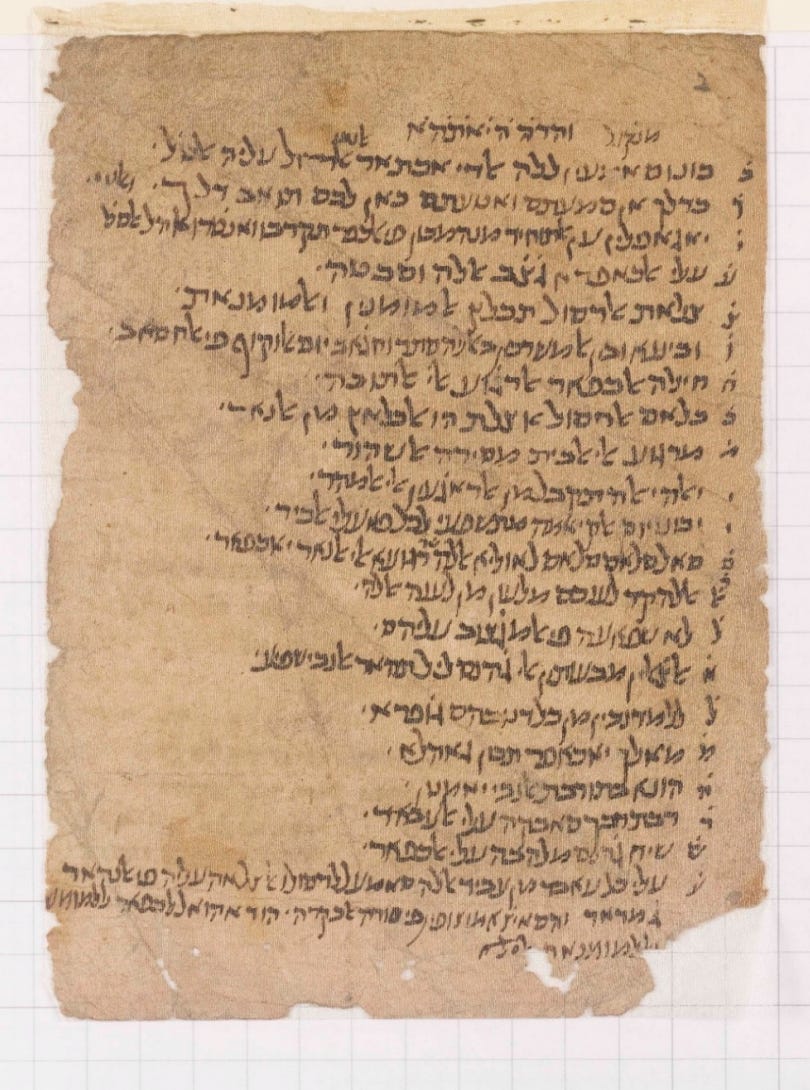
THE MANUSCRIPT CLAIMS
We have now set up a considerable amount of context. Before even addressing the core claims of JD’s article and evidence, I have shown to you thus far that:
JD’s specific claims about the Talmud, Islam & Christianity are not completely historically accurate and conflate several real things (like Maimonides’ writings, which came centuries after the Talmud was written).
European policies for most of the last 2,000 years were not liberal or progressive toward Jews, and even the most successful Jews/conversos (like the Pierleoni) were eventually undercut by polemics against their Jewish ancestry.
The Jesuits were not “infiltrated by Jews” nor was the Catholic Church, and the Catholic Church was corrupt and in error long before Vatican II and its pro-Jewish stance.
Rome & Judea have been united and intertwined throughout time and the devil’s system is far more complicated than “it’s the Jews”. For an overview of this history and my thesis, see a collection of presentations titled, Rome & Judea Are United Against Christ.
JD’s claims of Jewish-Islamic partnership against Christianity are inaccurate and way over-stated, because history is highly complex and inter-group relations were very circumstantial.
Muslims have been accusing rival Muslims of being Jews for centuries as a way to delegitimize opposition, and the examples I gave are all shown to lack credible evidence by expert historians or even Muslim scholars themselves.
JD has taken liberty with several of such writings by presenting them out of context to make his generalized case seem plausible.
All of this weighs heavily on the upcoming set of claims because it shows that JD’s reporting on this issue relies more on polemics than it does on facts. So now with that out of the way I will summarize the main claims and respond to them below.
1. Because the manuscript is “historically verified” and “authentic,” its story must be true.
This is the first, and really overall, point that needs to be addressed. Just because something is authentic or historically verified (i.e. was actually created in the purported time it is said to be from) does not mean it is telling the truth. The Donation of Constantine was a “real” document in the 8th-9th centuries, and the papacy used it to legitimize its supremacy for centuries after that. Yet the Donation of Constantine was a forgery, and even when it was exposed as such (by Lorenzo Valla) it still took several generations for the Church to finally disavow it.
So just because something is authentically ancient does not mean it is telling the truth. Princeton’s own catalog entry, which JD links, calls the Quranic verses in it “fabricated.”
2. Multiple copies (ENA 2541.1, T-S AS 161.32, Hebrew and Judeo-Arabic versions) show it circulated widely, so it isn’t a “one-off.”
Much like the previous point, JD assumes his conclusion rather than demonstrating it plainly with the evidence. Just because something was in wide circulation does not automatically show that it was true. The Infancy Gospel of Thomas was popular in the ancient world, but it contradicts scripture in several ways. So all popularity shows is just that — popularity. Legends spread precisely because people enjoy them. The variation between versions in names, details, and language is typical of folklore, not of a fixed eyewitness record.
Compare it to the countless variations of the flood narrative. Every culture has some version of this story, yet most of them are fantastical and involve things that the Bible would disagree with. That’s because, without the inspiration of the Holy Spirit, we can’t trust the transmission of information — especially from pagans who were deceived by false religion. Mankind is inherently prone to mythology, which is a simple explanation for why such stories quickly develop variations. One may bring up in response the Gospels, but the Gospels were written within decades of the events, from eyewitness circles and are corroborated by multiple outside sources. The Gospels have embarrassing details, undesigned coincidences and historical accuracies (like Luke’s various timestamps and details of who was ruling and when).
By comparison, the manuscript in question has none of these things and was written centuries after Muhammad. But even so, when you have a corpus of work with different testimonies, which version do you believe and why? In Christianity we believe the Bible over things like the Epic of Gilgamesh because we have solid reasons to do so, even though the latter was written down before the former. So the same applies to the versions of this manuscript: on what basis do you believe one over the other as the original? There is no basis, because the manuscript history isn’t that robust and it wasn’t a significant event in history like the flood or the crucifixion.
3. The “signature” in the Quran proves a conspiracy.
The back of the manuscript that JD links (ENA 2541.1) lists 21 lines in Arabic, written in Hebrew letters, that it claims are verses the Jewish sages planted in the Quran. This is called an acrostic, or a text where the first letter of each line spells out a hidden message. Read the first letter of each line in order and you get the Hebrew sentence kakh ya’atsu ḥakhmei yisra’el la’illem ha-rasha’: “Thus do the sages of Israel counsel the mute, wicked one.” JD argues this is the “signature inside the product itself.”
However scholars like Firestone reproduce all 21 lines and outline the problems in his paper (cited in a later point). The main issue is that not one line of the 21 in this acrostic appears in the Quran, and again — Princeton’s catalog calls them fabricated. So the acrostic isn’t hidden inside the Quran. These are made up verses and they exist only on the manuscript. JD says “this is all verified as authentic,” but what’s authentic is the medieval manuscript, not the verses it invents.
Another issue is that “Israel” is misspelled. In the Hebrew Bible, Israel is spelled ישראל, with the letter shin/sin (ש). The acrostic spells it with samekh (ס), a different “s” letter. A plausible explanation (my inference, not Firestone’s) is that the author was thinking in Arabic, where Israel is written with the letter “sin”. Either way, it’s an odd slip up for learned rabbis or sages supposedly encoding their signature in a calculated ploy to start a false religion. Firestone also notes there’s no verse for the letter ר (resh). In his table, the gap falls in the word “Israel”: the lines run י, ס, then a blank where ר should be, then the next word. So the acrostic doesn’t even spell its own sentence correctly.
Lastly, the versions can’t agree where the code actually is. The Hebrew version claims the sentence is in the surah called “The Cow” (Surah 2) but doesn’t present it as an acrostic at all. One part of the Arabic text says the sages wrote their names in the first surah and the sentence in “the middle chapter.” The verso says the verses are found in “The Cow.” A real hidden signature would have one location. Shifting locations are what you’d expect from a legend retold in different ways by different people over time.
There’s also the separate “code” in the Hebrew version: reading the Quran’s mysterious opening letters Alif-Lam-Mim (which begin Surah 2) as the Hebrew word ‘illem, “mute,” an allusion to Isaiah 56:10. Those letters really are in the Quran. But they open 29 surahs, their meaning has never been settled by Muslim or academic scholars, and finding a Hebrew word in three Arabic letters is a pun imposed after the fact, not evidence of authorship. More on this particular issue is expanded in the point below. Regardless, remember that Islam had already been around for at least three centuries by the time this manuscript was created, according to the earliest dating. The Hebrew version also has other “hint” letters that nobody has ever decoded, and Firestone suggests the code may have no solution at all. It may have been a literary flourish meant to suggest secret knowledge, but there’s no consensus either way.
4. The Y-S and H-M code proves a rabbinic conspiracy.
Continuing the discussion on the supposed secret coding in this text, JD writes:
“The technical mechanics of the code, as explained by the conspirators themselves, is that some Qur’anic chapters open with letters pronounced individually. Chapter 36, for example, begins ‘Yā, Sīn’, the Arabic names for the letters Y and S. The confession exposes these letters as a secret Hebrew abbreviation. Y–S stands for ‘Yisrael,’ meaning Israel. Likewise, it reads Ḥ–M elsewhere as an abbreviation for ḥakhmei, “wise men.” Another chapter’s opening letters supposedly supply ‘Thus advised.’”
A little context is important here. The acrostic on the manuscript (21 invented verses whose first letters spell the sentence) is the coding mechanism discussed previously. JD’s Ya-Sin / Ha-Mim claim is describing a second, separate coding mechanism. It uses the Quran’s real “disjointed letters” (muqatta’at), the mysterious letters that open 29 surahs, and treats each set as a Hebrew abbreviation of one word in the sentence.
The pieces come from different surahs:
kakh ya’atsu → “thus advised” → Kaf-Ha-Ya-Ayn-Sad → Surah 19
ḥakhmei → “the sages of” → Ha-Mim → Surahs 40–46
Yisra’el → “Israel” → Ya-Sin → Surah 36
(la-)’illem → “the mute” → Alif-Lam-Mim → Surah 2 (and some others)
JD only spells out Y–S and H–M, and vaguely mentions “another chapter” for “thus advised,” but the list above is the full scheme he’s portraying. So it isn’t two words in Surah 36. Each word supposedly comes from a different surah’s opening letters, and the reader assembles them into a sentence.
This appears like a convincing piece of evidence, but it is mostly JD assuming his conclusion again. In the Hebrew version of the manuscript, the “code” doesn’t use Ya-Sin and Ha-Mim at all. Firestone describes it as resting on the opening letters of Surah 2, (Alif-Lam-Mim), read as the Hebrew word ‘illem (“mute”), alluding to Isaiah 56:10 (“His watchmen are blind; they are all without knowledge; they are all silent dogs; they cannot bark, dreaming, lying down, loving to slumber”). Its other hint letters have never been satisfactorily explained, and he suggests the code may have no real solution at all.
Importantly, JD’s “Y–S = Yisrael, H–M = hakhmei” scheme isn’t in Firestone’s account, but an article titled, Jewish Accounts of Muhammad and His Apostate Informants by Liran Yadgar (Mizan Project) notes that some Jewish accounts claimed Surah 19’s opening letters, and other sequences like them, were placed in the Quran to show that Jews had tutored Muhammad. So the idea exists in the medieval Jewish tradition, even though Firestone’s article focuses on the Alif-Lam-Mim reading.
However despite all of these things, the conclusion that these are secret rabbinic signatures is wrong for several simple reasons:
The order is imposed on these words. To form the phrase, you have to go to Surah 19 → 40-46 → 36 → 2. That’s not chronological, right to left nor left to right. There is no numerical significance to this order, it is taking words and organizing them in the desired outcome.
There are 14 different letter combinations across 29 surahs, which makes it easy to find practically any phrase — since 14 letters is half the Arabic alphabet. The scheme uses four combinations and ignores the rest: Alif-Lam-Ra, Ta-Ha, Ta-Sin-Mim, Sad, Qaf, Nun and others.
Each “abbreviation” skips letters as is convenient. Ya-Sin takes two letters from Yisra’el and drops the rest. Ha-Mim skips the kh in ḥakhmei. Kaf-Ha-Ya-Ayn-Sad has a “Ha” that isn’t in kakh ya’atsu at all, which needs to be explained. These are loose pattern matches, not a precise esoteric code.
The same letters can “decode” into whatever the reader brings. Muslim commentators have read these very letters as abbreviations of God’s names and attributes. For example, a well-known tradition reads Kaf-Ha-Ya-Ayn-Sad that way, and Ya-Sin is often taken as a name of Muhammad. Western scholars have proposed still other explanations. When the same letters yield divine names for one reader (Muslims) and a Jewish insult for another, the method shows only what the interpreter already believes, not some objective pattern.
Lastly, the two code systems outlined by JD actually work against each other. If the sages’ signature were the opening letters, there’d be no need for the manuscript’s 21 invented acrostic verses. These are two incompatible “signatures” in different versions, and it is exactly what you’d expect from a legend developing as it was retold, not from a single calculated plan.
Related to the previous, JD says the code is “explained by the conspirators themselves,” meaning the manuscript. However the manuscript he links (ENA 2541.1) uses the acrostic mentioned previously (the 21 fabricated verses that form the word pattern), not the Ya-Sin / Ha-Mim reading. That’s an entirely different pattern inferred from the Quran text itself. So JD is attributing one version’s mechanism to a different document and conflating these two patterns, when in fact they are not related. The manuscript has its verses, but its verses aren’t actually in the Quran. The word/syllable associations (second mechanism) are inferred, and they are based on faulty reasoning.
I have outlined similar errors in my KJV Only Psyop series, where I discuss the problems KJV Onlyists have with their obsession with numerical patterns in the KJV. Mankind is programmed to find meaning in everything we encounter, and creating meaning out of complex information is a documented phenomenon called apophenia. In fact, researchers have used the famous “Bible Code” that many people still indulge in today (Christians, Jews and Muslims alike) to reproduce similar marvels in mundane examples. Brendan McKay, answering Michael Drosnin in 1997, did exactly this. Drosnin, author of The Bible Code, had said he’d believe his critics when they found a prime minister’s assassination encoded in Moby Dick. McKay found several. He took the novel and applied equidistant letter sequences, spacing rules, and directional variations (forward, backward, vertical, horizontal) identical to those used in Bible Code studies. He found "predictions" of assassinations: Prime Minister Indira Gandhi, René Moawad, Leon Trotsky, Martin Luther King Jr., and others. The patterns matched the actual historical events with striking semantic correlation.
But does that mean the author of Moby Dick was secretly a Freemason of the highest degree who had advanced knowledge of all these assassinations? Or that Moby Dick is a prophetic text? Absolutely not. What this demonstrates is that the methodology itself is flawed — it generates false positives through what's called the Texas Sharpshooter Fallacy and the look elsewhere effect. When you have a massive text, unlimited spacing rules, multiple directional options, and the freedom to search for any words you want, you're guaranteed to find something that looks meaningful. The more combinations you try, the more likely you'll stumble onto a pattern that seems to correlate with real events.
In the same way, the freedom given in these textual comparisons between these supposed “secret codes” and the Quran creates the possibility to find practically anything mildly relevant — and when you reserve the right to combine the words in whatever order you want until there’s a satisfactory meaning, that’s not an intentionally designed code, it’s cherrypicking the data to create a narrative. In fact a final historical example will solidify this point.
In the 1970s, the Egyptian-American biochemist Rashad Khalifa claimed the disjointed letters (the letters that begin various surahs) encoded a mathematical “miracle of 19,” with letter counts in their surahs coming out to multiples of 19, proving the Quran’s divine origin. To make his system work, he declared the last two verses of Surah 9 (9:128–129) to be later insertions and removed them from his translation. Mainstream Muslims rejected his claims. Why this is significant is that the same letters have been “decoded” to prove both that rabbis wrote the Quran and that God mathematically sealed it, and in Khalifa’s case the method required deleting text that didn’t fit. In fact omitting text that doesn’t fit the interpretation also applies to this second method, because recall that Kaf-Ha-Ya-Ayn-Sad has a “Ha” that isn’t in kakh ya’atsu (“thus advised”) at all. So it’s the same methodological problem.
5. Dating to the 10th–12th centuries shows the story is old and credible.
This argument is very similar to #1 above, but it deserves its own response, because JD is not aware that this line of reasoning actually undermines his entire position. That’s because even the earliest date puts it roughly 300 years after Muhammad, so no one involved could have been confessing anything. “Roughly a thousand years” is the age of the manuscript, it means nothing in regard to the proximity of the purported events. Muhammad’s life was centuries before the earliest dating, in which case you need to document an explanation and paper trail as to why it took so long for the “confessions” to appear.
In Christianity we have a similar phenomenon that can be seen with the gnostic gospels that arose 100-150 years after Christ, like the “Gospel of Mary Magdalene” or the “Gospel of Thomas” or other similar works. These arose a long time after the true gospels, and claimed things about Jesus that are simply not true. Some of these works inspired modern mythologies like The DaVinci Code, showing a simple principle that forgeries and myths emerge after real events to divert people into false teachings or various agendas.
Other examples, still within Christianity, are the countless Marian dogmas and mythologies that evolved centuries after the New Testament Church. The supposed appearance of Mary to the apostle James in the 1st century is one such story, a story that is completely fabricated and arose centuries after the death of James, only being attested in medieval sources.
These simple examples show you plainly that just because something is ancient does not mean it is true. They also show you that Satan has been incredibly busy in history creating a variety of deceptions to confuse and lead astray everyone on all sides.
6. Rabbis were experienced at “inventing” a religion, which made them perfect candidates to write the Quran.
This claim is debunkable in several ways. First, the assumption is that, by the time of Muhammad, the rabbis already had a solid track record of “inventing” a religion (i.e. Judaism), so they already had the process down. This is a gross over-simplification of history and it’s also not accurate.
The Mishnah (oral law) was compiled around 200 AD from earlier traditions, and the Babylonian Talmud was completed around 600 AD. Even JD admits that Rabbinic Judaism “didn’t reach its first phase until the 7th century.” But if this is true, you can’t credit the same rabbis with expertly crafting another religion at the same time theirs was being finalized.
Now add to this point something even more devastating, which is that creating a religion requires resources and planning and organization — especially if you’re inventing it out of thin air and it’s not the truth. But were the Jews comfortable and secure in their lofty mansions for all six centuries between 70 AD and Muhammad? The answer is no, because they were under constant revolt and dispersions. Between 70 AD and the 7th century, the Jews experienced significant conflicts with the Roman and Byzantine Empires, leading to forced migrations, slavery, and the growth of major diaspora communities outside of Judea. Here are a few major examples:
The Kitos War (115–117 AD): A massive uprising by Jewish communities within the Roman diaspora (mainly Cyrene, Cyprus, Egypt, and Mesopotamia) while Emperor Trajan was campaigning against the Parthian Empire. The Roman military brutally suppressed the rebellion, resulting in the near-total annihilation of the Jews in Cyprus and Cyrene.
The Bar Kokhba Revolt (132–136 AD): Led by false messiah Simon bar Kokhba, this was the last major Jewish-Roman war. It was triggered by Roman restrictions on Jewish practices and Emperor Hadrian’s decision to rebuild Jerusalem as a pagan city (Aelia Capitolina). After a grueling guerrilla war, the Romans crushed the rebellion. Hundreds of thousands of Jews were killed, Judea was devastated, and Jewish religious practices were heavily restricted.
The Jewish Revolt Against Gallus (351–352 AD): A localized uprising centered in Galilee (including Sepphoris and Tiberias) against Constantius Gallus, the Caesar of the East. The Roman commander Ursicinus brutally put down the rebellion, destroying several Galilean towns.
The Samaritan Revolts (484–573 AD): While primarily a series of insurgencies by the Samaritans against Byzantine Christian rule, these conflicts deeply impacted the shared geopolitical landscape of Palestine and occasionally involved local Jewish factions.
The Jewish Revolt Against Heraclius (614–628 AD): Falling just at the edge of this era, Jewish forces in Palestine allied with the invading Sasanian Persian Empire against the Byzantine Empire, briefly gaining control of Jerusalem. When the Byzantines retook the region, Emperor Heraclius ordered widespread expulsions and massacres of the Jewish population.
These are not every event, but they paint enough of a picture to establish the point: not only were the Jews developing their own religion in the first six centuries, many areas were also in consistent conflict with imperial powers and dispersed all over as a result. Echoing a previous point I made, these events show that Jews as a whole people group after 70 AD (and certainly until Muhammad) did not have the sustained kind of influence you would need to plan out something so outlandish as the propagation of a false religion onto your enemies. I will concede that the main rabbinic center in Babylonia (under the Persians) was relatively stable (which is why its academies completed the Talmud there), but overall Judaism was itself still developing with its own debates and disagreements concerning the law, and the Jewish population was highly dispersed. There is no evidence the Jews wrote the Quran and the Quran’s content doesn’t even favor Jews or Jewish thought.
7. “Academic consensus” holds that the sages posed as Muslims to protect Jews.
This sounds more persuasive, but it misrepresents the scholarship JD cites. Scholars describe that motive as part of the story’s plot, explaining why the legend portrays the sages this way. None of them say it actually happened. Firestone, Gil, and Shtober all treat the tale as legend in their own writings. Describing the content or perspective of a writing (or agreeing on what a piece of writing is describing) does not mean you believe or endorse the events as true. When the Iraqi intelligence report of 2002 (cited previously) reported that the Saudis were crypto Jews and Wahhabism was of Jewish descent, citing al-Shammari’s book, that doesn’t mean al-Shammari was telling the truth in his book or even that the Iraqi report was representing the book completely honestly. This is a different situation than with Firestone, Gil and Shtober, but the principle is the same. Just because someone describes something does not validate that something as true or their perspective.
8. Firestone’s quote is an “excuse” and effectively an admission that Jews were infiltrating the Arabic world to subvert it.
The specific quote JD cites is from Reuven Firestone’s 2019 paper titled Muhammad, the Jews, and the Composition of the Qur’an: Sacred History and Counter-History. The quote comes from section 3, “Point and Counterpoint,” with footnote 69:
“A characteristic response of subaltern communities is to counter the dominant narrative indirectly. Unsurprisingly, Jews polemicized subtly through a variety of indirect methods, some of which resulted in non-Jews identifying Jews as “sneaky” or dishonest and devious, but which have since been recognized as typical of powerless communities attempting to preserve their dignity under duress.”
What JD left out is the sentence that comes right after this, which completes Firestone’s thought:
“One such example is this ancient and rarely considered Jewish counter-history of Islamic origins.”
This is significant because it changes the meaning of what Firestone is trying to convey. He isn’t excusing an infiltration. He’s explaining why a minority community produced this story, which he classifies as a “counter-history”, a polemical retelling. Stopping the quote one sentence early lets JD make Firestone sound like he’s admitting the event happened, but the entirety of the quote actually admits the opposite.
And if we consider the article as a whole, Firestone’s position is unmistakable. The following are paraphrased from the article itself:
He describes the story as a polemical retelling of the Muslim revelation narrative, probably oral in origin, written down later in several variants. Its purpose was to counter Muslim claims that Islam had superseded Judaism.
He says outright that he isn’t reconstructing history. His aim is to examine polemical literature, not argue for or against the historicity of the sources. Found on page 2 of the paper, he says: “It is not my purpose here to try to reconstruct the actual history or to argue in favor of either a positivist or revisionist position over the historicity of the sources. It is enough for my purpose of examining polemical literature to establish the basic Muslim narrative and observe how Jews have responded to it with their own counter-narrative.”
He states that not one line of the 21 Arabic acrostic verses appears in the Quran. This is the same point as Princeton’s catalog entry made before, yet now from the very scholar JD cites.
He explains the curse as a literary device used by the authors to make the claim seem more credible by implying the secret was dangerous, and it kept the polemic away from Muslims who would have reacted harshly.
Lastly, he offers a plausible purpose for the story, which is to discourage Jews from leaving their community and escaping second-class status by converting to Islam. These were real temptations, and in an already small community it would provide a motive for self-preservation.
So in summation, Firestone is explaining why a minority community wrote a polemical legend, not admitting that Jews infiltrated Muhammad’s circle and created Islam. The “sneaky” reference concerns indirect polemic, the telling of counter-stories, not a covert operation. In other words, Firestone is describing how non-Jews perceived the polemical efforts of Jews against Muslims — not validating that they were actually creating another religion or that people believed such a thing at that time.
9. JD argues that because Jews wrote the document, in Hebrew letters, about what Jews supposedly did, it’s an insider admission, and so it can’t be dismissed as an antisemitic fabrication.
This is again assuming one’s conclusion before actually proving it. The reasoning here presents a false dichotomy: either antisemites invented the story to disparage Jews, or it’s a true confession. But there’s a third option, and it’s the one scholars actually hold: it’s genuine Jewish folklore that is historically false. And yet again we return to the over-arching point of this rebuttal: just because something is proven “authentic” doesn’t mean it is true or historically accurate.
A few more points to consider on the topic of mythologies and legends are as follows:
People have created myths and folklore throughout time about themselves. Romans told of Romulus and Remus raised by a wolf. Americans told of young George Washington and the cherry tree. Medieval Christians told countless saints’ legends. No historian treats a group’s flattering stories about its own cleverness or heroism as sworn testimony, just like no historian treats a group’s polemics and negative stories about its opponents as absolute fact either.
Toledot Yeshu is a medieval Jewish counter-history of Jesus that circulated for centuries. In some versions, the rabbis send Simon Peter to lead Jesus’s followers, give them new laws and festivals, and separate them from the Jews, while Peter secretly remains a faithful Jew. It has the same structure as the Quran tale: Jewish sages pose as followers of a new faith and shape it from inside to protect Jews. By JD’s reasoning, this “confession” would prove that Jews engineered Christianity’s separation from Judaism. But JD would never accept that, so he can’t consistently accept the same reasoning for Islam.
The Muslim biographies of Muhammad say Jewish scholars like Abd Allah ibn Salam recognized Muhammad as a prophet and joined him, and they use this against Jews, by claiming that even their own rabbis knew Muhammad was genuine. The Jewish tale takes those same figures and flips the story: yes, they joined him, but as secret agents, and the Quran was really their work. It’s a rebuttal built from the other side’s material, which is what Firestone means by “counter-history.” This is meaningful because it shows you the source of these polemics is something that already exists, namely Islam, and these are reactionary tales rather than accurate historical accounts.
So JD is right that the story is Jewish, and that we’re dealing with an “authentic” manuscript from a long time ago. But that doesn’t mean it’s a true account. All it shows is that some medieval Jews, living as a minority, told themselves their sages had outwitted the new religion’s founder. That’s a reality of medieval Jewish polemics, not an admission of how the Quran was secretly written.
10. The curse guarding the secret from Gentiles proves a conspiracy.
Curses against revealing contents to outsiders were a common literary device in esoteric and polemical texts. It’s also odd evidence of secrecy for a story that, by JD’s own account, circulated widely across languages and communities for centuries. People of all backgrounds (Christian, Muslim or Jew) were highly superstitious, so such things were prevalent in all cultures. For example, medieval Christian scribes routinely put curses in manuscripts against book thieves, and no one reads those as evidence of a conspiracy. Thus such things are expected and common tactics to preserve one’s efforts across generations.
11. The document “states a motive, names participants, and embeds a signature in the product itself.”
We addressed the “signature” issue previously. As for the motive and participants, context has to be considered. JD treats the document like a confession at a trial. In a real investigation, establishing a motive helps build a case, so he presents “to protect the Jewish people” (the stated motive of the document) as if it were evidence or proof of a Jewish conspiracy that actually happened.
But in this document, the motive isn’t an independent piece of evidence. It’s part of the story. Ten sages pretend to convert so that Muhammad won’t harm the Jews. That’s the narrative’s internal logic and explanation for its own content, the same way any story gives its characters reasons for their actions. Using a previous example of a famous forgery, the Donation of Constantine, the motive described by the document of Constantine giving his throne to the papacy as the prime authority over all does not mean that this actually happened — it merely describes a motive to justify the content of the document. So a story stating its own characters’ motives doesn’t make the story true. A novel tells you exactly why the villain committed the crime, but that doesn’t mean the crime happened. Toledot Yeshu also gives its secret agent a motive for reshaping Christianity (to separate Christians from Jews and protect the Jewish people) but that doesn’t make it true history.
Two important principles when investigating motive are as follows. First, there is independent evidence that the event happened, and second, the motive is established from outside sources, not from the same account you’re trying to verify. For the New Testament, we have lots of historical attestation to the crucifixion and to the growth and spread of Christianity. For the ten Jewish sages supposedly authoring the Quran, there are neither independent attestations of such an event nor outside sources documenting or corroborating this supposed motive.
That means that the event, the participants, the motive and the “signature” all come from the same source, which is the story itself, and which was written centuries after Islam. You can’t use the story’s own plot to confirm the story. It is not a self-evident and objectively true text like the Bible, it is a polemic — and one with many problems as we have consistently demonstrated.
Despite this though, there is still a question about motive of the authors. Why did the people who wrote this story tell it at all? This is what’s up for debate, not whether it is actually an accurate historical claim. That’s an important distinction, because no serious scholar treats this manuscript as reliable evidence of how the Quran was composed. But the motive behind the polemic is discussed, because certainly there was some social or political benefit that the author(s) perceived, otherwise they wouldn’t have created it.
Firestone’s answer, which I documented previously, is that a minority community facing a dominant religion’s claims needed a way to preserve its dignity (in light of polemics from Muslims against Jews and persecution) and also perhaps to discourage Jews from converting to Islam. This is a pragmatic and likely explanation given the historical realities of the time. Thus, the stated motive of the document (“we infiltrated Muhammad’s circle to protect Israel”) and the actual, likely motive of the authors (“we tell this tale to reassure ourselves that Islam isn’t from God”) are key to distinguish. The latter is what academics like Firestone actually study, and it explains why the story exists without requiring it to be true.
But JD presents the first motive as though it were the second, as in the sense that the document’s stated motive was actually the motive of the authors — as though the medieval storytellers were confessing their own scheme. They weren’t confessing anything; they were telling a story about sages who lived three centuries before them as a polemic to preserve their culture and newly finalized religion in the dispersion.
12. JD’s article has a whole section on Theophanes, the Apology of al-Kindi, and Sebeos. He uses it to argue that Christians made the accusation first, so the Jewish tale is a confession that corroborates it.
This requires a response to all three of these sources. JD states:
“Writing in the early ninth century, the Byzantine Christian chronicler (Theophanes the Confessor) describes Jewish leaders joining Muhammad because they initially believed he was the Messiah they expected.”
First, Theophanes (c. 815 AD) is about 180 years after Muhammad and likely drew on Muslim biographical material already in circulation. So again, you have the same problem as the manuscript — these writings came long after Islam was created. Scholars note that Theophanes’ “ten” is the same typological number as in the Jewish tale, but this just shows that the Christian and Jewish versions are one legend in two communities, not independent witnesses.
Next JD brings up The Apology of al-Kindi:
“The ninth-century Christian Apology of al-Kindī makes an even more explicit accusation. It alleges that Kaʿb al-Aḥbār and ʿAbd Allāh ibn Salām entered Muhammad’s community after the death of Sergius, a Christian monk whose role in the story is irrelevant for this part of the tale. The two supposedly introduced Rabbinic teachings and lore. This was a common Christian accusation that the Jews created Islam, going back to the earliest days of Islam. Christian versions of the Sergius-Baḥīrā narrative identify specific teachings Kaʿb introduced. These include circumcision, ritual washing, and Sharia, which mirrors Jewish Halakha. A related version attributes to him identifying Muhammad with the Paraclete (ie the Holy Spirit) promised by Jesus.”
The Apology of al-Kindi is itself a Christian polemical text. JD’s own summary admits it has the Christian monk Sergius teaching Muhammad first, then calls Sergius “irrelevant for this part of the tale.” But it is not irrelevant at all. The same genre of polemic, the Sergius-Bahira legend, has a Christian monk as Muhammad’s teacher. By JD’s logic, that would prove Christians wrote the Quran. So in consistent fashion, JD keeps the part he likes and discards the rest that works against his position.
In fact if anything I would argue that institutional Christianity actually influenced the development of Islam more than Judaism. I have argued this thoroughly in my video, Did the Catholic Church Create Islam? (cited above). The hierarchical nature of the Church by that point in time, the various superstitions and traditions, the stories and text of Christianity, and the many similarities between Catholicism and Islam (as compared to Islam and Judaism) all establish a spiritual connection for Islam as a harlot daughter of the main mystery religion of the ages, the gospel of Satan, which in the Church Age is fulfilled and actualized in Catholicism.
The third source JD cites is Sebeos, from Armenia around the 7th century. JD writes the following:
“An even earlier account from seventh-century Armenian history, attributed to Sebeos, describes Jews seeking assistance from Arabs and arguing that they have a ‘shared religious heritage.’ They basically appealed to Judeo-Islamic history, using the exact same arguments that Christian Zionists use today, to appeal for Christian support for Israel. What they perfected on Christians, they started with Muhammad. Then, because of his Rabbinic influence, Muhammad suddenly became an expert on Mosaic history, teaching the God of Abraham. Sebeos also explained that Muhammad urged his hearers to claim the country promised to Abraham and his descendants, because the Jews taught him how well that argument works. Claiming an ancient, ancestral land deed has benefited the Jewish people. And they loaned that precept to Islam, which took it and ran with it. Alongside later confessions from the conspirators, this earlier narrative corroborates that claim.”
Out of these sources, Sebeos is the earliest (660s) and most valuable. It describes Jewish refugees joining the Arabs and appealing to their shared descent from Abraham, and Muhammad preaching the God of Abraham. That’s evidence of Jewish contact and influence, which mainstream scholarship accepts. But it doesn’t say Jews wrote anything or that Jews created Islam. In fact if Jews did write the Quran it would be very out of character, considering that it affirms Jesus as the Messiah, honors Mary, and teaches the virgin birth (Surah 19 is named after her), while it also contains harsh polemics against Jews. Rabbis protecting their community wouldn’t write a scripture affirming Jesus’s messiahship, especially when Jewish counter-histories like Toledot Yeshu (which were running parallel to this narrative) call Him illegitimate.
CONCLUSION
We have examined a robust amount of material in this article, so I will not belabor a lengthy conclusion. JD takes many things out of their context textually and historically to present a narrative that suits his overall position. I can’t speculate as to his motives, but the consistent misrepresentation of the facts is there nonetheless and I will let the reader decide as to why. As far as my own position, Islam was not created by rabbis — it was created by Satan deceiving a false prophet and enslaving countless Arabs for centuries into false worship — worship that will soon find its ultimate fulfillment in serving the papacy.
Polemics have existed since the dawn of time, and polemics will continue to exist until Jesus returns. But polemics are at best entertainment, and should not form the basis of your education as a Christian. In this regard I invite JD to deepen his studies of history and not lean so hard on polemics and rage-bait material as the foundation for his teachings. I think we can do better as people with platforms, because at their worst polemics are tools of psychological warfare that deceive people into false realities and false history, and today with the rise of anti-Jewish polemics many are being led into traditional religions like Catholicism and Orthodoxy. That’s the real problem. Conservative Protestants cry “Christ is King” and gladly shake hands with Catholics against the big bad Zionists, Muslims and Communists — not realizing that Rome will subjugate them, too, once it has regained control of culture and becomes dominant.
So in the end, Jew-baiting is just as bad as Jew-idolizing. Blaming the Jews for every single problem in history is just as bad as believing the Jews are God’s chosen people and can do no wrong. It is an imbalance, not historically accurate, not biblically accurate, and it serves the agenda of the true antichrist power on the Earth. That’s why I encourage the reader to learn to do their due diligence and question everything they hear. History is full of complexities, unexpected relationships and nuanced situations. It is an incredibly fine art to navigate thousands of years of time and make accurate statements, and I’m not going to tell you that I am perfect at it because I’ve had to publish countless corrections over the years. But we should always strive to walk the narrow road and be discerning, so rather than relying on emotional clickbait polemics — strive instead to have good hermeneutics, patient examination of the details and, above all things, appreciation of context.
For a treatment of these and other theological topics in detail, please see my book “The Seven Transformations: Finding the Narrow Road by Pursuing a Sovereign Christ.”
